

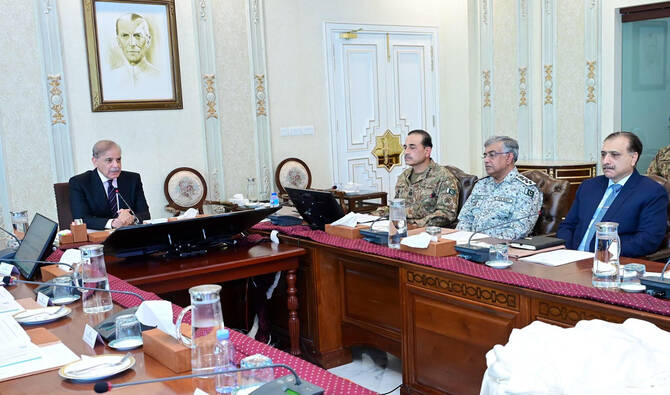

ISLAMABAD: Pakistan’s National Security Committee (NSC), which comprises top civilian and military leaders, has reaffirmed its support for Iran’s right to self-defense, Prime Minister Shehbaz Sharif’s office said on Monday, after United States and Israeli strikes on Iran.
The statement came a day after US attacks on three Iranian nuclear sites, joining Israel in the biggest Western military action against the Islamic Republic since its 1979 revolution.
As the strikes raised fears of a wider conflict in the already volatile region, Russia, China and Pakistan have urged the United Nations Security Council to adopt a resolution calling for an immediate and unconditional ceasefire in the Middle East.
On Monday, Pakistan PM Sharif presided over an NSC meeting to review the evolving regional situation and condemned Israeli attacks on Iran, which it said coincided with a constructive negotiation process between Iran and the United States.
“These reckless actions have escalated tensions, threatening to ignite a wider conflict and diminishing the opportunities for dialogue and diplomacy,” Sharif’s office said in a statement after the meeting.
“The NSC reaffirmed Iran’s right to self-defense as enshrined in the UN Charter.”
The NSC expressed grave concern over the potential for further escalation after the attacks on Iranian nuclear facilities in Fordow, Natanz and Isfahan by the US, reiterating that they violated the resolutions of the International Atomic Energy Agency (IAEA), relevant international law, and the UN Charter.
The forum reaffirmed Pakistan’s readiness to continue efforts to promote regional peace and stability and called on all parties to resolve the conflict through dialogue and diplomacy.
Tensions between Tehran and Tel Aviv initially flared on June 13 when Israel launched airstrikes against what it described as Iran’s military leadership and nuclear infrastructure. Both sides traded missiles on Monday in fresh strikes.
In a separate development, Pakistan PM Sharif spoke with Iranian President Masoud Pezeshkian on Monday afternoon — their second telephonic call in less than 48 hours.
“The Prime Minister conveyed Pakistan’s condemnation of the US attacks, which followed Israel’s unprovoked and unjustified aggression,” Sharif’s office said. “He reaffirmed Pakistan’s unwavering solidarity with the brotherly people and Government of Iran.”
The prime minister expressed concerns that the US strikes had targeted Iranian facilities that were under the safeguards of the International Atomic Energy Agency (IAEA), constituting a “serious violation of international law and the IAEA Statute.”
“While noting Iran’s right to self-defense, as enshrined under Article 51 of the UN Charter, the Prime Minister stressed upon the need to immediately return to dialogue and diplomacy as the only viable path forward,” the statement read. “He also called for urgent collective efforts to de-escalate the situation.”
Earlier on Monday, Pakistan’s UN Ambassador Asim Iftikhar Ahmad called on the Security Council to act “urgently and decisively,” warning against the danger posed to the populations of the region as the war intensifies.
Experts warn Pakistan, which shares a 900-kilometer porous border with Iran in its southwestern region prone to separatist militancy and cross-border attacks, will face additional security and economic challenges due to the worsening conflict between Tehran and Tel Aviv.
Surging global oil prices due to the worsening conflict will cause economic setbacks for Pakistan, which relies on expensive fuel imports for its energy demands, according to financial analysts. Islamabad is already grappling with a macroeconomic crisis amid a precarious balance of payment position.
The crisis also raises questions about how Islamabad will navigate its delicate balancing act between Iran, other Gulf partners, and the US, which remains one of Pakistan’s largest trading partners and a critical source of military and economic assistance.


