TOKYO: Okinawa marked the 80th anniversary of the end of one of the harshest battles of World War II fought on the southern island.
With global tensions escalating, its governor said on Monday it is the Okinawan “mission” to keep telling the tragic history and its impact today.
The Battle of Okinawa killed a quarter of the island’s population, leading to a 27-year US occupation and a heavy American troop presence to date.
Monday’s memorial comes one day after US attacks on Iranian nuclear facilities, adding to a sense of uncertainty on the island about the heavy American military presence and in its remote islands, already worried about getting embroiled in a potential conflict in Taiwan.
Gov. Denny Tamaki, noting the escalating global conflicts and nuclear threats, made a resolve to contribute to global peace studies, disarmament and the preservation of war remains. “It is our mission, as those living in the present, to preserve and pass on the reality and lessons to future generations.”
Fierce battle and civilian deaths
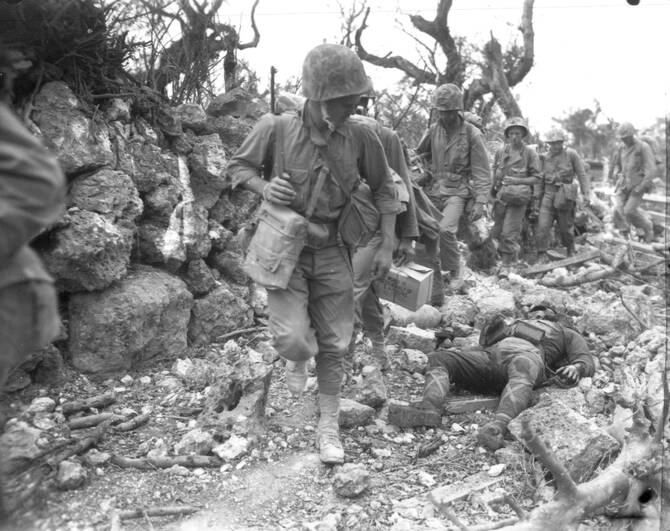
US troops landed on the main Okinawa island on April 1, 1945, beginning a battle in their push toward mainland Japan.
The Battle of Okinawa lasted nearly three months, killing some 200,000 people — about 12,000 Americans and more than 188,000 Japanese, half of them Okinawan civilians including students and victims forced into mass suicides by Japan’s military.
Okinawa was sacrificed by Japan’s Imperial Army to defend the mainland, historians say. The island group remained under US occupation until its reversion in 1972, two decades longer than most of Japan.
Monday’s memorial was held at the Mabuni Hill in Itoman City, where the remains of most of the war dead reside.
Remembering the tragedy
Prime Minister Shigeru Ishiba was in a hot seat when he attended Monday’s ceremony. Weeks earlier, one of his ruling party lawmakers Shoji Nishida, known for whitewashing Japan’s wartime atrocities, denounced an inscription on a famous cenotaph dedicated to students as “rewriting history” by portraying the Japanese army as having caused their deaths, while Americans liberated Okinawa. Nishida also called Okinawa’s history education “a mess.”
His remark triggered an uproar in Okinawa, forcing Ishiba days later to apologize to the island’s governor, who had criticized the remark as outrageous and distorting history.
The Himeyuri Cenotaph commemorates student nurses who were abandoned near the end of the battle and killed, some in group suicides with teachers. Japan’s wartime military told the people never to surrender to the enemy, or die.
Nishida’s remarks add to concerns about the whitewashing of Japan’s embarrassing wartime past as memories of the tragedy fade and ignorance about the suffering grows.
Ishiba, at Monday’s memorial, said Japan’s peace and prosperity is built on the sacrifices of Okinawa’s history of hardship and that it is the government’s responsibility to “devote ourselves to achieve a peaceful and prosperous Okinawa.”
Postwar years and growing fear
Okinawa remained under US occupation from 1945 until the 1972 reversion to Japan. The US military maintains a heavy presence there due to Okinawa’s strategic importance for security in the Pacific. Their presence serves not only to help defend Japan but also for missions elsewhere, including in the South China Sea and the Middle East.
Private properties were confiscated to build US bases, and the base-dependent economy has hampered the growth of local industry.
Fear of a Taiwan conflict rekindles bitter memories of the Battle of Okinawa. Historians and many residents say Okinawa was used as a pawn to save mainland Japan.
There are also ancient tensions between Okinawa and the Japanese mainland, which annexed the islands, formerly the independent kingdom of the Ryukus, in 1879.
Burden of history
Okinawa remains home to the majority of about 50,000 US troops stationed in Japan under a bilateral security pact. The island, which accounts for only 0.6 percent of Japanese land, hosts 70 percent of US military facilities.
Even 53 years after its reversion to Japan, Okinawa is burdened with the heavy US presence and faces noise, pollution, aircraft accidents and crime related to American troops, the governor said.
Nearly 2,000 tons of unexploded US bombs remain in Okinawa, with some regularly dug up. A recent explosion at a storage site at a US military base caused minor injuries to four Japanese soldiers.
Remains of hundreds of war dead are still unrecovered on Okinawa, as the government’s search and identification effort is slow to make progress.


![]()

Okinawa marks 80 years since end of one of harshest WWII battles with pledge to share tragic history
Short Url
https://arab.news/vvrx6
Okinawa marks 80 years since end of one of harshest WWII battles with pledge to share tragic history
- The Battle of Okinawa killed a quarter of the island’s population, leading to a 27-year US occupation and a heavy American troop presence to date


Latest updates




© 2026 SAUDI RESEARCH & PUBLISHING COMPANY, All Rights Reserved And subject to Terms of Use Agreement.