

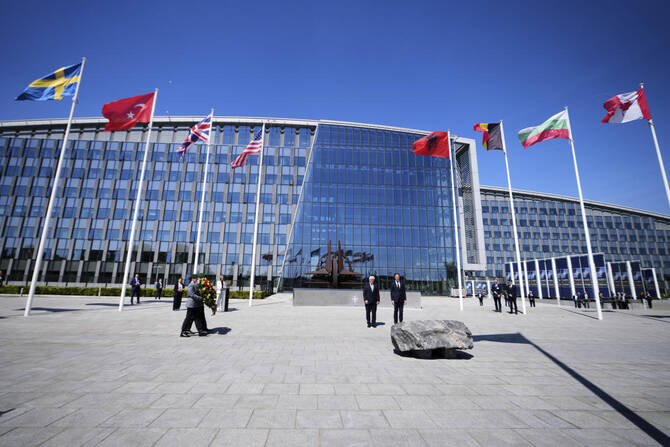

THE HAGUE: For a small country like the Netherlands, organizing a NATO summit is a big endeavour at the best of times. The government collapsing three weeks beforehand has not exactly made life easier.
With whole districts and key roads blocked for weeks, and schools and businesses closed, the usually serene seaside city of The Hague has certainly felt the force of the impending summit.
To much grumbling, even some cycle lanes have been shut down, usually unthinkable in the land of bikes.
Dozens of trees have also been uprooted to make way for the temporary buildings housing the thousands of delegates and journalists attending the summit.
For the Netherlands, welcoming 32 world leaders including US President Donald Trump is quite simply the biggest event it has ever hosted in terms of security.
The country is deploying some 27,000 police officers, around half its total force.
And all of this while Dutch politics is still reeling from far-right leader Geert Wilders’s withdrawal from the government in a row over immigration.
The sudden departure of Wilders and his far-right Freedom Party brought down a shaky coalition, with fresh elections now slated for October 29.
“It is highly undesirable to host such an important summit when the government has fallen and new elections are expected,” Claes de Vreese, political communications professor at the University of Amsterdam, told AFP.
It borders on embarrassing, stormed outgoing foreign minister Caspar Veldkamp, describing the withdrawal of Wilders three weeks before the summit as “scandalous.”
Fortunately, noted De Vreese, the Dutch parliament gave its green light to the defense spending increases at the center of the summit.
“This gives weight and legitimacy to the participation” of outgoing Prime Minister Dick Schoof at the summit, said the expert.
But as the government is a lame-duck administration, the next government will have to find the cash.
Speaking of cash, the estimated cost of the NATO summit is 183.4 million euros ($211 million), or just over one million euros per minute, according to Dutch daily AD.
NATO Secretary General Mark Rutte has chopped back the leaders’ meeting to just two-and-a-half hours on Wednesday morning, reportedly to appease Trump, not known to love lengthy summits.
At least Rutte himself will feel at home.
The NATO boss is a born-and-bred “Hagenaar” (citizen of the Hague), still has a house in the city and is often seen at weekends on his bike or shopping at his local supermarket despite his move to Brussels.
And despite the government collapse complicating matters, it is really NATO taking on the bulk of the organization.
“We’re not hosting the summit, that’s the secretary general,” said Schoof.
“But the host country does play an important role. The whole world will be looking at the Netherlands,” Schoof told reporters.
Much of the attention will naturally be on Trump — although there is a question mark over his appearance given the US strikes on Iran.
It falls to Noordwijk, a peaceful coastal resort between Schiphol Airport and The Hague, to host the US president, who will stay in a sumptuous hotel overlooking the North Sea — if he turns up.
His route in has been completely blocked off since Sunday — like several others in the city.
Some frustrated citizens of The Hague have asked why the summit couldn’t be held in Veluwe, a national park with no one around — or even at the airport.
At an anti-NATO protest the weekend before the summit, Alfons Vryland, a 54-year-old teacher, noted the irony of holding a military alliance meeting in the self-styled City of Peace and Justice.
“I’m embarrassed that they’re here talking about war instead of peace in my country, in this city,” Vryland told AFP.
Jan van Zanen, the city’s amiable mayor, sought to reassure everyone, from the crisis-hit PM to the average Hagenaar.
“I know people think that I’m a magician as mayor of The Hague, but I couldn’t prevent the government collapsing,” he told AFP.
“The impact (of the government falling) is there, but where we can, we’ve limited it to the utmost,” he said.
“Yes, the Netherlands is ready.”


