


ISLAMABAD: The United States (US) airstrikes on Iranian nuclear facilities violate international law and the International Atomic Energy Agency (IAEA) statute, the Pakistan prime minister’s office said on Sunday, as experts warned of their economic and security implications for Islamabad.
The strikes, which targeted three Iranian nuclear sites at Fordow, Isfahan and Natanz early Sunday, came amid Israel’s ongoing campaign against Iran’s nuclear program, which Israeli officials claim is nearing weaponization, an allegation Iran denies, insisting its activities remain peaceful and under international safeguards.
While the amount of damage remained unclear, the strikes have fueled fears of a wider conflict, with Iranian Foreign Minister Abbas Araghchi saying the US had “crossed a very big red line,” the time for diplomacy was over and Iran had the right to defend itself. US President Donald Trump warned Tehran against retaliation.
Pakistan PM Shehbaz Sharif spoke with Iranian President Masoud Pezeshkian on Sunday afternoon and conveyed Pakistan’s condemnation of the US attacks, which targeted Iranian nuclear facilities that were under the safeguards of the IAEA, according to Sharif’s office.
“These attacks constituted a serious violation of international law and the IAEA Statute,” Sharif’s office said. “While noting Iran’s right to self-defense, as enshrined under Article 51 of the UN Charter, the prime minister stressed upon the need to immediately return to dialogue and diplomacy as the only viable path forward.”
Sharif called for urgent collective efforts to de-escalate the situation and reiterated Pakistan’s readiness to play a constructive role in this context, according to his office. President Pezeshkian conveyed his appreciation for Pakistan’s support to Iran.
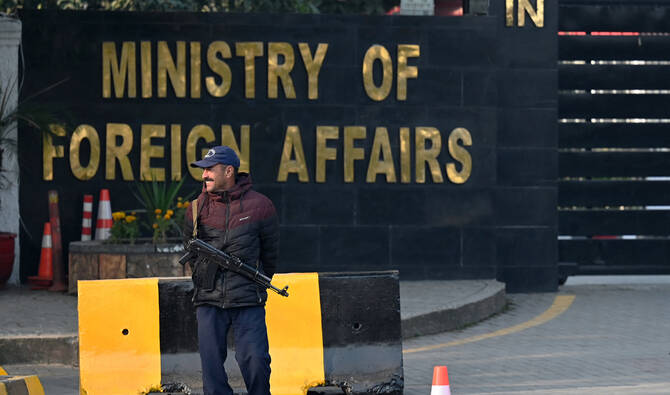
Pakistan’s foreign office earlier said Islamabad condemned the strikes and was “gravely concerned” at the possible further escalation of tensions in the region.
“Any further escalation of tensions will have severely damaging implications for the region and beyond,” it said, adding that Iran had the right to defend itself under the United Nations (UN) Charter and urged all parties to respect international humanitarian law, protect civilian lives and “immediately bring the conflict to an end.”
“Recourse to dialogue, diplomacy, in line with the principles and purposes of the UN Charter remain the only viable pathway to resolve the crises in the region.”
Tensions flared on June 13 when Israel launched airstrikes against what it described as Iran’s military leadership and nuclear infrastructure. Iran, a signatory to the Treaty on the Non-Proliferation of Nuclear Weapons (NPT), has since retaliated with missile attacks on Israeli targets. The United States, Israel’s closest ally, has now directly joined the campaign.
Experts have warned that the latest US strikes could have “catastrophic” economic and security implications for Pakistan.
“The economic implications of a wider war would be catastrophic for Pakistan. First and foremost, if the Strait of Hormuz is closed, our major concern will be the import of oil, as most of our oil supplies come from the Middle East,” Shakeel Ramay, a Pakistani economist, told Arab News.
“This would severely impact our economy since a significant portion of our power grid is powered by imported oil and gas from the region. The disruption would affect electricity production and have far-reaching consequences for our transportation network as well. The government will need to manage rising prices in the short term.”
Lt. Gen. (retired) Naeem Lodhi, a former Pakistani defense secretary, said Pakistan had so far acted “wisely” by condemning the attacks on Iran and offering to mediate the crisis.
“At this point, Pakistan needs to remain alert and ensure that it does not get directly involved. It must not allow any country — on either side — to use its soil, airspace, or any other assets,” he told Arab News.
“Although staying completely uninvolved is difficult due to our geographic proximity, it is still the most desirable course of action.”
If the war expanded, Lodhi said, Pakistan would face “serious challenges.”
“Many Pakistanis believe that if Iran is defeated in this war, it could create long-term problems for Pakistan,” he said.
“A new regime in Iran might not be friendly toward Pakistan and could even become hostile, bringing yet another threat to our borders. That is a key concern Pakistan must keep in mind.”
The crisis also raises questions about how Islamabad will navigate its delicate balancing act between Iran, other Gulf partners, and the United States, which remains one of Pakistan’s largest trading partners and a critical source of military and economic assistance.
“Certain demands may be made that Pakistan will find hard to ignore. For instance, if Arab countries become involved — which is likely — there could be strong pressure on Pakistan to support them in some capacity, whether through logistics, access to airspace, or even bases,” Lodhi said.
“While it may be relatively easier to say no to the United States despite its influence, refusing multiple allied Arab countries will be much more difficult. Still, Pakistan’s current leadership, especially the military leadership, is well aware of these dangers and will likely try to keep the country out of the conflict.”


