

Pakistan re-elected to OIC’s human rights commission till 2028

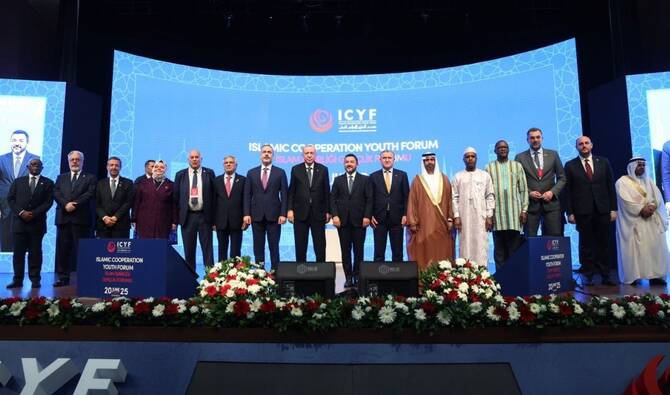
A photo of OIC Foreign Ministers before starting 51st meeting of the Council of Foreign Ministers at Istanbul, Türkiye, on June 21, 2025. (Photo courtesy: @MIshaqDar50)
Short Url
Updated 22 June 2025
Follow

Pakistan re-elected to OIC’s human rights commission till 2028

  • Former diplomat Riffat Masood to represent Pakistan at commission, says Deputy PM Ishaq Dar 
  • Commission deliberates on key issues such as women’s rights, Islamophobia, extremism and others

ISLAMABAD: Pakistan has been re-elected to the Organization of Islamic Cooperation’s (OIC) human rights commission from 2025-2028, Deputy Prime Minister Ishaq Dar said this week, thanking member states for their support. 

The Independent Permanent Human Rights Commission (IPHRC) is an expert body with advisory capacity established by the OIC as one of the principal organs working independently in human rights. 

Since it was launched in 2011, the commission has deliberated on important issues such as the rights of women and children, the right to development, combating Islamophobia, extremism and intolerance as well as human rights situations in different countries.

 “Pakistan has been re-elected today to the OIC-Independent Permanent Human Rights Commission (IPHRC) for the period 2025-2028 on the sidelines of ongoing meetings of the Council of Foreign Ministers in Istanbul,” Dar, who also serves as Pakistan’s foreign minister, wrote on X on Saturday.

Dar said former Pakistani ambassador Riffat Masood will represent Pakistan at the Commission.

“We thank the Member States for their support & commend IPHRC’s vital role in promoting respect for Human Rights globally,” the Pakistani minister concluded. 

At the 51st session of the OIC’s CFM in Istanbul, Dar voiced alarm over escalating tensions in the Middle East, blaming Israel’s military actions in Gaza and recent strikes in Iran for deepening instability and humanitarian crisis in the region.

The high-level conference was held at a moment of crisis for several OIC member states. Two of the bloc’s key countries — Pakistan and Iran — have recently experienced military escalations with regional rivals.

“Israeli aggression against Iran is not an isolated event,” Dar said in his address to the forum on Saturday night. “It is part of a dangerous and consistent pattern of militarism that Israel has demonstrated across the Middle East.”


Pakistan, ADB sign $730 loan agreements to boost SOE reforms, energy infrastructure

Updated 25 December 2025
Follow

Pakistan, ADB sign $730 loan agreements to boost SOE reforms, energy infrastructure

  • Both sign $330 million Power Transmission Strengthening Project and $400 million SOE Transformation Program loan agreements
  • Economic Affairs Division official says Transmission Project will secure Pakistan’s energy future by strengthening national grid’s backbone

KARACHI: Pakistan and the Asian Development Bank (ADB) on Thursday signed two loan agreements totaling $730 million to boost reforms in state-owned enterprises (SOEs) and energy infrastructure in the country, the bank said.

The first of the two agreements pertains to the SOE Transformation Program worth $400 million while the second loan, worth $330 million, is for a Power Transmission Strengthening Project, the lender said. 

The agreements were signed by ADB Country Director for Pakistan Emma Fan and Pakistan’s Secretary of Economic Affairs Division Humair Karim. 

“The agreements demonstrate ADB’s enduring commitment to supporting sustainable and inclusive economic growth in Pakistan,” the ADB said. 

Pakistan’s SOEs have incurred losses worth billions of dollars over the years due to financial mismanagement and corruption. These entities, including the country’s national airline Pakistan International Airlines, which was sold to a private group this week, have relied on subsequent government bailouts over the years to operate.

The ADB approved the $400 million loan for SOE reforms on Dec. 12. It said the program seeks to improve governance and optimize the performance of Pakistan’s commercial SOEs. 

Karim highlighted that the Power Transmission Strengthening Project will enable reliable evacuation of 2,300 MW from Pakistan’s upcoming hydropower projects, relieve overloading of existing transmission lines and enhance resilience under contingency conditions, the Press Information Department (PID) said. 

“The Secretary emphasized that both initiatives are transformative in nature as the Transmission Project will secure Pakistan’s energy future by strengthening the backbone of the national grid whereas the SOE Program will enhance transparency, efficiency and sustainability of state-owned enterprises nationwide,” the PID said. 

The ADB has supported reforms by Pakistan to strengthen its public finance and social protection systems. It has also undertaken programs in the country to help with post-flood reconstruction, improve food security and social and human capital. 

To date, ADB says it has committed 764 public sector loans, grants and technical assistance totaling $43.4 billion to Pakistan.