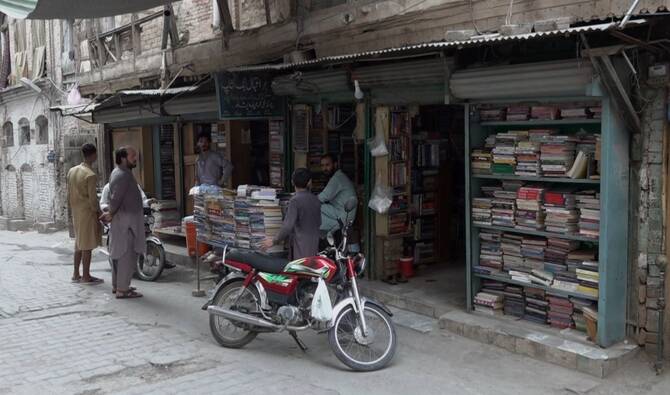
PESHAWAR: In a narrow alley in the heart of Peshawar’s walled city, the scent of dusty pages lingers in the air as visitors step into Chaka Gali, a book bazaar believed to be even older than Partition that continues to serve students and collectors with stacks of used and rare titles at prices few other markets can match.
Thought to have been there in some form before 1947, the market remains one of the oldest surviving second-hand book bazaars in Pakistan. Its tight street is lined with small, dimly lit shops where wooden shelves sag under the weight of textbooks, novels, encyclopedias and exam guides.
Some titles lie in neat piles. Others are scattered on the ground. Most have passed through many hands.
“Chaka Gali is more than 70 years old,” Abdul Jameel, a bookshop owner in his 50s, told Arab News. “You can see the houses [around]. They are almost older than the partition [of Pakistan and India].”
The market’s offerings cater to a wide range of interests. Textbooks for schoolchildren sit alongside Urdu and English fiction, MBBS manuals, CSS prep guides, and religious literature, all at steeply discounted prices.
“You can find any sort of book here,” Jameel continued. “If you need books for primary school for children [or] course books, they can be found here. If you need general English novels, they are also available. If you require Urdu novels, you can get them from here.”
The books, he said, come from multiple sources. Some are purchased from families clearing out private collections while others are supplied by scavengers who collect discarded books from homes and streets and resell them to vendors in the lane.
He identified Lahore’s famed Urdu Bazaar — a historic hub of Pakistan’s publishing trade — as the third source, noting that it supplies unsold or surplus books to dealers across the country.
Jameel said many of these brand-new but excess titles are passed on to vendors at reduced prices.
This benefits the market’s primary customers who come not for the love of books but because they have no other choice.
“The buyers mainly come from the lower class,” he said. “Those who can’t buy books for children [since they can’t afford them] come and take old books from us.”
Jameel said such buyers arrive in the lane “out of compulsion, not a passion for reading.”
“The craze for reading has almost ended,” he added.
Ismail Khan, another second-hand bookseller in his 30s, said he had worked in the market for 15 years.
He pointed out that the rise of digital learning and online reading has cut into sales, though physical books still hold emotional and practical value for many.
“The sales of old books has declined these days,” he noted. “If you see, many people read ebooks.”
However, he noted some readers prefer the tactile experience of a physical book and aren’t drawn to screens.
He also blamed the shrinking customer base on widespread financial hardship.
“A book that previously cost Rs100 is now available for Rs500,” he continued, adding that many people have lost the capacity to buy new books.
Hasir Mir, one of the regular visitors to the lane, said he is a pharmacy student who has relied on Chaka Gali for his academic needs since school.
“I have bought all books of Grade 8, 9 and 10 … from here,” he said. “One of the reasons is that the prices here are reasonable compared to other places.”
Beyond affordability, he observed, the market offers an unmatched range of books.
“I can easily find pharmacy-related books here,” he added. “If you are doing IT, ACCA or you are a student of any other field, you can find the books you want.”
For Mir and many others, Chaka Gali is more than just a marketplace — it’s a lifeline.
Visitors to the second-hand market say that in a country where inflation has turned books into a luxury, the lane quietly preserves the belief that knowledge should remain within reach — even if the pages are a little worn.


![]()

Dust, paper, and crowds: Inside the Peshawar book bazaar that never runs out
Short Url
https://arab.news/4569r
Dust, paper, and crowds: Inside the Peshawar book bazaar that never runs out
- Chaka Gali serves students and collectors with used and rare books at affordable prices
- Booksellers say many visit the lane out of compulsion, not passion, due to financial hardship
Latest updates



Recommended



© 2026 SAUDI RESEARCH & PUBLISHING COMPANY, All Rights Reserved And subject to Terms of Use Agreement.