Israel-Tehran conflict cripples border trade between Pakistan and Iran

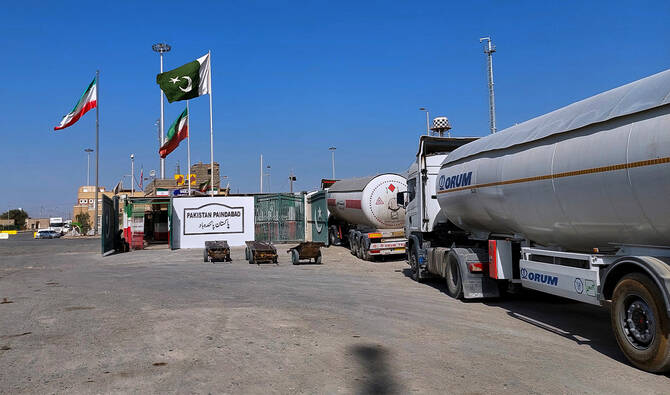
Oil tankers enter Iran through Taftan, a joint border crossing point on Pakistan Iran border on June 19, 2025. (AP)
Short Url
Updated 21 June 2025
Follow

Israel-Tehran conflict cripples border trade between Pakistan and Iran

  • Markets have been closed and dozens of trucks stranded at Pakistan’s Taftan border crossing with Iran since June 15
  • The key border crossing in Pakistan’s Balochistan typically handles daily exchanges in fuel, food and household goods

QUETTA: The ongoing conflict between Israel and Iran has crippled border trade between Pakistan and Iran, transporters and traders said this week, with markets closed and dozens of trucks stranded on the Pakistani side of the border.

Pakistan shares a 959-kilometer border with Iran in its southwest and the trade volume between the two countries stood at $2.8 billion in the last fiscal year that ended in June 2024, according to Pakistani state media.

In Feb., the two neighbors signed an agreement to take the bilateral trade volume to $10 billion, but tensions between Iran and Israel prompted Pakistan to suspend operations at the Taftan border crossing in Balochistan on June 15, mirroring the Iranian side’s restrictions following Israeli airstrikes.

“We’ve been stuck here in Taftan for four to five days, with six to seven vehicles,” Syed Khalil Ahmed, a local transporter, told Reuters on Friday. “We’re waiting for it to reopen so we can load our goods. The market is closed, and there’s a shortage of food and drinks.”

Israel began attacking Iran on June 13, saying its longtime enemy was on the verge of developing nuclear weapons. Iran, which says its nuclear program is only for peaceful purposes, retaliated with missile and drone strikes on Israel.

The Taftan border, a vital trade artery which typically handles daily exchanges in fuel, food and household goods, is now left paralyzed. Local traders said 90 percent of goods in Taftan typically come from Iran.

“With the border closed, no goods are arriving [from Iran] ... Local traders with Pakistani passports can’t enter Iran, and Iranian passport holders can only reach the border and return,” said Hajji Shaukat Ali, an importer of liquefied petroleum gas (LPG).

“This is hurting local businesses and traders. For us, as major LPG gas traders, some of our vehicles are stuck en route and won’t be able to reach us now.”

Ahmed said they were losing approximately Rs20,000 ($70) per truck daily while facing critical shortages of essential supplies.

“We’re managing with what we have, but it’s tough,” he added.


UK announces ‘major reset’ of Pakistan development partnership with new trade, climate, education initiatives

Updated 10 December 2025
Follow

UK announces ‘major reset’ of Pakistan development partnership with new trade, climate, education initiatives

  • UK commits to increased investment-led cooperation in climate, business regulation and higher education
  • London shifts from aid donor to investment-focused partner as bilateral trade crosses $7.3 billion

ISLAMABAD: The United Kingdom on Wednesday unveiled what it called a “major reset” in its development partnership with Pakistan, announcing new investment-focused cooperation, education programs and a bilateral climate compact during a visit by UK Minister for Development Jennifer Chapman.

The trip marks the first federal-level development dialogue between the two governments in eight years and reflects London’s shift from a traditional aid-donor role toward investment-based partnerships. The British government said the new approach aims to use UK expertise to help partner economies build capacity and unlock domestic growth.

Pakistan-UK trade has also reached a record high, crossing £5.5 billion ($7.3 billion) for the first time, with more than 200 British firms now active in Pakistan, an increase London says signals growing two-way commercial confidence.

“Pakistan is a crucial partner for the UK. We work together to tackle the drivers behind organized crime and illegal migration, keeping both our countries safer,” Chapman was quoted as saying in a statement by the British High Commission in Islamabad. 

“Our strong bilateral trading relationship brings jobs and growth to us both. And we’re working together to tackle climate change, a global threat.”

The minister and Prime Minister Shehbaz Sharif on Tuesday jointly launched a package of business regulatory reforms aimed at improving Pakistan’s investment climate and making it easier for UK firms to operate. Officials said the initiative supports Pakistan’s economic recovery agenda and creates new commercial avenues for British companies.

A second key announcement was the next phase of the Pak-UK Education Gateway, developed with the British Council and Pakistan’s Higher Education Commission. The expanded program will enable joint research between universities in both countries, support climate- and technology-focused academic collaboration, and introduce a startup fund to help commercialize research. The Gateway will also promote UK university courses delivered inside Pakistan, giving students access to British degrees without traveling abroad.

Accompanied by Pakistan’s Minister for Climate Change Dr. Musadik Malik, Chapman also launched a Green Compact, a framework for climate cooperation, green investment, environmental protection and joint work at global climate forums.

The UK emphasized it remains one of Pakistan’s largest development partners, citing ongoing work in education, health, climate resilience and anti-trafficking capacity building. 

During the visit to Pakistan, Chapman will meet communities benefiting from UK-supported climate programs, which London says helped 2.5 million Pakistanis adapt to climate impacts in the past year, and observe training of airport officers working to prevent human trafficking.

“We remain firm friends of Pakistan, including in times of crisis, as shown through our floods response,” Chapman said. “And we know to accelerate growth in both our countries, we must work together in partnership to tackle the problems we face.”