

VP Vance says US troops still ‘necessary’ in Los Angeles

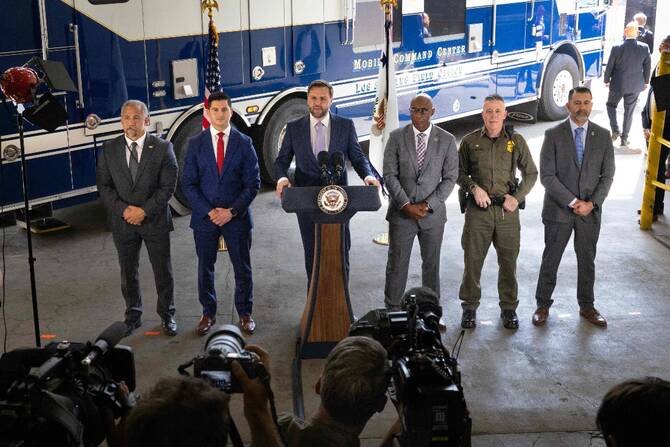
US Vice President JD Vance Visits Los Angeles After Unrest Over ICE Raids. (AFP)
Short Url
Updated 21 June 2025
Follow

VP Vance says US troops still ‘necessary’ in Los Angeles

  • Many in Los Angeles are angry about immigration raids carried out as part of Trump’s ambition to deport vast numbers of undocumented migrants around the country

LOS ANGELES: US Vice President JD Vance said on Friday that the thousands of troops deployed to Los Angeles this month were still needed despite a week of relative calm in the protest-hit city.
President Donald Trump has sent roughly 4,000 National Guard members and 700 Marines, purportedly to protect federal property and personnel, after demonstrations over immigration raids.
“Unfortunately, the soldiers and Marines are still very much a necessary part of what’s going on here because they’re worried that it’s going to flare back up,” Vance told reporters in Los Angeles.
He was speaking the day after an appeals court ruled that Trump could continue to control the California National Guard, which would normally fall under Governor Gavin Newsom’s authority.
California officials have heavily criticized Trump over his use of the military, saying it escalated protests that local law enforcement could have handled.
The demonstrations were largely peaceful and mostly contained to a small part of Los Angeles, the second-largest US city, although there were instances of violence and vandalism.
“If you let violent rioters burn Great American Cities to the ground, then, of course, we’re going to send federal law enforcement in to protect the people the president was elected to protect,” Vance said, adding that Trump would deploy them again if needed.
The Republican further accused Newsom — a possible contender for the Democratic presidential nomination in 2028 — and Los Angeles Mayor Karen Bass of encouraging protesters.
Newsom and Bass have both condemned rioting and violence toward law enforcement while accusing the Trump administration of manufacturing a crisis in the city.
Bass hit back at Vance during a news conference on Friday, accusing him of openly lying and saying that local law enforcement agencies handled crowd control.
“How dare you say that city officials encourage violence. We kept the peace. You know that the federal officials that were here protected a federal building — they were not involved in crowd control,” she said.
Bass said that even when there was vandalism, at its height “you are talking about a couple of hundred people who are not necessarily associated with any of the peaceful protests.”
“Los Angeles is a city that is 500 square miles and any of the disruption that took place took place at about 2 square miles in our city,” she said, accusing Vance of adding to “provocation” and sowing “division.”

Many in Los Angeles are angry about immigration raids carried out as part of Trump’s ambition to deport vast numbers of undocumented migrants around the country.
Outrage at the use of masked, armed immigration agents also sparked protests in other cities, including San Francisco, New York, Chicago and San Antonio, Texas.
Tensions spiked when California Senator Alex Padilla, a Democrat, was handcuffed and forcibly removed last week when attempting to ask Homeland Security Secretary Kristi Noem questions during her news conference.
Vance misnamed the senator when referring to the incident, saying: “I was hoping Jose Padilla would be here to ask a question but unfortunately I guess he decided not to show up because there wasn’t a theater.”
Bass reacted to the comment with outrage.
“How dare you disrespect him and call him Jose. But I guess he just looked like anybody to you,” she said.
Senate Minority Leader Chuck Schumer had said Padilla’s treatment “reeks of totalitarianism,” while the White House claimed — despite video evidence to the contrary — that Padilla had “lunged toward Secretary Noem.”


Youth voters take center stage in Bangladesh election after student-led regime change

Updated 4 sec ago
Follow

Youth voters take center stage in Bangladesh election after student-led regime change

  • About 45% of Bangladeshis eligible to vote in Thursday’s election are aged 18-33
  • Election follows 18 months of reforms after the end of Sheikh Hasina’s 15-year rule

DHAKA: When he goes to the polls on Thursday, Atikur Rahman Toha will vote for the first time, believing that this election can bring democratic change to Bangladesh.

A philosophy student at Dhaka University, Toha was already eligible to vote in the 2024 poll but, like many others, he opted out.

“I didn’t feel motivated to even go to vote,” he said. “That was a truly one-sided election. The election system was fully corrupted. That’s why I felt demotivated. But this time I am truly excited to exercise my voting rights for the first time.”

The January 2024 vote was widely criticized by both domestic and international observers and marred by a crackdown on the opposition and allegations of voter fraud.

But the victory of the Awami League of ex-Prime Minister Sheikh Hasina was short-lived, as a few months later the government was ousted by a student-led uprising, which ended the 15-year rule of Bangladesh’s longest-serving leader.

The interim administration, led by Nobel laureate Muhammad Yunus, took control in August 2024 and prepared a series of reforms to restructure the country’s political and institutional framework and organize the upcoming vote.

About 127.7 million Bangladeshis are eligible to cast their ballots, according to Election Commission data, with nearly a third of them, or 40.4 million, aged 18-29. Another 16.9 million are 30-33, making it a youth–dominated poll, with the voters hopeful the outcome will help continue the momentum of the 2024 student-led uprising.

“We haven’t yet fully transitioned into a democratic process. And there is no fully stable situation in the country,” Toha said. “After the election we truly hope that the situation will change.”

For Rawnak Jahan Rakamoni, also a Dhaka University student, who is graduating in information science, voting this time meant that her voice would count.

“We are feeling that we are heard, we will be heard, our opinion will matter,” she said.

“I think it is a very important moment for our country, because after many years of controversial elections, people are finally getting a chance to exercise their voting rights and people are hoping that this election will be more meaningful and credible. This should be a fair election.”

But despite the much wider representation than before, the upcoming vote will not be entirely inclusive in the absence of the Awami League, which still retains a significant foothold.

The Election Commission last year barred Hasina’s party from contesting the next national elections, after the government banned Awami League’s activities citing national security threats and a war crimes investigation against the party’s top leadership.

The UN Human Rights Office has estimated that between July 15 and Aug. 5, 2024 the former government and its security and intelligence apparatus, together with “violent elements” linked to the Awami League, “engaged systematically in serious human rights violations and abuses in a coordinated effort to suppress the protest movement.”

It estimated that at least 1,400 people were killed during the protests, with the majority shot dead from military rifles.

Rezwan Ahmed Rifat, a law student, wanted the new government to “ensure justice for the victims of the July (uprising), enforced disappearances, and other forms of torture” carried out by the previous regime.

The two main parties out of the 51 contesting Thursday’s vote are the Bangladesh Nationalist Party and Jamaat-e-Islami. Jamaat, which in 2013 was banned from political participation by Hasina’s government, heads an 11-party alliance, including the National Citizen Party formed by student leaders from the 2024 movement.

“I see this election as a turning point of our country’s democratic journey … It’s not just a normal election,” said Falguni Ahmed, a psychology student who will head to the polls convinced that no matter who wins, it will result in the “democratic accountability” of the next government.

Ahmed added: “People are not voting only for their leaders; they are also voting for the restoration of democratic credibility. That’s why this election is very different.”