Trump confirms DR Congo-Rwanda peace deal, gripes about Nobels

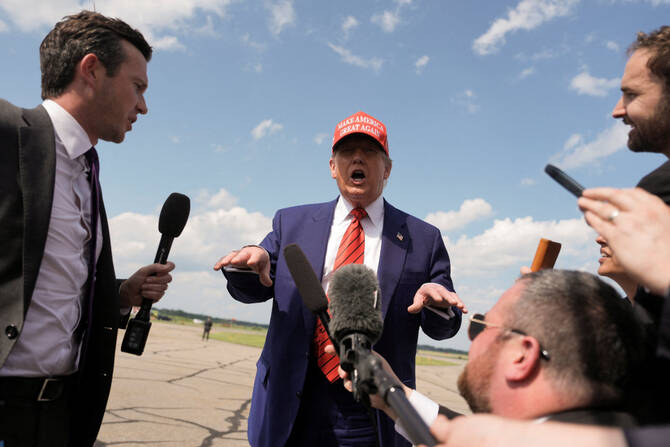
US President Donald Trump talks to reporters upon his arrival at Morristown Municipal Airport in Morristown, New Jersey, on June 20, 2025. (REUTERS)
Short Url
Updated 21 June 2025
Follow

Trump confirms DR Congo-Rwanda peace deal, gripes about Nobels

  • DR Congo and Rwanda officials expected to sign accord in Washington next week
  • Trump's campaign promise to quickly end wars in Ukraine and Gaza have both failed
  • But he believes he deserves a Nobel for his supposed mediating role in other conflicts

WASHINGTON: US President Donald Trump took credit Friday for a peace deal negotiated in Washington between the Democratic Republic of Congo and Rwanda — and complained that he would not get a Nobel Peace Prize for his efforts.
The warring African nations said in a joint statement on Wednesday that they had initialed an agreement aimed at ending the conflict in eastern DRC — to be formally signed in the US capital next week.
“This is a Great Day for Africa and, quite frankly, a Great Day for the World!” Trump said in a Truth Social post confirming the breakthrough.
But his triumphant tone darkened as he complained that he had been overlooked by the Norwegian Nobel Committee for his mediating role in conflicts between India and Pakistan, as well as Serbia and Kosovo.
He also demanded credit for “keeping peace” between Egypt and Ethiopia and brokering the Abraham Accords, a series of agreements aiming to normalize relations between Israel and several Arab nations.


US Secretary of State Marco Rubio hosts a signing ceremony in which Congo's Foreign Minister Therese Kayikwamba Wagner, left, and Rwanda's Foreign Minister Olivier Nduhungirehe, right, pledge to work toward a peace deal at the State Department in Washington on April 25, 2025. (AP/File)

Trump campaigned for office as a “peacemaker” who would use his negotiating skills to quickly end wars in Ukraine and Gaza, although both conflicts are still raging five months into his presidency.
Indian officials have denied that he had any role in its ceasefire with Pakistan.
And the Republican greatly exaggerated the significance of the 2020 Serbia-Kosovo agreements, which were statements of intent thin on detail and that quickly unraveled.
Trump’s claims for the Abraham Accords being able to “unify the Middle East” have also yet to be realized, with war breaking out between Israel and Iran, and no end in sight to the conflict in Gaza.
The president said officials from DR Congo and Rwanda would be in Washington on Monday for their signing, although their joint statement said they would put pen to paper on June 27.
The resource-rich eastern DRC, which borders Rwanda, has been plagued by violence for three decades, with a resurgence since the anti-government M23 armed group went on a renewed offensive at the end of 2021.
The deal — which builds on a declaration of principles signed in April — was reached during three days of talks between the neighbors in Washington, according to their statement.
Trump has received multiple Nobel Peace Prize nominations from supporters and loyal lawmakers over the years.
He has made no secret of his irritation at missing out on the prestigious award, bringing it up as recently as February during an Oval Office meeting with Israeli Prime Minister Benjamin Netanyahu.
President Barack Obama won the prize soon after taking office in 2009, and Trump complained during his 2024 election campaign that his Democratic predecessor was not worthy of the honor.


US kills 8 in eastern Pacific strikes on alleged drug boats

Updated 3 sec ago
Follow

US kills 8 in eastern Pacific strikes on alleged drug boats

  • Strikes on three alleged drug-trafficking vessels in the eastern Pacific Ocean killed eight people on Monday, according to the US military
WASHINGTON: Strikes on three alleged drug-trafficking vessels in the eastern Pacific Ocean killed eight people on Monday, according to the US military, the latest in a controversial campaign that has killed dozens of people.
Since early September, the US military under Pentagon chief Pete Hegseth has targeted alleged drug-smuggling boats in the Caribbean Sea and eastern Pacific Ocean, destroying at least 26 vessels and killing at least 95 people.
The US Southern Command announced the latest three strikes on X, saying the eight men killed had been involved in drug trafficking, without providing evidence.
The post included video footage of three separate boats floating in water before they are each hit by strikes.
“Intelligence confirmed that the vessels were transiting along known narco-trafficking routes in the Eastern Pacific and were engaged in narco-trafficking,” it said.
The strikes killed three men in the first vessel, two in the second and another three in the third, the US Southern Command added.
The strikes have drawn intense scrutiny from human rights advocates and Democratic lawmakers, with the United Nations’s human rights chief warning last month they could violate international law.
The US administration has labeled those killed as “unlawful combatants” and said it can legally engage in lethal strikes without judicial review due to a classified Justice Department finding.
US authorities have not provided specific evidence that the boats it has targeted were ferrying drugs.
Senate Minority Leader Chuck Schumer said that there would be an all-senators briefing Tuesday on the “administration’s rogue and reckless actions in the Caribbean,” with Hegseth and US Secretary of State Marco Rubio.
“The American people deserve oversight. We intend to deliver it,” the senior Democratic party lawmaker said in an X post published before the latest strike announcement by the US military.
- Concern over strikes -
The strikes have been accompanied by a massive US military buildup in the Caribbean that includes the world’s largest aircraft carrier and a slew of other warships.
US President Donald Trump has insisted the goal is combating narco-trafficking, while Venezuelan President Nicolas Maduro says he suspects it is a pretext for leadership change in Caracas.
The admiral leading US forces in the Caribbean, Alvin Holsey, stepped down last week, just a year into his tenure and after reportedly expressing concerns about the boat strikes.
Neither he nor Hegseth have publicly provided a reason for his early departure.
“We must always be there for like-minded partners, like-minded nations who share our values — democracy, rule of law and human rights,” Holsey said in a ceremony to mark him relinquishing command.
During one of the first strikes in September, survivors of an initial attack on a boat were killed in a second US strike on the vessel, generating accusations of a possible war crime since media reported details of the incident in November.
Hegseth has maintained he did not order a second strike, instead attributing it to the operational commander Admiral Frank Bradley.
Even before news of the double-strike broke, UN rights chief Volker Turk had urged Washington to investigate the legality of the campaign and warned of “strong indications” of “extrajudicial killings.”