

Chad hopes ‘green charcoal’ can save vanishing forests

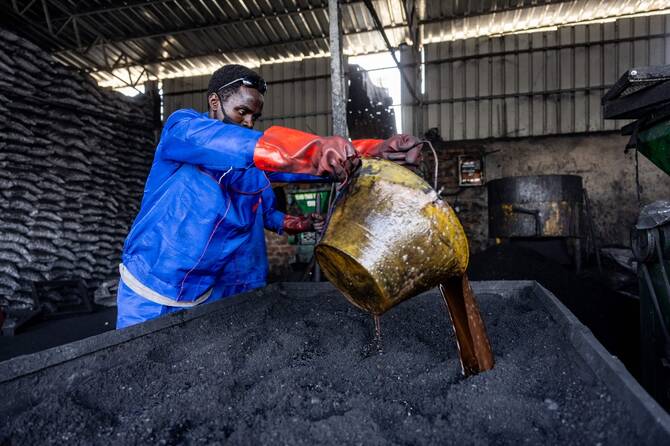
A worker pours a gum arabic-based binder at Grace International's green coal production site in N'Djamena, Chad. (AFP)
Short Url
Updated 20 June 2025
Follow

Chad hopes ‘green charcoal’ can save vanishing forests

  • Chad has lost more than 90 percent of its forest cover since the 1970s, hit by climate change and overexploitation of trees for household uses such as cooking

N’DJAMENA: As they zigzagged from one machine to another in the searing African sun, the workers were covered in black soot.
But the charcoal they were making is known as “green,” and backers hope it can save impoverished Chad from rampant deforestation.
Chad, a vast, landlocked country of 19 million people perched at the crossroads of north and central Africa, is steadily turning to desert.
It has lost more than 90 percent of its forest cover since the 1970s, hit by climate change and overexploitation of trees for household uses such as cooking, officials say.
“Green charcoal” aims to protect what forest is left.
Made from discarded plant waste such as millet and sesame stalks or palm fronds, it is meant to save trees from being chopped down for cooking.
The product “releases less emissions than traditional charcoal, it doesn’t blacken your pots, it has high energy content and lasts up to three times longer than ordinary charcoal,” said Ousmane Alhadj Oumarou, technical director of the Raikina Association for Socioeconomic Development (Adser).
“Using one kilogramme of green charcoal saves six kilogrammes of wood.”
The group has installed a production facility in Pont Belile, just north of the capital, N’Djamena.
There, workers grind up burnt plant waste, then mix it with gum arabic, which helps it ignite, and clay, which makes it burn more slowly.
The resulting black nuggets look like ordinary charcoal.
Like the traditional kind, it emits CO2 when it burns — but less, said Souleymane Adam Adey, an ecologist at the University of N’Djamena.
And “it contributes to fighting deforestation, by ensuring the trees that aren’t cut down continue to capture and store carbon,” he said.

The conflict in neighboring Sudan, which is facing one of the worst humanitarian crises in the world, is adding to pressure on Chad, which has become home to more than 800,000 Sudanese refugees since 2023 — double the 400,000 it already hosted.
“Desertification has progressed in the regions that have been hosting Sudanese refugees for the past two years,” said Adser’s director, 45-year-old businessman Ismael Hamid.
Adser invested 200 million CFA francs (about $350,000) to launch the project, then won backing from the World Bank, which buys the charcoal for 750 CFA francs per kilogramme.
The United Nations refugee agency, UNHCR, distributes the charcoal in refugee camps in eastern Chad.
But Hamid said he hoped to expand production and slash prices to 350 to 500 CFA francs per kilo to make “green charcoal” available and affordable nationwide.
The plant currently produces seven to nine tons per day.
“If we want to meet the country’s needs, we have to increase our output by at least a factor of 10,” said Hamid, calling for subsidies to support the budding sector.
Environment Minister Hassan Bakhit Djamous told AFP the government was working on a policy to promote such projects.
“We need to bet on green charcoal as an energy source for the future of our country,” he said.
jbo-emp/lnf/jhb/cw


US airlines cancel 1,200 flights Tuesday as shutdown continues

Updated 6 sec ago
Follow

US airlines cancel 1,200 flights Tuesday as shutdown continues

  • After airlines canceled 2,400 flights and delayed 9,600 on Monday, airlines delayed just 1,700 on Tuesday, the best performance for the industry in recent days

WASHINGTON: Airlines canceled 1,200 flights on Tuesday as air traffic control staffing improved significantly ahead of an expected end to a record-setting government shutdown as soon as Wednesday.
After airlines canceled 2,400 flights and delayed 9,600 on Monday, airlines delayed just 1,700 on Tuesday, the best performance for the industry in recent days.
Last week, the Federal Aviation Administration instructed airlines to cut 4 percent of daily flights starting on Friday, November 7, at 40 major airports because of air traffic control staffing issues. Reductions in flights rose to 6 percent on Tuesday.
Flight reductions were set to hit 8 percent on Thursday and 10 percent on Friday, November 14. Airlines and the FAA are in discussions about when and how the cuts will be reduced and eventually eliminated as a record-setting 42-day government shutdown nears an end.
On Monday, President Donald Trump threatened to dock the pay of any controller who did not return to work and would welcome the resignations of workers who were not diligent in showing up for work.
Some airlines are holding off on cutting 8 percent of flights for Thursday. United Airlines said Tuesday it has cut about 5 percent of Thursday flights.
Several options are being discussed for how the FAA might end or shrink the flight cuts, sources told Reuters.
Air traffic control staffing shortages improved dramatically on Tuesday after more than two dozen issues on Monday. Transportation Secretary Sean Duffy said just four staffing issues were reported Tuesday, down from 81 Saturday.
Duffy said at a press conference at Chicago O’Hare that he will reduce flight cuts as safety allows.
“When that data changes, we’re going to start taking that down from 6 percent, maybe we’ll go to four, two, and get back to normal air travel,” Duffy said. “It depends on controllers coming back to work.”
On Monday night, the Senate voted to approve legislation to end the shutdown and fund the government through January 30. The House is set to take it up on Wednesday. Duffy said that if the House did not approve the bill that flight disruptions could skyrocket this weekend and some major airlines might not keep flying. “That’s how serious this is,” Duffy said.
Air traffic absences have led to tens of thousands of flight cancelations and delays since October 1 when the shutdown began. Over the weekend, 1.2 million passengers were delayed or had their flight cancelations due to air traffic controller absences.
The shutdown, the longest in US history, has forced 13,000 air traffic controllers and 50,000 Transportation Security Administration agents to work without pay.
The FAA is about 3,500 air traffic controllers short of targeted staffing levels. Many had been working mandatory overtime and six-day weeks even before the shutdown.