Russia’s economy minister says the country is on ‘the brink of recession’

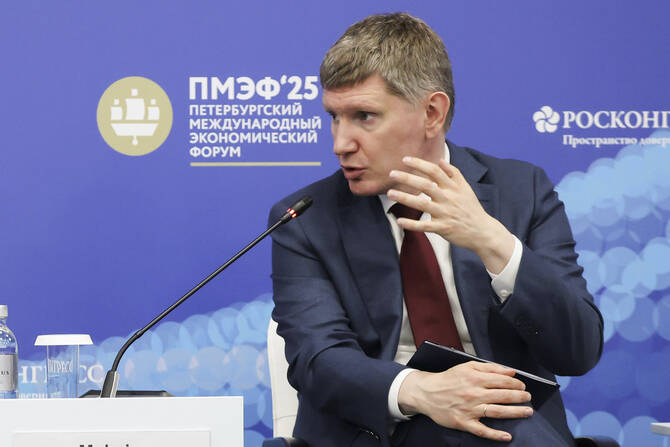
Maxim Reshetnikov, minister of economic development of the Russian Federation, attends a plenary session of the St. Petersburg International Economic Forum in St. Petersburg, Russia, on June 19, 2025. (Roscongress Foundation via AP)
Short Url
Updated 20 June 2025
Follow

Russia’s economy minister says the country is on ‘the brink of recession’

  • Minister delivers warning at the St. Petersburg International Economic Forum
  • Economy ministry also sees export losses due to trade wars at $9 billion

ST. PETERSBURG, Russia: Russia’s economy is “on the brink of going into a recession,” the country’s economy minister said Thursday, according to Russian media reports.
Economy Minister Maxim Reshetnikov delivered the warning at the St. Petersburg International Economic Forum, the annual event in Russia’s second largest city designed to highlight the country’s economic prowess and court foreign investors.
Russian business news outlet RBC quoted the official as saying “the numbers indicate cooling, but all our numbers are (like) a rearview mirror. Judging by the way businesses currently feel and the indicators, we are already, it seems to me, on the brink of going into a recession.”
The economy, hit with a slew of sanctions after the Kremlin sent troops into Ukraine in February 2022, has so far outperformed predictions. High defense spending has propelled growth and kept unemployment low despite fueling inflation. At the same time, wages have gone up to keep pace with inflation, leaving many workers better off.
Large recruiting bonuses for military enlistees and death benefits for those killed in Ukraine also have put more income into the country’s poorer regions. But over the long term, inflation and a lack of foreign investments remain threats to the economy, leaving a question mark over how long the militarized economy can keep going.
Economists have warned of mounting pressure on the economy and the likelihood it would stagnate due to lack of investment in sectors other than the military.
Speaking at a forum session, Reshetnikov said Russia was “on the brink,” and whether the country would slide into a recession or not depends on the government’s actions.
“Going forward, it all depends on our decisions,” Reshetnikov said, according to RBC.
RBC reported Russia’s Finance Minister Anton Siluanov and Central Bank Gov. Elvira Nabiullina gave more optimistic assessments.
Siluanov spoke about the economy “cooling” but noted that after any cooling “the summer always comes,” RBC reported.
Nabiullina said Russia’s economy was merely “coming out of overheating,” according to RBC.

Export losses

On the issue of exports, Russia estimates potential losses due to global trade wars at $9 billion, but expects a gradual stabilization of flows and a possible expansion of supplies to China, Deputy Economy Minister Vladimir Ilyichev said.
President Trump has upended longstanding trade relations since returning to the White House, using erratic tariff threats and aggressive negotiating tactics in a bid to secure better deals from trading partners.
“Overall, we estimate the impact on Russia of this reorientation at $33 billion, of which about $9 billion is the potential loss of Russian exports in third-country markets,” said Ilyichev.


Saudi ambassador becomes first foreign envoy to meet Bangladesh’s new PM

Updated 4 sec ago
Follow

Saudi ambassador becomes first foreign envoy to meet Bangladesh’s new PM

  • Tarique Rahman took oath as PM last week after landslide election win
  • Ambassador Abdullah bin Abiyah also meets Bangladesh’s new FM

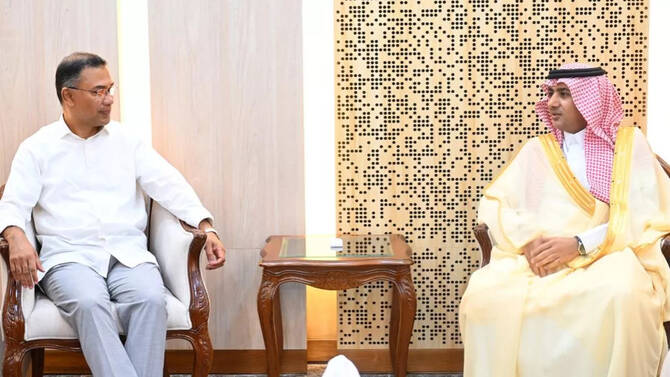
Dhaka: Saudi Arabia’s ambassador to Dhaka became on Sunday the first foreign envoy to meet Bangladesh’s new Prime Minister Tarique Rahman since he assumed the country’s top office.

Rahman’s Bangladesh Nationalist Party made a landslide win in the Feb. 12 election, securing an absolute majority with 209 seats in the 300-seat parliament.

The son of former Prime Minister Khaleda Zia and former President and BNP founder Ziaur Rahman, he was sworn in as the prime minister last week.

The Saudi government congratulated Rahman on the day he took the oath of office, and the Kingdom’s Ambassador Abdullah bin Abiyah was received by the premier in the Bangladesh Secretariat, where he also met Bangladesh’s new foreign minister.

“Among the ambassadors stationed in Dhaka, this is the first ambassadorial visit with Prime Minister Tarique Rahman since he assumed office,” Saleh Shibli, the prime minister’s press secretary, told Arab News.

“The ambassador conveyed greetings and best wishes to Bangladesh’s prime minister from the king and crown prince of Saudi Arabia … They discussed bilateral matters and ways to strengthen the ties among Muslim countries.”

Rahman’s administration succeeded an interim government that oversaw preparations for the next election following the 2024 student-led uprising, which toppled former leader Sheikh Hasina and ended her Awami League party’s 15-year rule.

New Cabinet members were sworn in during the same ceremony as the prime minister last week.

Foreign Minister Khalilur Rahman is a former UN official who served as Bangladesh’s national security adviser during the interim government’s term.

He received Saudi Arabia’s ambassador after the envoy’s meeting with the prime minister.

“The foreign minister expressed appreciation for the Saudi leadership’s role in promoting peace and stability in the Middle East and across the Muslim Ummah. He also conveyed gratitude for hosting a large number of Bangladeshi workers in the Kingdom and underscored the significant potential for expanding cooperation across trade, investment, energy, and other priority sectors, leveraging the geostrategic positions of both countries,” the ministry said in a statement.

“The Saudi ambassador expressed his support to the present government and his intention to work with the government to enhance the current bilateral relationship to a comprehensive relationship.”

Around 3.5 million Bangladeshis live and work in Saudi Arabia. They have been joining the Saudi labor market since 1976, when work migration to the Kingdom was established during the rule of the new prime minister’s father.

Bangladeshis are the largest expat group in the Kingdom and the largest Bangladeshi community outside Bangladesh and send home more than $5 billion in remittances every year.