

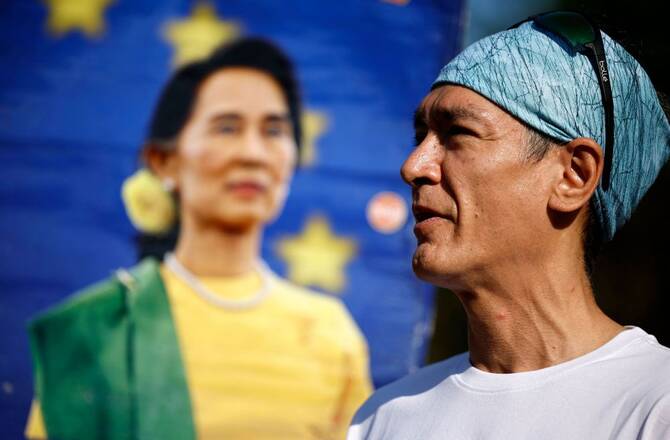

YANGON: Myanmar’s deposed democratic leader Aung San Suu Kyi marked her 80th birthday in junta detention on Thursday, serving a raft of sentences set to last the rest of her life.
Suu Kyi was the figurehead of Myanmar’s decade-long democratic thaw, becoming de facto leader as it opened up from military rule.
But as the generals snatched back power in a 2021 coup, she was locked up on charges ranging from corruption to breaching Covid-19 pandemic restrictions and is serving a 27-year sentence.
“It will be hard to be celebrating at the moment,” said her 47-year-old son Kim Aris from the UK. “We’ve learned to endure when it’s been going on so long.”
He has run 80 kilometers (50 miles) over the eight days leading up to her birthday, and collected over 80,000 well-wishing video messages for his mother.
But Suu Kyi will not see them, sequestered in Myanmar’s sprawling capital Naypyidaw from where the military directs a civil war against guerilla fighters, many of whom took up arms in response to the toppling of her government.
Aris said he has heard from his mother only once via letter two years ago since she was imprisoned.
“We have no idea what condition she’s in,” he said, adding that he fears she is suffering from untreated medical problems with her heart, bones and gums.
Myanmar junta spokesman Zaw Min Tun told AFP late on Thursday Suu Kyi “is in good health,” without providing any further details.
No formal celebrations took place in junta-held parts of Myanmar, but a gaggle of followers in military-controlled Mandalay city staged a spontaneous protest ahead of her birthday, local media said.
A few masked protesters showered a street with pamphlets reading “freedom from fear” and “happy birthday” as one member held up a portrait of Suu Kyi in shaky camera footage shared on social media.
“Do you still remember this great person?” asked one of the protesters in the video, which AFP has not been able to independently verify.
Other small protests were also reported, including in a rebel-contested area of northern Sagaing region where women marched holding roses in tribute to the former leader, who famously wore garlands of flowers in her hair.
While Suu Kyi remains hugely popular in the majority Buddhist country, her status as a democracy icon abroad collapsed before the military takeover after she defended the generals in their crackdown against the Rohingya.
Hundreds of thousands of the Muslim minority were sent fleeing to neighboring Bangladesh under her rule, though some argued she was powerless against the lingering influence of Myanmar’s military.
Nonetheless institutions and figures that once showered Suu Kyi with awards rapidly distanced themselves, and her second round of imprisonment has received far less international attention.
Suu Kyi, the daughter of Myanmar independence hero Aung San, became a champion of democracy almost by accident.
After spending much of her youth abroad, she returned in 1988 to nurse her sick mother but began leading anti-military protests crushed by a crackdown.
She was locked up for 15 years, most of it in her family’s Yangon lakeside mansion where she still drew crowds for speeches over the boundary wall.
The military offered freedom if she went into exile but her poised refusal thrust her into the spotlight and won her the 1991 Nobel Peace Prize.
Suu Kyi was released in 2010 and led her National League for Democracy (NLD) party to electoral victory in 2015, never formally in charge as army-drafted rules kept her from the presidency.
The NLD said in a statement on Thursday she “must be recognized as an essential figure in any credible and inclusive solution to Myanmar’s ongoing crisis.”
But if the octogenarian were released from her current incarceration, Aris predicts she would likely step back from a “frontline position” in Myanmar politics.
The military has promised new elections at the end of this year, but they are set to be boycotted by many groups comprised of former followers of Suu Kyi’s non-violent vision who have now taken up arms.


