

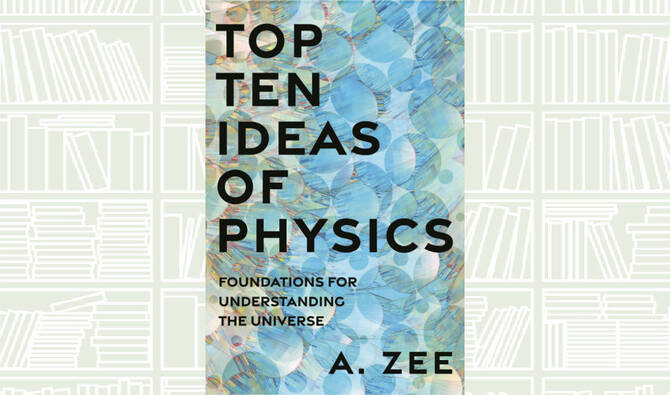
What We Are Reading Today: Top Ten Ideas of Physics by Anthony Zee

Short Url
Updated 18 June 2025
Follow

What We Are Reading Today: Top Ten Ideas of Physics by Anthony Zee

Could any discovery be more unexpected and shocking than the realization that the reality we were born into is but an approximation of an underlying quantum world that is barely within our grasp? This is just one of the foundational pillars of theoretical physics that A. Zee discusses in this book. Join him as he presents his Top Ten List of the biggest, most breathtaking ideas in physics—the ones that have fundamentally transformed our understanding of the universe.

“Top Ten Ideas of Physics” tells a story that will keep readers enthralled, along the way explaining the meaning of each idea and how it came about. Leading the list are the notions that the physical world is comprehensible and that the laws of physics are the same here, there, and everywhere. 

As the story unfolds, the apparently solid world dissolves into an intertwining web of dancing fields, exhibiting greater symmetries as we examine them at deeper and deeper levels.


What We Are Reading Today: ‘How the Universe Got Its Spots’

Photo/Supplied
Updated 02 January 2026
Follow

What We Are Reading Today: ‘How the Universe Got Its Spots’

  • Nimbly explaining geometry, topology, chaos, and string theory, Levin shows how the pattern of hot and cold spots left over from the big bang may one day reveal the size of the cosmos

Author: JANNA LEVIN 

Is the universe infinite or just really big? With this question, cosmologist Janna Levin announces the central theme of this book, which established her as one of the most direct, unorthodox, and creative voices in contemporary science.

As Levin sets out to determine how big “really big” may be, she offers a rare intimate look at the daily life of an innovative physicist, complete with jet lag and the tensions between personal relationships and the extreme demands of scientific exploration.

Nimbly explaining geometry, topology, chaos, and string theory, Levin shows how the pattern of hot and cold spots left over from the big bang may one day reveal the size of the cosmos.