

Pakistan secures $1 billion in ADB-backed financing from Middle Eastern banks

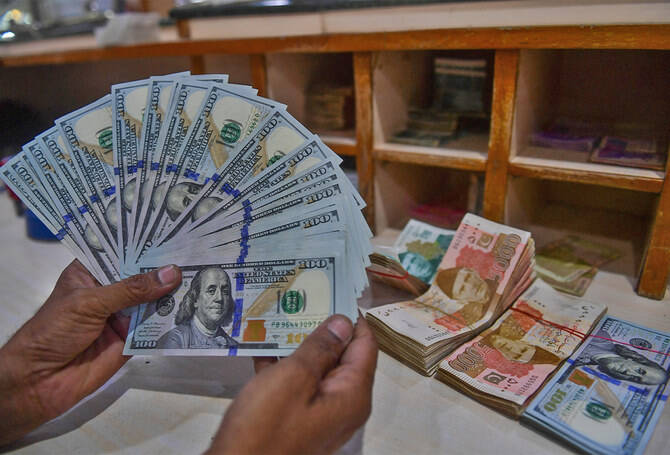
A foreign currency dealer counts US dollars at a shop in Karachi, Pakistan, on May 19, 2022. (AFP/ file)
Short Url
Updated 19 June 2025
Follow

Pakistan secures $1 billion in ADB-backed financing from Middle Eastern banks

  • The loan aims to strengthen the country’s fiscal resilience, support reform momentum
  • The government says the deal signals renewed trust in Pakistan’s economic trajectory

KARACHI: Pakistan has signed a $1 billion syndicated term finance facility backed by Middle Eastern banks, marking its return to the region’s financial markets after more than two years, the finance ministry said on Wednesday.

The five-year facility is partially guaranteed by the Asian Development Bank (ADB) under its Policy-Based Guarantee program, which is linked to fiscal reforms undertaken by Pakistan to improve resource mobilization and economic stability.

The financing by the Middle Eastern banks is structured across Islamic and conventional tranches, with 89 percent of the total amount raised through a Shariah-compliant facility.

“This is a landmark transaction for the Government of Pakistan that demonstrates strong support from leading financiers in the region,” the finance ministry said in a statement.

It informed that Dubai Islamic Bank acted as the sole Islamic global coordinator on the landmark issue, while Dubai Islamic Bank and Standard Chartered Bank acted as mandated lead arrangers and bookrunners.

Other financiers include Abu Dhabi Islamic Bank as mandated lead arranger, and Sharjah Islamic Bank, Ajman Bank and Pakistan’s Habib Bank Limited (HBL) as arrangers.

The deal marks the first time a facility has been backed by an ADB Policy-Based Guarantee linked to specific reform measures undertaken by a member country.

According to the ministry, the ADB’s support helped Pakistan attract significant interest from regional lenders and re-enter global capital markets at a critical time for the economy.

The government said the success of the transaction signals renewed trust in Pakistan’s fiscal outlook and macroeconomic trajectory, marking the beginning of a new partnership with Middle Eastern banks.

Pakistan, which has faced persistent external financing gaps in recent years, has relied on friendly nations and global lenders to stabilize its balance of payments and rebuild investor confidence.

The ADB-backed facility is intended to help strengthen fiscal resilience while supporting economic reform momentum.


Pakistan army chief tells Kabul to choose Islamabad or Taliban militants amid strained ties

Updated 9 sec ago
Follow

Pakistan army chief tells Kabul to choose Islamabad or Taliban militants amid strained ties

  • Pakistan blames Afghanistan for facilitating cross-border attacks in its territory, allegations that Kabul denies 
  • Ties remain strained since October, when deadly border clashes left dozens dead on both sides of the border

ISLAMABAD: Pakistan’s Chief of Defense Forces Field Marshal Syed Asim Munir has told Afghanistan to choose between Islamabad and the outlawed Tehreek-e-Taliban Pakistan (TTP) militants, state media reported on Sunday as ties between both neighbors remain strained. 

Pakistan’s army and civilian government have both blamed the Afghan Taliban recently for facilitating cross-border attacks in Pakistan, a charge Kabul denies. Afghanistan says it does not allow its territory to be used for attacks against Pakistan and cannot be held responsible for Islamabad’s security challenges. 

Both countries were involved in deadly border clashes in October that saw dozens of soldiers killed and wounded on both sides. Officials from Afghanistan and Pakistan have held peace talks in Qatar, Türkiye and Saudi Arabia over the past few months but failed to reach an agreement. 

“Chief of Army Staff and Chief of Defense Forces Field Marshal Syed Asim Munir has said Afghanistan will have to choose between Fitna Al-Khawarij and Pakistan,” state broadcaster Radio Pakistan reported. 

Munir was addressing the National Ulema and Mashaikh Conference held in Islamabad earlier this month, the state media said.

“Fitna Al-Khawarij” is a term the Pakistan military frequently uses for the TTP. 

Munir highlighted that 70 percent of the TTP’s formations that enter Pakistan from Afghanistan comprise Afghan nationals. 

“He said innocent citizens, including children, are being targeted through terrorism with the backing of the Afghan Taliban,” Radio Pakistan reported. 

While Pakistan and Afghanistan have agreed to a temporary ceasefire, tensions persist between the two nations as militant attacks persist in Pakistan. 

Pakistan summoned Afghanistan’s deputy head of mission on Friday and demanded “decisive action” against TTP militants after four Pakistani soldiers were killed in an attack on a military camp in northwest Pakistan. 

The foreign office said the Afghan government had been informed that Pakistan “reserves the right to defend its sovereignty and protect its citizens” and would take all necessary measures to respond to attacks originating from Afghan territory.

Afghanistan has warned Pakistan in the past against attacking its territory, saying it reserves the right to respond to such provocations.