Under Israeli attack, Iran has ‘legitimate’ right to self-defense: Erdogan

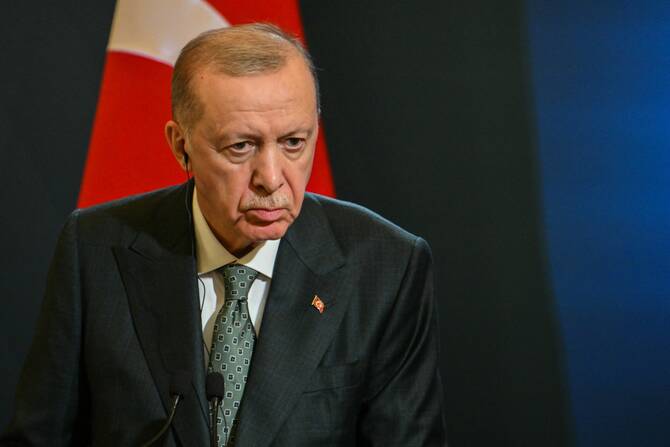
Turkish President Recep Tayyip Erdogan addresses a joint press conference in Rome, Italy. (File/AFP)
Short Url
Updated 18 June 2025
Follow

Under Israeli attack, Iran has ‘legitimate’ right to self-defense: Erdogan

  • Erdogan said Turkiye is 'closely following Israel’s terrorist attacks on Iran'
  • He had ordered the defense industry to increase production of medium and long-range missiles to 'increase its level of deterrence'

ISTANBUL: Turkish President Recep Tayyip Erdogan said Wednesday Iran had the “legitimate” right to defend itself in the face of Israel’s ongoing bombing campaign, now in its sixth day.
“It is a very natural, legitimate and legal right for Iran to defend itself against Israel’s thuggery and state terrorism,” the Turkish leader said, a day after referring to Israeli Prime Minister Benjamin Netanyahu as “the biggest threat to the security of the region.”
The long-range blitz began early Friday, when Israel launched a massive bombing campaign that prompted Iran to hit back with missiles and drones, including hypersonic missiles.
“These attacks were organized while the Iranian nuclear negotiations were taking place,” Erdogan said.
“Israel, which possesses nuclear weapons and does not recognize any international rules... did not wait for the negotiations to end but carried out a terrorist act without waiting for the result,” he added.
Iran says at least 224 people have been killed in the Israeli attacks, which have targeted nuclear and military facilities, while Iranian fire on Israel has claimed at least 24 lives and wounded hundreds more, Netanyahu’s office said.
“We are closely following Israel’s terrorist attacks on Iran. All our institutions are on high alert regarding the possible effects of these attacks on Turkiye,” Erdogan said.
“We are making preparations for every kind of scenario,” he said.
“Nobody should dare to test us. We don’t have any desire to take other people’s lands... in the region,” he added.
His remarks prompted a sharp riposte from Israeli Foreign Minister Gideon Saar, who pointed to Turkiye’s presence in Syria and in the divided island of Cyprus, where it controls the northern part.
“It is particularly ironic that someone who does not hide his imperialist ambitions, who invaded northern Syria and illegally holds northern Cyprus, claims to speak in the name of morality and international law,” Saar wrote on X.
“A little self-awareness could be helpful,” he added.
On Monday, Erdogan said he had ordered the defense industry to increase production of medium and long-range missiles to “increase its level of deterrence” in light of the air war between Israel and Iran.


Syria announces new currency framework, 2-zero redenomination

Updated 15 sec ago
Follow

Syria announces new currency framework, 2-zero redenomination

  • Under the plan, every 100 Syrian pounds will be converted into one unit of the new Syrian Arab Republic’s pound
  • Governor calls move ‘pivotal milestone within a comprehensive strategy’

DAMASCUS: Syria’s Central Bank announced executive instructions on Sunday to introduce a new Syrian currency, launching a monetary reform that includes removing two zeros from the pound and allowing a 90-day period of dual circulation.

The announcement was made during a press conference at the bank’s headquarters in Damascus.

Central Bank Gov. Abdulkader Husrieh said the step was part of a comprehensive institutional strategy to restore confidence and achieve sustainable economic stability.

He said: “The launch of the new currency is not a formal measure, but a pivotal milestone within a comprehensive strategy based on solid institutional foundations.”

Under the plan, every 100 Syrian pounds will be converted into one unit of the new Syrian Arab Republic’s pound. The old and new currencies will circulate together for 90 days, a period which may be extended.

All bank balances will be converted to the new currency at the beginning of next year, while the overall money supply will be maintained without increase or reduction.

Husrieh said the economic strategy was based on five pillars: monetary stability, a stable and transparent foreign-exchange market, effective and accountable financial institutions, secure digital transformation, and balanced international economic relations.

He said the move required updating financial laws and regulations, improving data systems, keeping pace with global digital developments, and ensuring sustainable financing and training for the financial sector.

The currency exchange will be provided free of charge, with no commissions, fees, or taxes.

All public and private entities must apply the official conversion standard to prices, salaries, wages, and financial obligations. Official exchange-rate bulletins will be issued in both currencies to ensure transparency and prevent speculation.

The governor said the central bank was closely monitoring markets to stabilize the exchange rate and would supply Syrian pounds if demand for foreign currency rises, adding that citizens will feel the impact more clearly after the exchange process is completed.

“Our policy is financial discipline, with no room for inflation,” Husrieh added.

He confirmed that the decree regulating the exchange limits the process to Syrian territory, and said the measures fell within the bank’s 2026-2030 strategy to align with international standards.

The new banknotes, he added, were being printed by leading international companies to prevent counterfeiting.