

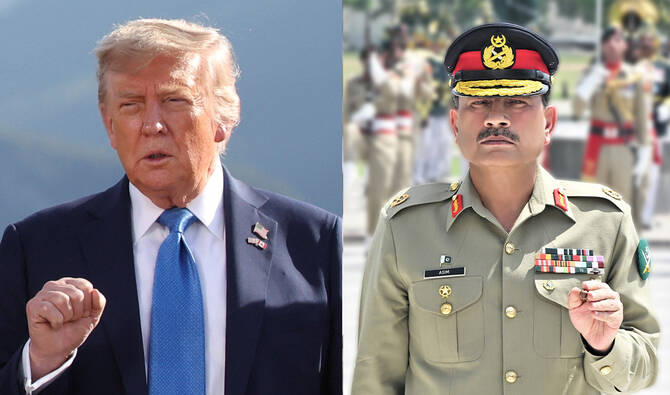
Trump calls Pakistan army chief ‘extremely influential’ ahead of White House luncheon

The collage of images created on June 18, 2025, shows US President Donald Trump (left) and Pakistan's Field Marshal General Syed Asim Munir. (AFP/ISPR/File)
Short Url
Updated 18 June 2025
Follow

Trump calls Pakistan army chief ‘extremely influential’ ahead of White House luncheon

  • Pakistan and the United States signal intent to rebuild ties after years of counterterrorism disagreements
  • This is the first time in years a Pakistani army chief is being hosted at the White House by a US President

ISLAMABAD: US President Donald Trump on Wednesday called Pakistan’s army chief “extremely influential,” crediting him with playing a major role in securing a ceasefire with India, shortly before a scheduled luncheon with Field Marshal Asim Munir.

The meeting comes amid heightened tensions in the Middle East and marks a rare direct engagement, signaling a cautious thaw in US-Pakistan relations under Trump’s second term.

This will be the first time in several years a Pakistani army chief is hosted by a sitting US president at the White House.

Both sides appear eager to rebuild military and economic cooperation after years of strained ties, largely over counter-terrorism disagreements.

“I love Pakistan,” Trump said when asked what he wanted to achieve diplomatically in the meeting with Pakistan’s army chief.

“This man [the army chief] was extremely influential in stopping it [the war] from the Pakistan side,” he added.

Trump also highlighted his role in the India-Pakistan ceasefire, saying that he prevented war between two nuclear powers.

Previously, he has hinted at a possible trade deal with Pakistan and India after helping broker a ceasefire between the nuclear-armed neighbors, following a deadly flare-up earlier this year.

Around 70 people were killed on both sides during the hostilities, which saw the exchange of missiles, drones and artillery fire. Pakistan said it shot down six Indian Air Force fighter jets, including three French-made Rafale aircraft.

The US has praised Pakistan’s leadership and reinstated military assistance previously suspended over concerns related to Afghanistan as part of Washington’s renewed outreach.

Islamabad, meanwhile, is also seeking to balance its deepening strategic partnership with China including arms supplies and defense infrastructure with broader engagement with the US.

Pakistan’s powerful military remains central to shaping its foreign and security policies.

The direct outreach to its top commander underscores Washington’s efforts to manage regional stability, including the fallout from the Taliban takeover in Afghanistan, recent cross-border tensions with India and the broader Israel-Iran escalation.

Security analysts say the meeting also signals a renewed US push to retain influence in a region where China is expanding its footprint through infrastructure investments and growing defense cooperation with Islamabad.

It remains unclear whether Trump will raise the Iran-Israel conflict with Munir, though Pakistan’s status as the world’s only nuclear-armed Muslim country and its shared border with Iran may factor into broader regional security discussions.


Pakistan says it seized 32 square kilometers inside Afghanistan as border clashes escalate

Updated 28 February 2026
Follow

Pakistan says it seized 32 square kilometers inside Afghanistan as border clashes escalate

  • Security official describes ‘limited tactical action’ in Gudwana after Afghan assaults
  • Islamabad accuses Kabul of sheltering militants as UN, China and Russia urge restraint

ISLAMABAD: Pakistan has seized a 32-square-kilometer area inside Afghanistan following overnight fighting, a security official said on Saturday, as cross-border clashes between the two countries escalated sharply.

A Pakistani security official, speaking on condition of anonymity, said troops carried out a “limited tactical action” in the Gudwana area opposite the Zhob sector along the frontier, capturing Afghan territory after responding to attacks on Pakistani positions.

“On the night of Feb. 26/27, posts opposite the Zhob sector launched anticipated physical attacks on multiple Pakistani positions,” the official said, referring to fighters linked to Afghanistan’s Taliban authorities, whom Islamabad identifies as Tehreek-e-Taliban Afghanistan (TTA).

“In response to aggressive unprovoked fire and physical attacks, Pakistan security forces launched a limited tactical action on the night of Feb. 27/28 in the general area of Gudwana with a view to capture TTA Tahir Post,” he continued, adding that 32 square kilometers of Afghan territory were seized.

The official said special combat teams crossed the border after preparatory bombardment, supported by intelligence, surveillance and reconnaissance assets providing “real-time battlefield awareness.”

He said 24 Afghan Taliban fighters were killed and 37 wounded, with no Pakistani casualties reported.

The claims could not be independently verified, and there was no immediate confirmation from Taliban authorities in Kabul of any territorial loss in the Gudwana area.

The latest clashes erupted after Pakistani airstrikes targeted what Islamabad described as militant hideouts inside Afghanistan over the weekend, triggering retaliatory fire along the frontier and sharply escalating long-running tensions. Islamabad accuses Kabul of sheltering Pakistani Taliban militants responsible for attacks inside Pakistan, an allegation that Afghanistan denies.

Pakistan’s Information Minister Attaullah Tarar said on Saturday evening that 352 Afghan Taliban fighters had been killed and more than 535 wounded since the latest phase of hostilities began.

Tarar said Pakistani strikes had destroyed 130 check posts, 171 tanks and armored vehicles and targeted 41 locations across Afghanistan by air. Those figures could not be independently verified.

The United Nations, as well as China and Russia, have called for restraint.

The United States said Pakistan has the right to defend itself against cross-border militancy.