


WASHINGTON: A powerful American bunker-busting bomb is the only weapon capable of destroying Iran’s deeply buried nuclear facilities, making it President Donald Trump’s weapon of choice if he chooses to militarily back Israel.
The GBU-57, a 30,000-pound (13,607 kg) warhead capable of penetrating 200 feet (61 meters) underground before exploding, is missing from Israel’s arsenal despite its stated goal of preventing Iran from building a nuclear bomb.
In less than a week, the Israeli army has taken out Iranian military commanders and damaged numerous surface installations, raising more questions than answers.
“The regime’s missile stockpiles, launchers, military bases, production facilities, nuclear scientists, military command and control has taken a very severe beating,” said Behnam Ben Taleblu, director of the Iran program at the Washington-based think tank Foundation for Defense of Democracies (FDD), a conservative-leaning group.
“But there are still outsized questions as to how efficacious of a strike Israel had against the beating hearts of Iran’s nuclear program,” Taleblu said.
The International Atomic Energy Agency (IAEA) has reported no damage at Fordo, a uranium enrichment plant south of Tehran. Unlike the Natanz and Isfahan sites in central Iran, Fordo is buried deep underground, beyond the reach of Israeli bombs.
“All eyes will be on Fordo, which is buried under about 300 feet of rock in central Iran,” Taleblu said.
Former US Army lieutenant general and Rand Corporation defense researcher Mark Schwartz insists that “only the United States has the conventional capacity” to destroy such a site.
And by “conventional capacity,” he means the non-nuclear GBU-57 bomb.
The US military says the GBU-57 – also named Massive Ordnance Penetrator – “is designed to penetrate up to 200 feet underground before exploding,” navigating through rock and concrete.
This differs from missiles or bombs that typically detonate their payload near or upon impact.
“To defeat these deeply buried targets, these weapons need to be designed with rather thick casings of steel, hardened steel, to sort of punch through these layers of rock,” said Masao Dahlgren, a fellow working on missile defense for the Center for Strategic and International Studies (CSIS), a Washington-based research center.
The 6.6-meter-long GBU-57 also has a specialized fuse because “you need an explosive that’s not going to immediately explode under that much shock and pressure,” Dahlgren said.
Design for this bomb began in the early 2000s, and an order for 20 units was placed with Boeing in 2009.
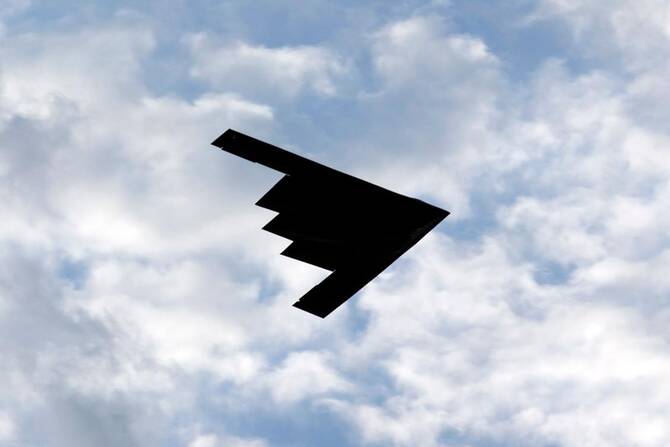
The only aircraft capable of deploying the GBU-57 is an American B-2 Bomber, a stealth aircraft.
Some of these bombers were deployed in early May on Diego Garcia, the site of a joint UK-US military base in the Indian Ocean, but were no longer visible by mid-June, according to AFP’s analysis of satellite imagery provided by Planet Labs.
With their long-range capabilities, B-2s departing from the United States “are able to fly all the way to the Middle East to do bombing runs. That’s been done before,” Dahlgren said.
Each B-2 can carry two GBU-57 bombs, and Schwartz said multiple bombs will likely be needed.
“They’re not going to just be one and done,” he said.
Schwartz added that the air superiority Israel has established over Iran reduces the risks faced by the B-2 bombers.
Such a US intervention would come with “a lot of political baggage for America,” Taleblu said, emphasizing that the bunker-buster bomb is not the only way to address Iran’s nuclear program.
Without the GBU-57 bombs, and short of a diplomatic solution, Taleblu said Israelis could attack access to underground complexes like Fordo by “trying to hit entrances, collapse what they can, cut electricity” and take other measures that have already been taken at Natanz.


