Four years with a company counts as loyalty in the modern job market, HR summit hears

1 / 2
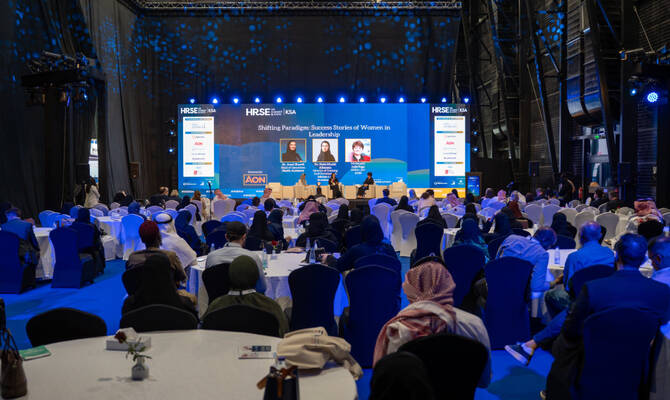
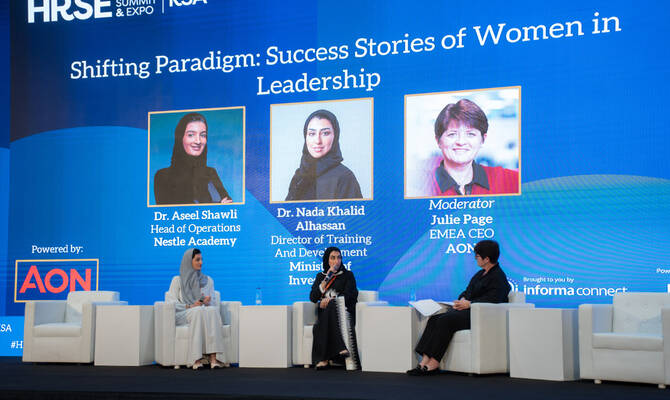
During the ‘Shifting Paradigm: Success Stories of Women in Leadership’ session, the Ministry of Investment’s Director of Training and Development Dr. Nada Al-Hassan and Nestlé Academy’s Head of Operations Dr. Aseel Shawli shared some transformative strategies for advancing inclusive leadership in the region at the Leaders Stage. (AN photo by Jaafer Alsaleh)
2 / 2
During the ‘Shifting Paradigm: Success Stories of Women in Leadership’ session, the Ministry of Investment’s Director of Training and Development Dr. Nada Al-Hassan and Nestlé Academy’s Head of Operations Dr. Aseel Shawli shared some transformative strategies for advancing inclusive leadership in the region at the Leaders Stage. (AN photo by Jaafer Alsaleh)
Short Url
Updated 18 June 2025
Follow

Four years with a company counts as loyalty in the modern job market, HR summit hears

  • Delegates at Human Resources Summit and Expo in Riyadh hear generational diversity and differing views on career progression are challenges that must be addressed
  • Experts discussed the effects of AI on the job market and explored strategies businesses need to adopt to ‘future-proof’ talent and navigate changing work landscapes

RIYADH: An employee who remains in the same role for four years is considered loyal in today’s job market, the audience at a human resources conference in Riyadh heard during a panel discussion on Tuesday.

The comment, at the Human Resources Summit and Expo, came from Syed Azharudin, director of learning and organizational development at logistical services company Ajex, who cited a recent study into workforce trends. Generational diversity is a factor that has to be addressed, he added.

“The biggest challenge for the HR industry is that you have different generations working together, like Gen X, baby boomers, millennials, Gen Z, and soon Gen Alpha, so you cannot have a blanket approach,” Azharudin said.

People from the most recent generations are more likely to be “job-hoppers,” he added; a study by global tech consultancy FDM Group found that Generation Z respondents were 13 per cent more likely than their non-Gen Z counterparts to view their current role as a stepping stone to a better career. 

In other sessions, HR experts discussed the effects of artificial intelligence on the job market, and explored the strategies companies need to adopt in their attempts to “future-proof” talent and navigate ever-changing work landscapes. As the rapidly evolving technology continues to dominate headlines, they considered a hot-button question: What would the future look like if human labor was replaced by AI?

“We’re not going to lose (our jobs) but we also need to make sure that we go efficiently and with innovative ways to utilize such tools,” said Eid Alkhaldi, succession management director at the Saudi Telcom Company.

During another discussion, Nada Al-Hassan, the Saudi Ministry of Investment’s director of training and development, spoke about ways to advance inclusive leadership in the region. 

“There are a lot of success stories and a lot of initiatives in all governmental sectors (in Saudi Arabia),” she said, highlighting in particular the Vision 2030 Human Resources Development Program and the Saudization program Tawteen.

The Human Resources Summit and Expo began on June 15 and continues until June 19.


Experimental farm in Al-Lith looks into future of Saudi Arabian agriculture

Updated 58 min 22 sec ago
Follow

Experimental farm in Al-Lith looks into future of Saudi Arabian agriculture

  • Research initiative reflects strategic transformation

JEDDAH: An experimental farm in Saudi Arabia’s Al-Lith Governorate is one of the research initiatives reflecting the strategic transformation taking place in the Kingdom’s agricultural sector.

The farm uses highly efficient, sustainable production models that combine scientific research with commercial application, contributing to strengthening the country’s food security system and the sustainability of water resources.

Located in the Ghumaiqa Center on an area of about 10 hectares, the cutting-edge farm is a testing platform for modern agricultural technologies that tackle the challenge of water scarcity.

The farm includes developed open fields and modern greenhouses, supported by smart irrigation encompassing drip and sprinkler irrigation alongside surface and subsurface technologies.

All the systems operate via smart controls that enable the monitoring of water consumption and ensure improved efficiency, thereby achieving a balance between agricultural production and water conservation.

The farm also uses treated and diluted low-salinity seawater.

It aims to diversify agricultural water sources, reduce reliance on freshwater, and open new horizons for agriculture in coastal and semi-arid environments.

The project represents a promising investment opportunity in the field of smart agriculture, enabling the development of commercially scalable production models, particularly for high-value vegetables and fruits, while reducing operational costs associated with water and energy, enhancing the economic feasibility of future agricultural projects.

In addition, the project contributes to transferring and localizing agricultural expertise, supporting local food supply chains, and creating an attractive environment for agricultural investment.

This aligns with Sustainable Development Goals and enhances the efficiency of the private sector in adopting innovative agricultural solutions.

Yahya bin Abdulrahman Al-Mahabi, the director of the Ministry of Environment, Water and Agriculture office in Al-Lith Governorate, told the Saudi Press Agency that the project represented the future of agriculture in the Kingdom.

He explained that the vision was based on investing in technology, enhancing the return on water per unit, and integrating scientific research with investment opportunities.

Al-Mahabi spoke of the experimental farm as a modern, scalable and replicable model applicable in several regions of the Kingdom, particularly in coastal environments.

Al-Mahabi highlighted the Ministry of Environment, Water and Agriculture’s commitment to supporting distinctive projects that contributed to achieving food security while developing rural areas and enhancing agricultural production efficiency, in line with the objectives of the Kingdom’s Vision 2030.