Spain says April power outage caused by ‘overvoltage’

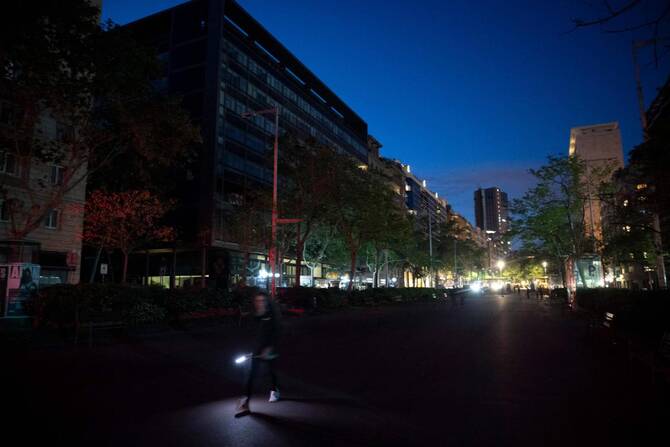
A pedestrian uses a flashlight to walk in a street of Barcelona, without electricity, following a massive power cut affecting the entire Iberian peninsula and the south of France, on Apr. 28, 2025. (AFP/File)
Short Url
Updated 17 June 2025
Follow

Spain says April power outage caused by ‘overvoltage’

  • Ecological Transition Minister Sara Aagesen said the system “lacked sufficient voltage control capacity” that day
  • Authorities have been scrambling to find answers after the April 28 outage

MADRID: A major power outage that struck the Iberian Peninsula in April was caused by “overvoltage” on the grid that led to “a chain reaction,” according to a government report released Tuesday.

The blackout had “multiple” causes, Ecological Transition Minister Sara Aagesen told reporters following a cabinet meeting, adding the system “lacked sufficient voltage control capacity” that day.

Overvoltage is when there is too much electrical voltage in a network, overloading equipment. It can be caused by surges in networks due to oversupply or lightning strikes, or when protective equipment is insufficient or fails.

When faced with overvoltage on networks protective systems shut down parts of the grid, potentially leading to widespread power outages.

Authorities have been scrambling to find answers after the April 28 outage cut Internet and telephone connections, halted trains, shut businesses and plunged cities into darkness across Spain and Portugal as well as briefly affecting southwestern France.

Spanish Prime Minister Pedro Sanchez announced the formation of an inquiry commission led by the Ecological Transition Ministry shortly after the blackout, urging residents not to speculate until detailed results were available.

He had warned that the probe’s conclusions could take several months, given the complexity of the incident.

Aagesen singled out the role of the Spanish grid operator REE and certain energy companies she did not name which disconnected their plants “inappropriately... to protect their installations.”

She also pointed to “insufficient voltage control capacity” on the system that day, due in part to a programming flaw, stressing that Spain’s grid is theoretically robust enough to handle such situations.

Due to these misjudgments “we reached a point of no return with an uncontrollable chain reaction” that could only have been controlled if steps had been taken beforehand to absorb the overvoltage problems, she added.


Italian police fire tear gas as protesters clash near Winter Olympics hockey venue

Updated 08 February 2026
Follow

Italian police fire tear gas as protesters clash near Winter Olympics hockey venue

  • Police vans behind a temporary metal fence secured the road to the athletes’ village, but the protest veered away, continuing on a trajectory toward the Santagiulia venue

MILAN: Italian police fired tear gas and a water cannon at dozens of protesters who threw firecrackers and tried to access a highway near a Winter Olympics venue on Saturday.
The brief confrontation came at the end of a peaceful march by thousands against the environmental impact of the Games and the presence of US agents in Italy.
Police held off the violent demonstrators, who appeared to be trying to reach the Santagiulia Olympic ice hockey rink, after the skirmish. By then, the larger peaceful protest, including families with small children and students, had dispersed.
Earlier, a group of masked protesters had set off smoke bombs and firecrackers on a bridge overlooking a construction site about 800 meters (a half-mile) from the Olympic Village that’s housing around 1,500 athletes.
Police vans behind a temporary metal fence secured the road to the athletes’ village, but the protest veered away, continuing on a trajectory toward the Santagiulia venue. A heavy police presence guarded the entire route.
There was no indication that the protest and resulting road closure interfered with athletes’ transfers to their events, all on the outskirts of Milan.
The demonstration coincided with US Vice President JD Vance’s visit to Milan as head of the American delegation that attended the opening ceremony on Friday.
He and his family visited Leonardo da Vinci’s “The Last Supper” closer to the city center, far from the protest, which also was against the deployment of US Immigration and Customs Enforcement agents to provide security to the US delegation.
US Homeland Security Investigations, an ICE unit that focuses on cross-border crimes, frequently sends its officers to overseas events like the Olympics to assist with security. The ICE arm at the forefront of the immigration crackdown in the US is known as Enforcement and Removal Operations, and there is no indication its officers are being sent to Italy.
At the larger, peaceful demonstration, which police said numbered 10,000, people carried cardboard cutouts to represent trees felled to build the new bobsled run in Cortina. A group of dancers performed to beating drums. Music blasted from a truck leading the march, one a profanity-laced anti-ICE anthem.
“Let’s take back the cities and free the mountains,” read a banner by a group calling itself the Unsustainable Olympic Committee. Another group called the Association of Proletariat Excursionists organized the cutout trees.
“They bypassed the laws that usually are needed for major infrastructure project, citing urgency for the Games,” said protester Guido Maffioli, who expressed concern that the private entity organizing the Games would eventually pass on debt to Italian taxpayers.
Homemade signs read “Get out of the Games: Genocide States, Fascist Police and Polluting Sponsors,” the final one a reference to fossil fuel companies that are sponsors of the Games. One woman carried an artificial tree on her back decorated with the sign: “Infernal Olympics.”
The demonstration followed another last week when hundreds protested the deployment of ICE agents.
Like last week, demonstrators Saturday said they were opposed to ICE agents’ presence, despite official statements that a small number of agents from an investigative arm would be present in US diplomatic territory, and not operational on the streets.