

US forces still in ‘defensive posture’ in Middle East: White House

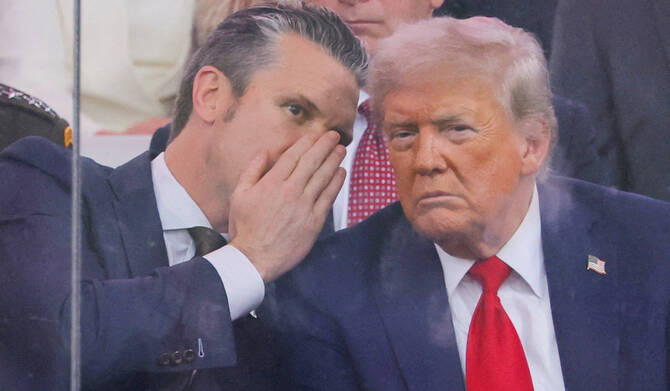
U.S. Secretary of Defense Pete Hegseth talks to U.S. President Donald Trump during the U.S. Army's 250th Birthday parade, on the same day of U.S. President Donald Trump 79th birthday, in Washington, D.C., U.S., June 14, 2025. (REUTERS)
Short Url
Updated 18 June 2025
Follow

US forces still in ‘defensive posture’ in Middle East: White House

  • “We will defend American interests,” White House spokesperson Alex Pfeiffer added in a post on social media

WASHINGTON: The White House insisted Monday evening that US forces remained in a “defensive” posture in the Middle East, despite a military buildup over the Israel-Iran war and a shock warning from President Donald Trump to evacuate Tehran.

Trump’s brief warning on social media, without further details, raised speculation that the United States may be readying to join Israel in attacking Iran.

Those suspicions rose further after it was announced that Trump would be leaving a G7 summit in Canada and returning to the White House a day early over the mounting Middle East conflict.

But White House and Pentagon officials reiterated that US forces in the region remained in a “defensive” posture.

White House spokesperson Alex Pfeiffer, replying to a post on social media that claimed the United States was attacking in Iran, said: “This is not true.”

“American forces are maintaining their defensive posture, and that has not changed,” he said.

Pentagon Chief Pete Hegseth similarly told Fox News in a televised interview that “we are postured defensively in the region, to be strong, in pursuit of a peace deal, and we certainly hope that’s what happens here.”

Earlier in the day, Hegseth had announced that he had “directed the deployment of additional capabilities” over the weekend to the Middle East.

“Protecting US forces is our top priority and these deployments are intended to enhance our defensive posture in the region,” he wrote on X.

His post on social media came after the aircraft carrier USS Nimitz was tracked leaving Southeast Asia on Monday, and amid reports that dozens of US military aircraft were heading across the Atlantic.

A US defense official, speaking on condition of anonymity, confirmed that Hegseth had ordered the Nimitz Carrier Strike Group to the Middle East, saying it was “to sustain our defensive posture and safeguard American personnel.”

The movement of one of the world’s largest warships came on day four of the escalating air war between Israel and Iran, with no end in sight despite international calls for de-escalation.


Trump warns Iran of ‘very traumatic’ outcome if no nuclear deal

Updated 12 February 2026
Follow

Trump warns Iran of ‘very traumatic’ outcome if no nuclear deal

  • Speaking a day after he hosted Netanyahu at the White House, Trump said he hoped for a result “over the next month”

WASHINGTON: US President Donald Trump threatened Iran Thursday with “very traumatic” consequences if it fails to make a nuclear deal — but Israeli Prime Minister Benjamin Netanyahu said he was skeptical about the quality of any such agreement.
Speaking a day after he hosted Netanyahu at the White House, Trump said he hoped for a result “over the next month” from Washington’s negotiations with Tehran over its nuclear program.
“We have to make a deal, otherwise it’s going to be very traumatic, very traumatic. I don’t want that to happen, but we have to make a deal,” Trump told reporters.
“This will be very traumatic for Iran if they don’t make a deal.”
Trump — who is considering sending a second aircraft carrier to the Middle East to pressure Iran — recalled the US military strikes he ordered on Tehran’s nuclear facilities during Israel’s 12-day war with Iran in July last year.
“We’ll see if we can get a deal with them, and if we can’t, we’ll have to go to phase two. Phase two will be very tough for them,” Trump said.
Netanyahu had traveled to Washington to push Trump to take a harder line in the Iran nuclear talks, particularly on including the Islamic Republic’s arsenal of ballistic missiles.
But the Israeli and US leaders apparently remained at odds, with Trump saying after their meeting at the White House on Wednesday that he had insisted the negotiations should continue.

- ‘General skepticism’ -

Netanyahu said in Washington on Thursday before departing for Israel that Trump believed he was laying the ground for a deal.
“He believes that the conditions he is creating, combined with the fact that they surely understand they made a mistake last time when they didn’t reach an agreement, may create the conditions for achieving a good deal,” Netanyahu said, according to a video statement from his office.
But the Israeli premier added: “I will not hide from you that I expressed general skepticism regarding the quality of any agreement with Iran.”
Any deal “must include the elements that are very important from our perspective,” Netanyahu continued, listing Iran’s ballistic missile program and its support for armed groups such as the Palestinian movement Hamas, Yemen’s Houthi rebels and Hezbollah in Lebanon.
“It’s not just the nuclear issue,” he said.
Despite their differences on Iran, Trump signaled his strong personal support for Netanyahu as he criticized Israeli President Isaac Herzog for rejecting his request to pardon the prime minister on corruption charges.
“You have a president that refuses to give him a pardon. I think that man should be ashamed of himself,” Trump said on Thursday.
Trump has repeatedly hinted at potential US military action against Iran following its deadly crackdown on protests last month, even as Washington and Tehran restarted talks last week with a meeting in Oman.
The last round of talks between the two foes was cut short by Israel’s war with Iran and the US strikes.
So far, Iran has rejected expanding the new talks beyond the issue of its nuclear program. Tehran denies seeking a nuclear weapon, and has said it will not give in to “excessive demands” on the subject.