
ISLAMABAD: Pakistan’s largest and richest Punjab province on Monday unveiled its Rs5.33 trillion [$18.9 billion] budget for the fiscal year 2025-26, increasing its development spending by 47% and refraining from imposing new taxes on the masses.
Punjab, home to more than half of Pakistan’s over 240 million people, plays a dominant role in the national economy. It contributes roughly 60% to Pakistan’s gross domestic product and receives the largest share of federal funds under the National Finance Commission (NFC) Award.
Last year, Punjab’s budget for FY2024–25 was about $19.6 billion, with a development outlay of $3 billion. Punjab’s budget is seen as politically significant for the ruling Pakistan Muslim League-Nawaz (PML-N) party of Prime Minister Shehbaz Sharif, which has faced tough economic and governance challenges since forming its government at the center last year.
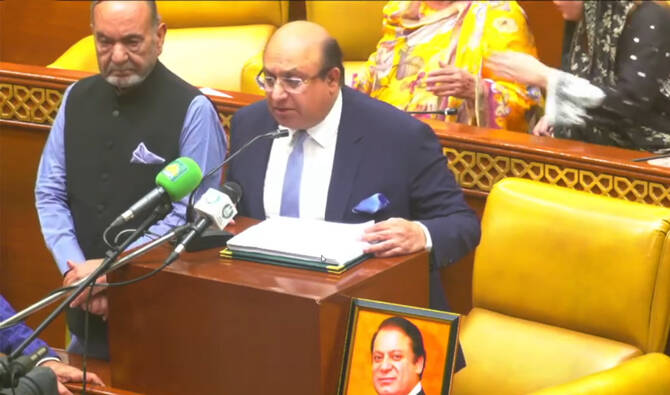
“The total outlay for [Punjab’s] 2025-2026 budget is Rs5,335 billion [$19.2 billion],” Punjab Finance Minister Mujtaba Shuja-ur-Rehman said while presenting the budget in the provincial assembly.
Rehman said the provincial government was presenting a “record-breaking development budget” this time.
“For which the total amount recommended is Rs1,240 billion [$4.36 billion], which is more than 47% compared to the current financial year,” he added.
The minister said the FY26 budget did not contain any new taxes on the masses, adding that the government wanted to widen the tax net to increase revenue.
Punjab’s own-source revenue is projected at Rs828.1 billion ($2.94 billion), including Rs524.7 billion ($1.86 billion) in tax receipts and Rs303.4 billion ($1.08 billion) in non-tax receipts.
According to budget documents seen by Arab News, the Federal Board of Revenue (FBR) has set a national target of Rs14,131 billion ($50.11 billion), with Punjab’s share estimated at Rs4,062.2 billion ($14.4 billion).
Rehman said the province has proposed a significant increase in education and health budgets to benefit the people of Punjab.
HEALTH, EDUCATION BUDGETS
“The total allocation for the education sector is Rs811.8 billion ($2.88 billion), which is 21% higher than last year, where development allocation stands at Rs148.5 billion ($526 million), the highest in the province’s history and 127% higher than the previous year,” he said.
He said Punjab would launch new education projects while continuing existing ones, allocating Rs15 billion ($53 million) for scholarships for high-achieving students and continuing with its Rs5.9 billion ($21 million) Undergraduate Scholarship Programme.
“To address infrastructure needs, Rs40 billion ($142 million) is set aside for building classrooms, while a Rs35 billion ($124 million) Education Delivery Programme aims to enhance access and quality across Punjab,” Rehman said.
The minister said the provincial government has allocated Rs630.5 billion ($2.24 billion) for the health sector in this budget, which is 17% higher than last year.
“Of this, Rs181 billion ($641 million) is earmarked for development, reflecting a 41% increase over the previous year,” Rehman said.
The minister said Punjab had allocated Rs494 billion ($1.75 billion) for the social sector, which accounted for 40% of the development budget.
Rehman said provincial government employees’ salaries would be increased by 10%, while pensions have been raised by 5% and the proposed increase in the minimum wage is from Rs37,000 ($131) to Rs40,000 ($142) per month.
The minister said that the new budget has given special priority to Pakistan’s agriculture sector.
“In the next financial year, Rs123 billion ($436 million) are allocated for development in the agriculture, livestock, irrigation, and water sectors, while Rs56.2 billion ($199 million) is allocated for non-development expenses,” he said.
The provincial minister said to ensure a climate-resilient Punjab, a record Rs795 billion (approximately $2.82 billion) worth of projects were included in the budget this year, accounting for 64% of the overall development budget.
Pakistan’s top revenue-generating Sindh province last Friday unveiled its Rs3.45 trillion ($12.41 billion) new budget while the northwestern Khyber Pakhtunkhwa (KP) province announced a surplus budget of Rs2,119 billion ($7.63 billion) for the next year on the same day.