

Filipino grandfather’s sidewalk library sparks reading mission — one book at a time

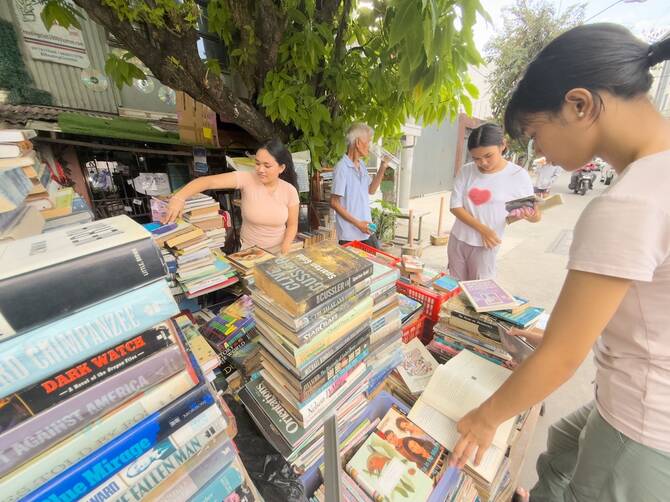
Students browse books at Reading Club 2000, a sidewalk library run by Hernando Guanlao in Makati City, in the Philippines, on June 8, 2025. (AN photo)
Short Url
Updated 16 June 2025
Follow

Filipino grandfather’s sidewalk library sparks reading mission — one book at a time

  • Hernando Guanlao started the library in front of his home in Makati City
  • It has no membership fee, no rules, and no late return penalties

MANILA: Hernando Guanlao had just 50 books when in 2000, on a mission to encourage more people to read, he set out a sidewalk display. A quarter of a century later, the collection has grown to include thousands of volumes and a roadside library that is free and open to all, at all times.

Located in Barangay La Paz in Makati City, the Philippines’ main financial district, Reading Club 2000 greets passersby with the sign: “A good book is easy to find.”

Affectionately known as Tatay Nanie, Guanlao keeps books on the shelves in front of his house, on the ground floor and in his driveway, making them accessible to anyone looking for something to read. His vast collection ranges from fiction and non-fiction books to religious texts, academic theses, encyclopedias, dictionaries, children’s literature and magazines, as well as self-help and textbooks.

The library is open 24/7, has no rules, no membership fee, and no late return penalties. If a reader fails to return a book, it is no problem — more will soon arrive in its place.

“A lot of books came over here from donations, delivered personally by people from different kinds of economic groups — individuals who still love (and) value printed words, love what they learnt from reading. They share it. They become givers,” Guanlao told Arab News.

In the past, when Reading Club 2000 was still small and he started running out of books, there would always be people offering support — something that for him is intrinsically Filipino.

“I’m not alone. I was able to generate participation of the community,” he said. “The donors are reminded of our culture. Filipinos have different cultures: In Ilocos, they have the Ilocano culture; in Bicol, the Bicolano culture ... But there’s one (common) thing: They are heroes, the givers. They have that in their hearts.”

Those who borrow a book from the sidewalk library usually return. Most are surprised Guanlao’s books are all available free of charge.

But the 75-year-old bibliophile does not see himself as the owner of the books; rather, he their custodian, on a mission he hopes his children and grandchildren will continue.

He has not counted how many books have come through the library over the past 25 years but estimates that each day at least 200 leave — some never to return.

“These books are not mine. These are entrusted to me by a lot of book donors. I have to take care of the distribution of the books ... (to) readers that will contribute and be a force of change in the society,” he said.

“Reading is liberating ... As you read, you learn and learn and learn. And when you learn, you discuss and discuss and discuss. You are not alone in doing that ... You will (find) the answer you’re looking for in life — the purpose of why you are here.”


Palestinian woman hospitalized following seizure in US ICE detention

Updated 9 sec ago
Follow

Palestinian woman hospitalized following seizure in US ICE detention

  • Kordia, a 33-year-old Muslim Palestinian woman living in the US and whose ‌mother is an ‌American citizen, was detained by US immigration ‌authorities ⁠early ​last year

WASHINGTON: A Palestinian woman, who lost dozens of family members in the Gaza war, has ​been hospitalized following a seizure in US immigration detention, the Department of Homeland Security said on Monday.
On February 6, 2026, at about 8:45 p.m., “medical staff at the Prairieland Detention Center in Alvarado, Texas, notified ICE that detainee Leqaa Kordia was admitted to Texas Health Huguley Hospital in Burleson, Texas, for further evaluation following a seizure,” a DHS spokesperson said.
Kordia, a 33-year-old Muslim Palestinian woman living in the US and whose ‌mother is an ‌American citizen, was detained by US immigration ‌authorities ⁠early ​last year.
She ‌was detained during a meeting with immigration officials at the Newark Immigration and Customs Enforcement Field Office, where she was accompanied by her attorney. At the time of her detention last year, Kordia was in the process of securing legal residency.
In a weekend statement cited by media, her family and legal team said they have not received communication from US authorities about her ⁠health. The family could not immediately be reached for comment. DHS says ICE will ensure ‌she receives proper medical care.
Rights groups have long ‍reported on detainee complaints about conditions ‍in ICE detention facilities, calling the conditions inhumane. The federal government ‍has denied treating detainees inhumanely.
Amnesty International says 175 members of Kordia’s family have been killed during Israel’s assault on Gaza since late 2023 following an attack by militant group Hamas.
The Homeland Security Department says Kordia, who was raised in the ​Israeli-occupied West Bank, was arrested for immigration violations related to overstaying her expired student visa. The DHS also says she was ⁠arrested by local authorities in 2024 during pro-Palestinian protests at Columbia University that the department cast as being supportive of Hamas.
Kordia and other protesters, including some Jewish groups, say the government wrongly equates criticism of Israel’s assault on Gaza and its occupation of Palestinian territories with antisemitism, and advocacy for Palestinian rights with support for extremism.
Kordia has said she was targeted for pro-Palestinian activism and cast the conditions in her detention facility as “filthy, overcrowded and inhumane.”
President Donald Trump’s administration cracked down on pro-Palestinian protests by threatening to freeze federal funds for universities where protests occurred and by attempting to deport ‌foreign protesters. It has faced legal obstacles while rights advocates say the crackdown hurts free speech and lacks due process.