

Iran says parliament is preparing bill to leave nuclear non-proliferation treaty

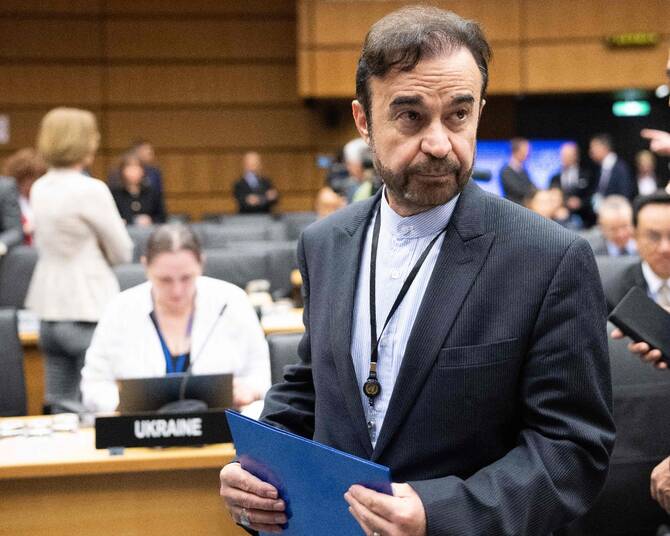
Iran’s ambassador Reza Najafi attends the IAEA’s Board of Governors meeting at the agency's headquarters in Vienna, Austria. (AFP)
Short Url
Updated 16 June 2025
Follow

Iran says parliament is preparing bill to leave nuclear non-proliferation treaty

DUBAI: Iranian parliamentarians are preparing a bill that could push Tehran toward exiting the nuclear Non-Proliferation Treaty the foreign ministry said on Monday, while reiterating Tehran’s official stance against developing nuclear weapons.
“In light of recent developments, we will take an appropriate decision. Government has to enforce parliament bills but such a proposal is just being prepared and we will coordinate in the later stages with parliament,” the ministry’s spokesperson Esmaeil Baghaei said, when asked at a press conference about Tehran potentially leaving the NPT.
The NPT, which Iran ratified in 1970, guarantees countries the right to pursue civilian nuclear power in return for requiring them to forego atomic weapons and cooperate with the UN nuclear watchdog, the IAEA.

Israel began bombing Iran last week, saying Tehran was on the verge of building a nuclear bomb. Iran has always said its nuclear program is peaceful, although the IAEA declared last week that Tehran was in violation of its NPT obligations.
President Masoud Pezeshkian reiterated on Monday that nuclear weapons were against a religious edict by Supreme Leader Ayatollah Ali Khamenei.
Iran’s state media said that no decision on quitting the NPT had yet been made by parliament, while a parliamentarian said that the proposal was at the initial stages of the legal process.
Baghaei said that developments such as Israel’s attack “naturally affect the strategic decisions of the state,” noting that Israel’s attack had followed the IAEA resolution, which he suggested was to blame.
“Those voting for the resolution prepared the ground for the attack,” Baghaei said.
Israel, which never joined the NPT, is widely assumed by regional governments to possess nuclear weapons, although it does not confirm or deny this.
“The Zionist regime is the only possessor of weapons of mass destruction in the region,” Baghaei said.


Israel aims to ensure more Palestinians are let out of Gaza than back in

Updated 4 sec ago
Follow

Israel aims to ensure more Palestinians are let out of Gaza than back in

  • It was still not clear how Israel planned to enforce limits on the number of Palestinians entering Gaza from Egypt
  • Sources said Israeli officials had insisted on setting up a military checkpoint in Gaza to screen Palestinians moving in and out

TEL AVIV: Israel wants to restrict the number of Palestinians entering Gaza through the border crossing with Egypt to ensure that more are allowed out than in, three sources briefed on the matter said ahead of the border’s expected opening next week.
The head of a transitional Palestinian committee backed by the US to temporarily administer Gaza, Ali Shaath, announced on Thursday that the Rafah Border Crossing — effectively the sole route in or out of Gaza for nearly all of the more than 2 million people who live there — would open next week.
The border was supposed to have opened during the initial phase of President Donald Trump’s plan to end the war, under a ceasefire reached in October between Israel and Hamas.
Earlier this month, Washington announced that the plan had now moved into the second phase, under which Israel is expected to withdraw troops further from Gaza ⁠and Hamas is due to yield control of the territory’s administration. The Gaza side of the crossing has been under Israeli military control since 2024.
The three sources, who spoke on condition of anonymity due to the sensitivity of the issue, said it was still not clear how Israel planned to enforce limits on the number of Palestinians entering Gaza from Egypt, or what ratio of exits to entries it aimed to achieve.
Israeli officials have spoken in the past about encouraging Palestinians to emigrate from Gaza, although they deny intending to transfer the population out by force. Palestinians ⁠are highly sensitive to any suggestion that Gazans could be expelled, or that those who leave temporarily could be barred from returning.
The Rafah Crossing is expected to be staffed by Palestinians affiliated with the Ramallah-based Palestinian Authority and monitored by EU personnel, as took place during an earlier, weeks-long ceasefire between Israel and Hamas early last year.
The Israeli prime minister’s office did not immediately respond to a request for comment for this story. The military referred questions to the government, declining to comment.
The three sources said that Israel also wants to establish a military checkpoint inside Gaza near the border, through which all Palestinians entering or leaving would be required to pass and be subjected to Israeli security checks.
Two other sources also said that Israeli officials had insisted on setting up a military checkpoint in Gaza to screen Palestinians moving in and out.
The US Embassy in ⁠Israel did not immediately respond to a request for comment on whether Washington supported Israel in limiting the number of Palestinians entering Gaza or setting up a checkpoint to screen those entering and leaving.
Under the initial phase of Trump’s plan, the Israeli military partially pulled back its forces within Gaza but retained control of 53 percent of the territory including the entire land border with Egypt. Nearly all of the territory’s population lives in the rest of Gaza, under Hamas control and mostly in makeshift tents or damaged buildings.
The sources said that it was not clear how individuals would be dealt with if they were blocked by Israel’s military from passing through its checkpoint, particularly those entering from Egypt.
The Israeli government has repeatedly objected to the opening of the border, with some officials saying Hamas must first return the body of an Israeli police officer held in Gaza, the final human remains of a hostage due to be transferred under the ceasefire’s first phase.
US officials in private say that Washington, not Israel, is driving the rollout of the president’s plan to end the war.