Police break up Nigeria protest as anger mounts over killings in southern state

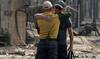
Villagers bury the dead victims of Friday night's massacre in the Yelewata in Nigeria's state of Benue. (Photo courtesy of Amnesty International)
Short Url
Updated 16 June 2025
Follow

Police break up Nigeria protest as anger mounts over killings in southern state

  • Gunmen attacked the village of Yelewata in Benue state, killiing over 100, according to Amnesty International
  • Pope Leo XIV condemned the killings, in comments during his Sunday prayer in Rome, calling it a “terrible massacre”

JOS, Nigeria: Police fired tear gas to disperse protesters in the central city of Makurdi on Sunday, as anger mounted over the killing of dozens of people by gunmen in a nearby town.
Gunmen attacked the village of Yelewata on Friday night in a region that has seen a surge in violence amid clashes between Muslim Fulani herders and mostly Christian farmers competing for land and resources.
Police fired tear gas to break up a protest by thousands of people, witnesses said, as demonstrators called on the state’s governor to act swiftly to halt the cycle of violence.
“The protesters were given specific time by the security to make their peaceful protest and disperse,” Tersoo Kula, spokesperson for Benue state’s governor, told AFP.
John Shiaondo, a local journalist, said he was covering the “peaceful protest” when the police moved in and started firing tear gas.
“Many people ran away for fear of injuries, and I also left the scene for my safety,” he told AFP.
Joseph Hir, who took part in the protest, said people were protesting the killings in Benue when the police intervened.
“We are not abusing anyone, we are also not tampering with anybody’s property, we are discharging our rights to peacefully protest the unabated killings of our people, and now the police are shooting tear gas at us,” he told AFP.

Benue state governor Hyacinth Alia told a news conference late Sunday that the death toll had reached 59 in Yelewata, though residents said the toll could exceed 100.
“We will move very quickly to set up a five-man panel... to enable us find out who the culprits are, to know who the sponsors are and to identify the victims and to see how justice will be applied,” Alia said.
Amnesty International put the death toll at more than 100.
The rights group called the attack “horrifying,” saying it “shows the security measures (the) government claims to be implementing in the state are not working.”
Pope Leo XIV also condemned the killings, in comments during his Sunday prayer in Rome, calling it a “terrible massacre” in which mostly displaced civilians were murdered with “extreme cruelty.”
He said “rural Christian communities” in Benue were victims of incessant violence.
Authorities typically blame such attacks on Fulani herders but the latter say they are targets of violence and land seizures too.
Nigerian President Bola Ahmed Tinubu said in a statement Sunday night he had “directed the security agencies to act decisively and arrest perpetrators of these evil acts on all sides of the conflict and prosecute them.
“Political and community leaders in Benue State must act responsibly and avoid inflammatory utterances that could further increase tensions and killings,” he said.
Governor Alia said earlier that “tactical teams had begun arriving from the federal government and security reinforcements are being deployed in vulnerable areas.”
“The state’s joint operational units are also being reinforced, and the government will not let up its efforts to defend the lives and property of all residents,” he said.
Attacks in the region, part of what is known as the central belt of Nigeria, are often motivated by religious or ethnic differences.
Two weeks ago, gunmen killed 25 people in two attacks in Benue state.
More than 150 people were killed in massacres across Plateau and Benue states in April.


Trump pays respects to 2 Iowa National Guardsmen and interpreter killed in Syria as they return home

Updated 5 sec ago
Follow

Trump pays respects to 2 Iowa National Guardsmen and interpreter killed in Syria as they return home

  • The two guardsmen killed in Syria on Saturday were Sgt. Edgar Brian Torres-Tovar, 25, of Des Moines, and Sgt. William Nathaniel Howard, 29, of Marshalltown, according to the US Army

DOVER AIR FORCE BASE, Delaware: President Donald Trump on Wednesday paid his respects to two Iowa National Guard members and a US civilian interpreter who were killed in an attack in the Syrian desert, joining their grieving families as their remains were brought back to the country they served.
Trump met privately with the families at Dover Air Force Base in Delaware before the dignified transfer, a solemn ritual conducted in honor of US service members killed in action. The civilian was also included in the transfer.
Trump, who traveled to Dover several times in his first term, once described it as “the toughest thing I have to do” as president.
The two guardsmen killed in Syria on Saturday were Sgt. Edgar Brian Torres-Tovar, 25, of Des Moines, and Sgt. William Nathaniel Howard, 29, of Marshalltown, according to the US Army. Both were members of the 1st Squadron, 113th Cavalry Regiment, and have been hailed as heroes by the Iowa National Guard.
Torres-Tovar’s and Howard’s families were at Dover for the return of their remains, alongside Iowa Gov. Kim Reynolds, members of Iowa’s congressional delegation and leaders of the Iowa National Guard. Their remains will be taken to Iowa after the transfer.
A US civilian working as an interpreter, identified Tuesday as Ayad Mansoor Sakat, of Macomb, Michigan, was also killed. Three other members of the Iowa National Guard were injured in the attack. The Pentagon has not identified them.
They were among hundreds of US troops deployed in eastern Syria as part of a coalition fighting the Daesh group.
The process of returning service member remains
There is no formal role for a president at a dignified transfer other than to watch in silence, with all thoughts about what happened in the past and what is happening at Dover kept to himself for the moment. There is no speaking by any of the dignitaries who attend, with the only words coming from the military officials who direct the highly choreographed transfers.
Trump arrived without first lady Melania Trump, who had been scheduled to accompany him, according to the president’s public schedule. Her office declined to elaborate, with spokesperson Nick Clemens saying the first lady “was not able to attend today.”
During the process at Dover, transfer cases draped with the American flag that hold the soldiers’ remains are carried from the belly of a hulking C-17 military aircraft to a waiting vehicle under the watchful eyes of grieving family members. The vehicle then transports the remains to the mortuary facility at the base, where the fallen are prepared for burial at their final resting places.
Iowa National Guard members hailed as heroes
Howard’s stepfather, Jeffrey Bunn, has said Howard “loved what he was doing and would be the first in and last out.” He said Howard had wanted to be a soldier since he was a boy.
In a social media post, Bunn, who is chief of the Tama, Iowa, police department, said Howard was a loving husband and an “amazing man of faith.” He said Howard’s brother, a staff sergeant in the Iowa National Guard, would escort “Nate” back to Iowa.
Torres-Tovar was remembered as a “very positive” family-oriented person who always put others first, according to fellow Guard members who were deployed with him and issued a statement to the local TV broadcast station WOI.
Dina Qiryaqoz, the daughter of the civilian interpreter who was killed, said Wednesday in a statement that her father worked for the US Army during the invasion of Iraq from 2003 to 2007. Sakat is survived by his wife and four adult children.
The interpreter was from Bakhdida, Iraq, a small Catholic village southeast of Mosul, and the family immigrated to the US in 2007 on a special visa, Qiryaqoz said. At the time of his death, Sakat was employed as an independent contractor for Virginia-based Valiant Integrated Services.
Sakat’s family was still struggling to believe that he is gone. “He was a devoted father and husband, a courageous interpreter and a man who believed deeply in the mission he served,” Qiryaqoz said.
Trump’s reaction to the attack in Syria
Trump told reporters over the weekend that he was mourning the deaths. He vowed retaliation. The most recent instance of US service members killed in action was in January 2024, when three American troops died in a drone attack in Jordan.
Saturday’s deadly attack followed a rapprochement between the US and Syria, bringing the former pariah state into a US-led coalition fighting the Daesh group.
Trump has forged a relationship with interim Syrian President Ahmed Al-Sharaa, the onetime leader of an Islamic insurgent group who led the ouster of former President Bashar Assad.
Trump, who met with Al-Sharaa last month at the White House, said Monday that the attack had nothing to do with the Syrian leader, who Trump said was “devastated by what happened.”
During his first term, Trump visited Dover in 2017 to honor a US Navy SEAL killed during a raid in Yemen, in 2019 for two Army officers whose helicopter crashed in Afghanistan, and in 2020 for two Army soldiers killed in Afghanistan when a person dressed in an Afghan army uniform opened fire.