

After day of nationwide protests, Trump’s military parade rolls through US capital

1 / 4
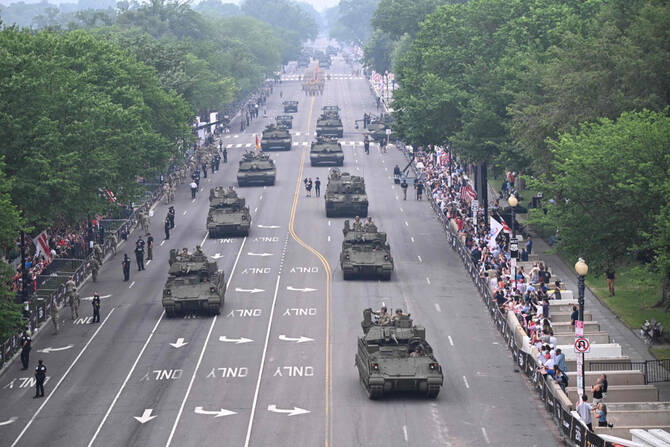
Armored vehicles drive during the Army 250th Anniversary Parade in Washington, DC on June 14, 2025. (AFP)
2 / 4
A US Army C-47 Skytrain and P-51 flyover during the Army 250th Anniversary Parade in Washington, DC, on June 14, 2025. (AFP)
3 / 4
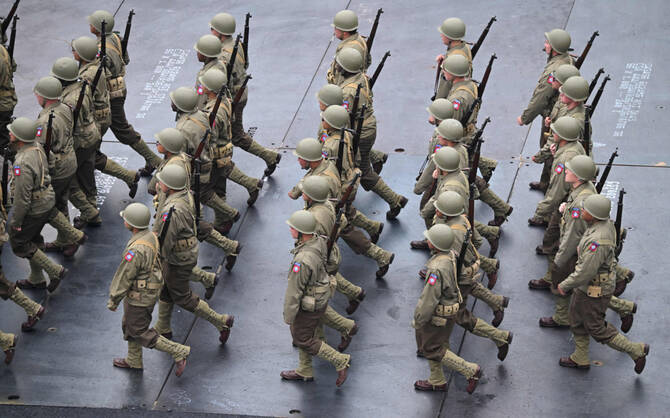
Airborne soldiers wearing period uniforms march during the Army 250th Anniversary Parade in Washington, DC on June 14, 2025. (AFP)
4 / 4
The Army’s Golden Knights parachute demonstration and competition team parachute onto the Ellipse during the Army 250th Anniversary Parade in Washington, DC, on June 14, 2025. (AFP)
Short Url
Updated 15 June 2025
Follow

After day of nationwide protests, Trump’s military parade rolls through US capital

  • Largest outpouring of protests against Trump since his return to power
  • Military parade brings tanks, troops to streets of Washington

WASHINGTON/LOS ANGELES/CHICAGO: President Donald Trump’s long-sought military parade rolled though the streets of downtown Washington on Saturday, but the celebration of the US Army’s 250th anniversary was marred by a day of violence and discord.

In the hours before the parade began, hundreds of thousands of Americans marched and rallied in streets in cities from New York to Chicago to Los Angeles, protesting Trump’s actions while in office, in the largest such actions since his return to power in January.

Earlier in the day, a gunman assassinated a Democratic lawmaker and wounded another in Minnesota and remained at large.

Meanwhile, Israel on Saturday pounded Iran with a second barrage of strikes in a bid to destroy its nuclear program after Iran retaliated with strikes the evening before, stoking fears of a mushrooming conflict between the two nations.

All of it followed a week of tension in Los Angeles, where protests over federal immigration raids resulted in Trump calling in National Guard troops and US Marines to help keep the peace, over the objections of the state’s Democratic Governor Gavin Newsom.

The parade, which falls on Trump’s 79th birthday, kicked off earlier than expected with thunderstorms forecast in the Washington area.

Tanks, armored personnel carriers and artillery rumbled down the parade route along storied Constitution Avenue, an unusual sight in the US where such displays of military are rare.

“Every other country celebrates their victories, it’s about time America did too,” Trump told the crowd following the parade.


Thousands of spectators lined up along the route. Trump watched the proceedings from an elevated viewing stand behind bulletproof glass.

Some of the president’s opponents also managed to find a spot along the parade route, holding signs in protest. Other demonstrators were kept separate from the parade crowd by local police.

The US Army has brought nearly 7,000 troops into Washington, along with 150 vehicles, including more than 25 M1 Abrams tanks, 28 Stryker armored vehicles, four Paladin self-propelled artillery vehicles, and artillery pieces including the M777 and M119.

Army history

The parade traced the history of the Army from its founding during the Revolutionary War through modern day. Trump frequently stood and saluted troops as they marched by.

Members of Trump’s cabinet including Pentagon chief Pete Hegseth and Secretary of State Marco Rubio looked on.

Trump had first expressed interest in a military parade in Washington early in his first 2017-2021 term in office.

In 1991, tanks and thousands of troops paraded through Washington to celebrate the ousting of Iraqi President Saddam Hussein’s forces from Kuwait in the Gulf War.

The celebrations were expected to cost the US Army between $25 million and $45 million, US officials have told Reuters. That includes the parade itself as well as the cost of moving equipment and housing and feeding the troops.

Critics have called the parade an authoritarian display of power that is wasteful, especially given Trump has said he wants to slash costs throughout the federal government.

Bryan Henrie, a Trump supporter, flew in from Texas to celebrate the Army’s anniversary and did not see any issues with tanks rolling down the streets of Washington.

“I don’t see a controversy. I will celebrate safety and stability any day over anarchy,” 61-year-old Henrie said.

‘Shame! shame!’

Earlier in the day, thousands marched in Washington and in other cities in protest of Trump’s policies. The demonstrations were largely peaceful, and marked the largest outpouring of opposition to Trump’s presidency since he returned to power in January.

In Los Angeles, however, police, some on horseback, used flash-bang grenades and tear gas to push back a crowd of protesters around the federal building that has been a focus of much of the demonstrations.

Earlier, the crowd had yelled at the Marines guarding the facility, “Shame! Shame!” and “Marines, get out of LA!”

Anti-Trump groups planned nearly 2,000 demonstrations across the country to coincide with the parade. Many took place under the theme “No Kings,” asserting that no individual is above the law.


Thousands of people of all ages turned out in and around Bryant Park in Midtown Manhattan, many carrying homemade signs that played off the “No Kings” theme. “No crown for a clown,” said one. Actor Mark Ruffalo was among the demonstrators, wearing a hat that read “immigrant.”

“We’re seeing dehumanizing language toward LGBT people, toward people with autism, toward people with other disabilities, racial minorities, undocumented people,” said Cooper Smith, 20, from upstate New York. “Somebody’s got to show that most Americans are against this.”

Protesters in downtown Chicago stood off against police on Saturday, with some waving upside-down American flags and chanting: “Who do you protect? Who do you serve?” and “No justice, no peace.”

Members of the far-right Proud Boys, ardent Trump supporters, appeared at an Atlanta “No Kings” protest, wearing the group’s distinctive black and yellow colors.

About 400 protesters, organized by a group called RefuseFascism.org, marched through Washington and gathered for a rally in a park opposite the White House. Trump had warned people against protesting at the parade itself, saying that “they’re going to be met with very big force.”

Sunsara Taylor, a founder of RefuseFascism, told the crowd, “Today we refuse to accept Donald Trump unleashing the military against the people of this country and in the streets of this country. We say, ‘hell no.’”


Soldiers on the streets. What’s behind South Africa’s plan to deploy army in high-crime areas

Updated 1 sec ago
Follow

Soldiers on the streets. What’s behind South Africa’s plan to deploy army in high-crime areas

JOHANNESBURG: It’s an unusual move for the African continent’s leading democracy: South Africa’s president announced earlier this month that he will deploy the army to high-crime areas to fight the scourge of organized crime, gang violence and illegal mining.
President Cyril Ramaphosa said soldiers would take to the streets — in places that have some of the world’s highest rates of violent crime — to combat what he described as the “most immediate threat” to South Africa’s democracy and economic development.
He said the deployment would happen in three of the country’s nine provinces, without giving a timeline. Some critics, however, say the army deployment could be seen as an admission that Ramaphosa’s government is losing the battle.
A top tourist city marred by violence
With a population of some 3.8 million, the stunningly beautiful Cape Town is South Africa’s second-largest city and one of its top tourist attractions.
But the neighborhoods on its outskirts, known as the Cape Flats, are notorious for deadly gang violence.
Street gangs with names such as the Americans, the Hard Livings and the Terrible Josters have for years battled for control of the illegal drug trade, while also being involved in extortion rackets, prostitution and contract killings.
Bystanders, including children, are often caught in the crossfire and killed in gang-related shootings. According to the latest crime statistics, South Africa’s three police precincts with the most serious crime rates are all in and around Cape Town.
Ramaphosa said one part of the army would deploy in the Western Cape province, where Cape Town is located and which statistics say has around 90 percent of the country’s gang-related killings.
Two other provinces, he said, would also see troop deployments: Gauteng, which is home to Johannesburg, South Africa’s biggest city, and the Eastern Cape province.
Illegal mining run by organized crime syndicates
The outskirts of Johannesburg and the wider Gauteng province are dotted with abandoned mine shafts and authorities there have long grappled with illegal gold mining.
They say the mining gang, known as zama zamas, are typically run by heavily armed crime syndicates, brutal in protecting their operations. They use “informal miners” recruited from desperate and impoverished communities to go into the shafts, searching for leftover precious deposits.
These gangs are often connected to high-profile violence, including a 2022 case that shocked South Africa when around 80 alleged illegal miners were accused of gang raping eight women who were part of a music video shoot at an abandoned mine.
Last year, a standoff between police and illegal miners in an abandoned mine left at least 87 miners dead after police took a hard-line approach and cut off their food supplies in an attempt to force them out.
The illegal miners are often involved in other crimes in nearby communities, analysts say, and turf battles between rival gangs have forced people to leave their homes and seek safety elsewhere.
Authorities say there are an estimated 30,000 illegal miners in South Africa, operating in some of its 6,000 abandoned mine shafts.
The government has noted an increase in illegal mining, which it estimates is worth more than $4 billion a year in gold lost to criminal syndicates.
The trade is believed to be predominantly controlled by migrants from neighboring Lesotho, Zimbabwe, and Mozambique, stoking anger among South African communities against both the criminal bosses and foreigners living in the local community.
Previous army deployments linked to apartheid
Ramaphosa is well aware that South Africans old enough to remember the years of forced racial segregation under the apartheid system, which ended in 1994, likely will recall images of troops deployed to suppress pro-democracy protests.
Mindful of that painful past, he said it was important not to deploy the army “without a good reason.”
But he said it has now “become necessary due to a surge in violent organized crime that threatens the safety of our people and the authority of the state.”
Ramaphosa sought to calm concerns by saying the army would operate under police command.
There have been other recent deployments of South African troops. In 2023, soldiers fanned out into the streets after a series of truck burnings raised concerns over wider public disorder. And around 25,000 troops were deployed in 2021 to quell violent riots sparked by the imprisonment of former President Jacob Zuma.
South Africa also used soldiers to enforce strict lockdown rules during the early months of the COVID-19 pandemic in 2020.
Crime experts have expressed concern over Ramaphosa’s latest deployment plans, insisting the army is not a long-term solution to fighting crime and soldiers are not experts in domestic law enforcement.
Firoz Cachalia, the country’s police minister, has backed Ramaphosa and insisted the army will act in support of police and “their operations in particular locations.”
He said the deployment is time-limited and meant to stabilize areas “where people are losing their lives” every day.