

Pakistan delegation in Brussels says Islamabad can develop counterterror partnership with Delhi

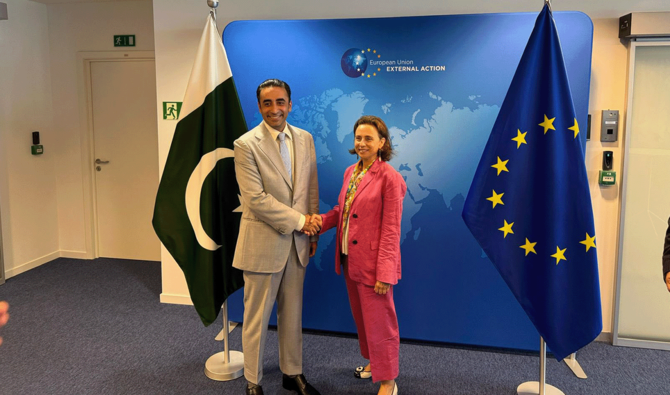
Pakistan's former Foreign Minister Bilawal Bhutto Zardari (left) shakes hands with Belén Martínez Carbonell, Secretary‑General of the European External Action Service in Brussels, Belgium, on June 14, 2025. (@BBhuttoZardari/X)
Short Url
Updated 14 June 2025
Follow

Pakistan delegation in Brussels says Islamabad can develop counterterror partnership with Delhi

  • India blames Pakistan for supporting “terrorist” attacks in the part of disputed Kashmir it governs
  • Islamabad, Washington thwarted attacks in Pakistan, US and Europe, says head of delegation

ISLAMABAD: The head of a delegation visiting Brussels to present Pakistan’s point of view regarding the country’s recent military standoff with India said on Saturday that Islamabad can develop a “phenomenal” counterterror partnership with Delhi, similar to the one it has with Washington. 

India blames Pakistan for arming and funding militants who carry out subversive activities in the part of disputed Kashmir it governs, an allegation Islamabad has always denied. The two countries engaged in a military confrontation for four days last month after India accused Pakistan of supporting an attack at the Pahalgam tourist resort in Indian-administered Kashmir. Twenty-six people, mostly tourists, were killed in the attack. 

Pakistan enjoys counterterror cooperation with several countries, including the US, which includes intelligence sharing and other forms of coordination to thwart militant attacks. The head of the United States Central Command (CENTCOM), General Michael Kurilla, this week praised Pakistan as a “phenomenal partner” in counterterrorism efforts during a testimony. 

Speaking to reporters in Brussels, Bilawal Bhutto Zardari, who is the head of the Pakistani delegation, pointed out that the US and Pakistan have thwarted “terrorist attacks” in Europe, the US and Pakistan through counter-terror coordination. 

“Will we be more effectively able to combat terror if India and Pakistan sat together and coordinated, conducted intelligence sharing,” Bhutto Zardari asked in response to a question. 

Citing Kurilla’s statement, Bhutto Zardari said Islamabad can develop a counter-terror partnership with New Delhi similar to the one it enjoyed with Washington. 

“We can develop that phenomenal partnership with India as well,” he added.

He lamented that there was no cooperation or coordination between the two nuclear-armed nations on combating “terrorism,” adding that the two countries last had a dialogue on counter-terror in 2012. 


Prime Minister Shehbaz Sharif announced the nine-member diplomatic group last month, headed by Bhutto Zardari, who is a former foreign minister and the head of the Pakistan Peoples Party.

He has been leading a team to visits in New York, Washington DC, London and Brussels since June 2. Another delegation, led by Special Assistant to the Prime Minister Syed Tariq Fatemi, has visited Moscow.

While the ceasefire between the two countries continues to remain in place, tensions continue to simmer as India says it is holding in abeyance a decades-old water-sharing treaty with Pakistan. 

Islamabad had said after India suspended the Indus Waters Treaty that it considered any attempt to stop or divert the flow of water belonging to Pakistan to be an “act of war.”

About 80 percent of Pakistani farms depend on the Indus system, as do nearly all hydropower projects serving the country of some 250 million.

Pakistan and India, bitter rivals, have fought two out of three wars over the disputed territory of Kashmir that they both claim in full but govern only parts of.


ADB, Pakistan sign over $300 million agreements to undertake climate resilience initiatives

Updated 30 December 2025
Follow

ADB, Pakistan sign over $300 million agreements to undertake climate resilience initiatives

  • Pakistan ranks among nations most vulnerable to climate change and has seen erratic changes in weather patterns
  • The projects in Sindh and Punjab will restore nature-based coastal defenses and enhance agricultural productivity

ISLAMABAD: The Pakistani government and the Asian Development Bank (ADB) have signed more than $300 million agreements to undertake two major climate resilience initiatives, Pakistan’s Press Information Department (PID) said on Tuesday.

The projects include the Sindh Coastal Resilience Sector Project (SCRP), valued at Rs50.5 billion ($180.5 million), and the Punjab Climate-Resilient and Low-Carbon Agriculture Mechanization Project (PCRLCAMP), totaling Rs34.7 billion ($124 million).

Pakistan ranks among nations most vulnerable to climate change and has seen erratic changes in its weather patterns. In 2022, monsoon floods killed over 1,700 people, displaced another 33 million and caused over $30 billion losses, while another 1,037 people were killed in floods this year.

The South Asian country is ramping up climate resilience efforts, with support from the ADB and World Bank, and investing in climate-resilient infrastructure, particularly in vulnerable areas.

“Both sides expressed their commitment to effectively utilize the financing for successful and timely completion of the two initiatives,” the PID said in a statement.

The Sindh Coastal Resilience Project (SCRP) will promote integrated water resources and flood risk management, restore nature-based coastal defenses, and strengthen institutional and community capacity for strategic action planning, directly benefiting over 3.8 million people in Thatta, Sujawal, and Badin districts, according to ADB.

The Punjab project will enhance agricultural productivity and climate resilience across 30 districts, improving small farmers’ access to climate-smart machinery, introducing circular agriculture practices to reduce residue burning, establishing testing and training facilities, and empowering 15,000 women through skills development and livelihood diversification.

Earlier this month, the ADB also approved $381 million in financing for Pakistan’s Punjab province to modernize agriculture and strengthen education and health services, including concessional loans and grants for farm mechanization, Science, Technology, Engineering and Mathematics (STEM) education, and nursing sector reforms.