

Pakistan delegation in Brussels says Islamabad can develop counterterror partnership with Delhi

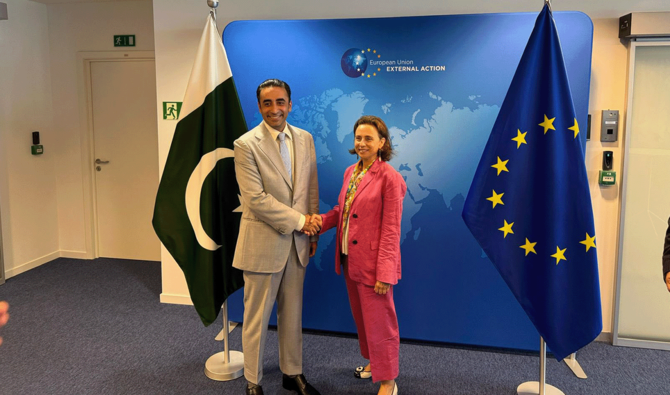
Pakistan's former Foreign Minister Bilawal Bhutto Zardari (left) shakes hands with Belén Martínez Carbonell, Secretary‑General of the European External Action Service in Brussels, Belgium, on June 14, 2025. (@BBhuttoZardari/X)
Short Url
Updated 14 June 2025
Follow

Pakistan delegation in Brussels says Islamabad can develop counterterror partnership with Delhi

  • India blames Pakistan for supporting “terrorist” attacks in the part of disputed Kashmir it governs
  • Islamabad, Washington thwarted attacks in Pakistan, US and Europe, says head of delegation

ISLAMABAD: The head of a delegation visiting Brussels to present Pakistan’s point of view regarding the country’s recent military standoff with India said on Saturday that Islamabad can develop a “phenomenal” counterterror partnership with Delhi, similar to the one it has with Washington. 

India blames Pakistan for arming and funding militants who carry out subversive activities in the part of disputed Kashmir it governs, an allegation Islamabad has always denied. The two countries engaged in a military confrontation for four days last month after India accused Pakistan of supporting an attack at the Pahalgam tourist resort in Indian-administered Kashmir. Twenty-six people, mostly tourists, were killed in the attack. 

Pakistan enjoys counterterror cooperation with several countries, including the US, which includes intelligence sharing and other forms of coordination to thwart militant attacks. The head of the United States Central Command (CENTCOM), General Michael Kurilla, this week praised Pakistan as a “phenomenal partner” in counterterrorism efforts during a testimony. 

Speaking to reporters in Brussels, Bilawal Bhutto Zardari, who is the head of the Pakistani delegation, pointed out that the US and Pakistan have thwarted “terrorist attacks” in Europe, the US and Pakistan through counter-terror coordination. 

“Will we be more effectively able to combat terror if India and Pakistan sat together and coordinated, conducted intelligence sharing,” Bhutto Zardari asked in response to a question. 

Citing Kurilla’s statement, Bhutto Zardari said Islamabad can develop a counter-terror partnership with New Delhi similar to the one it enjoyed with Washington. 

“We can develop that phenomenal partnership with India as well,” he added.

He lamented that there was no cooperation or coordination between the two nuclear-armed nations on combating “terrorism,” adding that the two countries last had a dialogue on counter-terror in 2012. 


Prime Minister Shehbaz Sharif announced the nine-member diplomatic group last month, headed by Bhutto Zardari, who is a former foreign minister and the head of the Pakistan Peoples Party.

He has been leading a team to visits in New York, Washington DC, London and Brussels since June 2. Another delegation, led by Special Assistant to the Prime Minister Syed Tariq Fatemi, has visited Moscow.

While the ceasefire between the two countries continues to remain in place, tensions continue to simmer as India says it is holding in abeyance a decades-old water-sharing treaty with Pakistan. 

Islamabad had said after India suspended the Indus Waters Treaty that it considered any attempt to stop or divert the flow of water belonging to Pakistan to be an “act of war.”

About 80 percent of Pakistani farms depend on the Indus system, as do nearly all hydropower projects serving the country of some 250 million.

Pakistan and India, bitter rivals, have fought two out of three wars over the disputed territory of Kashmir that they both claim in full but govern only parts of.


China backs Pakistan in fight against militancy after deadly Balochistan attacks

Updated 8 sec ago
Follow

China backs Pakistan in fight against militancy after deadly Balochistan attacks

  • China is a major ally and investor in Pakistan and has pledged over $65 billion in major infrastructure projects, including in Balochistan
  • Chinese Foreign Ministry spokesperson Lin Jian says ‘we mourn for lives lost, and our hearts go out to injured and those who lost loved ones’

ISLAMABAD: China condemns the recent attacks that killed more than 200 people in Pakistan’s southwestern Balochistan province, a Chinese foreign ministry spokesperson said on Tuesday, reaffirming Beijing’s support for Pakistan in its fight against militancy.

The Baloch Liberation Army (BLA) group launched coordinated attacks in several cities across Balochistan on Saturday, killing 33 civilians and 17 security personnel. Officials said 117 militants were killed in skirmishes and follow-up operations.

Balochistan, which borders Iran and Afghanistan, is the site of a decades-long insurgency waged by Baloch separatist groups who often attack security forces, foreigners and non-local Pakistanis and kidnap government officials.

China is a major ally and investor in Pakistan and has pledged over $65 billion in investment in road, infrastructure and development projects under the China-Pakistan Economic Corridor (CPEC).

“China strongly condemns the [Balochistan] attacks... We mourn for the lives lost, and our hearts go out to the injured and those who lost their loved ones,” Chinese Foreign Ministry spokesperson Lin Jian said at a press briefing on Tuesday.

“China firmly opposes any form of terrorism and will as always firmly support Pakistan in combating terrorism, maintaining solidarity and social stability, and protecting the safety of the people.”

Chinese nationals working in Pakistan have often been targeted by militants, particularly in the southwestern Balochistan province, where China is developing a deep seaport that is touted as the crown jewel of CPEC.

Interior Minister Mohsin Naqvi said last week the attacks, claimed by the separatist Baloch Liberation Army (BLA), were planned from India. New Delhi rejected the allegation as “baseless,” saying Islamabad was attempting to deflect attention from its internal challenges.

Balochistan is home to vast reserves of minerals and hydrocarbons. Separatist militant groups such as the BLA blame Islamabad for exploiting Balochistan’s natural resources and denying locals a share in them. The military and civilian government reject these allegations and say they are investing in the province’s development.