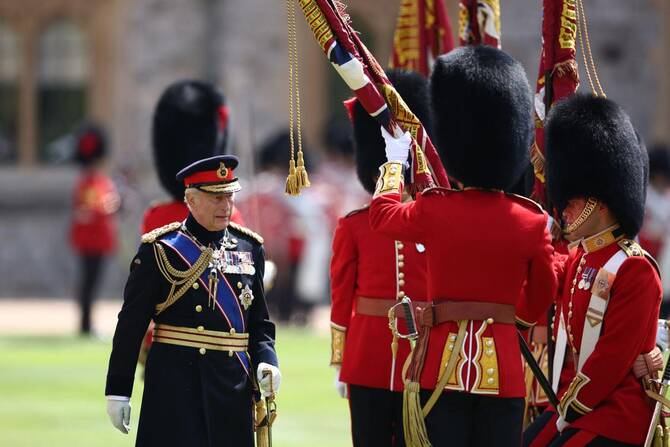
LONDON: King Charles III and other members of the royal family in uniform wore black armbands and observed a moment of silence during his annual birthday parade Saturday as the monarch commemorated those who died in this week’s Air India plane crash.
Charles requested the symbolic moves “as a mark of respect for the lives lost, the families in mourning and all the communities affected by this awful tragedy,” Buckingham Palace said.
An Air India flight from the northwestern city of Ahmedabad to London crashed shortly after takeoff on Thursday, killing 241 people on board and at least 29 on the ground. The plane was carrying 169 Indians, 53 Britons, seven Portuguese and one Canadian. One man survived.
In addition to being Britain’s head of state, Charles is the head of the Commonwealth, an organization of independent states that includes India and Canada.
The monarch’s annual birthday parade, known as Trooping the Colour, is a historic ceremony filled with pageantry and military bands in which the king reviews his troops on Horse Guards Parade adjacent to St. James’ Park in central London.
The military ceremony dates back to a time when flags of the battalion, known as colours, were "trooped,'' or shown, to soldiers in the ranks so they could recognize them.
All members of the royal family in uniform wore black armbands. The moment of silence occurred while the king was on the dais after reviewing the troops.
Charles’ mother, Queen Elizabeth II, held a similar moment of silence in 2017 when Trooping the Colour took place three days after a fire ripped through the Grenfell Tower apartment bloc in west London, killing 72 people.

King Charles III marks Air India tragedy at Trooping the Colour
Short Url
https://arab.news/7jyxw
King Charles III marks Air India tragedy at Trooping the Colour
Bangladesh police say student leader’s killers fled to India
DHAKA: Bangladesh police on Sunday said the alleged killers of popular student leader Sharif Osman Hadi had fled to India, in comments likely to further strain relations with its neighbor.
Hadi, a vocal India critic who took part in last year’s mass uprising, was shot by masked assailants in Dhaka earlier this month and later succumbed to his injuries at a hospital in Singapore.
His death set off violent protests with angry mobs torching several buildings, including two major newspapers deemed to favor India as well as a prominent cultural institution.
With protests being held across the country almost daily, pressure has been growing on Bangladesh’s interim government to arrest the killers of Hadi, who was set to contest general elections in February next year.
“The killing was premeditated. Those behind it have been identified,” SN Nazrul Islam, a senior Dhaka Metropolitan Police officer, said at a news conference.
Suspects Faisal Karim Masud and Alamgir Sheikh left Bangladesh through the Haluaghat border with India shortly after attacking Hadi on December 12, Islam said.
They were received at the border by two Indian citizens, who escorted them into the northeastern state of Meghalaya before handing them over to two accomplices.
Bangladeshi investigators were in contact with their Indian counterparts who had arrested the two suspected accomplices, Islam said.
“We are communicating with Meghalaya police, who have confirmed the arrest of two Indian nationals,” he added.
Two senior Meghalaya police officers however did not comment when contacted by AFP.
The Indian foreign ministry had earlier said it rejects “false narratives” about New Delhi’s involvement in Hadi’s killing.
Ties between the neighbors have deteriorated since ousted prime minister Sheikh Hasina fled the pro-democracy uprising and sought refuge in India.
India says it is still considering Dhaka’s requests to extradite Hasina, who was sentenced to death in absentia for orchestrating a deadly crackdown on the uprising.
The lynching of a Hindu garment worker by a mob on December 18 has also hit ties.
Amid the deteriorating security situation in the Muslim-majority country, Khuda Baksh Chowdhury, special assistant to interim leader Muhammad Yunus overseeing the home department, stepped down on Wednesday.
Hadi, a vocal India critic who took part in last year’s mass uprising, was shot by masked assailants in Dhaka earlier this month and later succumbed to his injuries at a hospital in Singapore.
His death set off violent protests with angry mobs torching several buildings, including two major newspapers deemed to favor India as well as a prominent cultural institution.
With protests being held across the country almost daily, pressure has been growing on Bangladesh’s interim government to arrest the killers of Hadi, who was set to contest general elections in February next year.
“The killing was premeditated. Those behind it have been identified,” SN Nazrul Islam, a senior Dhaka Metropolitan Police officer, said at a news conference.
Suspects Faisal Karim Masud and Alamgir Sheikh left Bangladesh through the Haluaghat border with India shortly after attacking Hadi on December 12, Islam said.
They were received at the border by two Indian citizens, who escorted them into the northeastern state of Meghalaya before handing them over to two accomplices.
Bangladeshi investigators were in contact with their Indian counterparts who had arrested the two suspected accomplices, Islam said.
“We are communicating with Meghalaya police, who have confirmed the arrest of two Indian nationals,” he added.
Two senior Meghalaya police officers however did not comment when contacted by AFP.
The Indian foreign ministry had earlier said it rejects “false narratives” about New Delhi’s involvement in Hadi’s killing.
Ties between the neighbors have deteriorated since ousted prime minister Sheikh Hasina fled the pro-democracy uprising and sought refuge in India.
India says it is still considering Dhaka’s requests to extradite Hasina, who was sentenced to death in absentia for orchestrating a deadly crackdown on the uprising.
The lynching of a Hindu garment worker by a mob on December 18 has also hit ties.
Amid the deteriorating security situation in the Muslim-majority country, Khuda Baksh Chowdhury, special assistant to interim leader Muhammad Yunus overseeing the home department, stepped down on Wednesday.
© 2025 SAUDI RESEARCH & PUBLISHING COMPANY, All Rights Reserved And subject to Terms of Use Agreement.


