



ISLAMABAD: Pakistan’s Deputy Prime Minister and Foreign Minister Ishaq Dar spoke with his Iranian counterpart on Friday as Tehran launched a retaliatory missile strike on Israel following deadly Israeli attacks on nuclear facilities and senior military commanders.
Air raid sirens sounded across Israel on Friday night as dozens of Iranian missiles struck the country in a dramatic escalation of tensions. Explosions were heard throughout Jerusalem and plumes of smoke were seen rising in Tel Aviv after apparent strikes. While no casualties were immediately reported, the Israeli military ordered residents nationwide into bomb shelters.
The latest attacks came after Israel carried out a wave of airstrikes across Iran, reportedly killing at least three top Iranian military officers and targeting nuclear facilities and ballistic missile sites. Israeli military officials said 200 fighter jets were involved in the operation, which struck more than 100 locations in what analysts described as the most significant assault Iran has faced since its war with Iraq in the 1980s.
The Pakistani deputy PM held a phone call with Iranian Foreign Minister Seyed Abbas Araghchi, as the war escalated between the two Middle Eastern rivals.
“Deputy Prime Minister/Foreign Minister, Senator Mohammad Ishaq Dar @MIshaqDar50, today spoke with the Foreign Minister of Iran, Seyed Abbas Araghchi @Araghchi,” the Pakistani foreign office said in a statement.
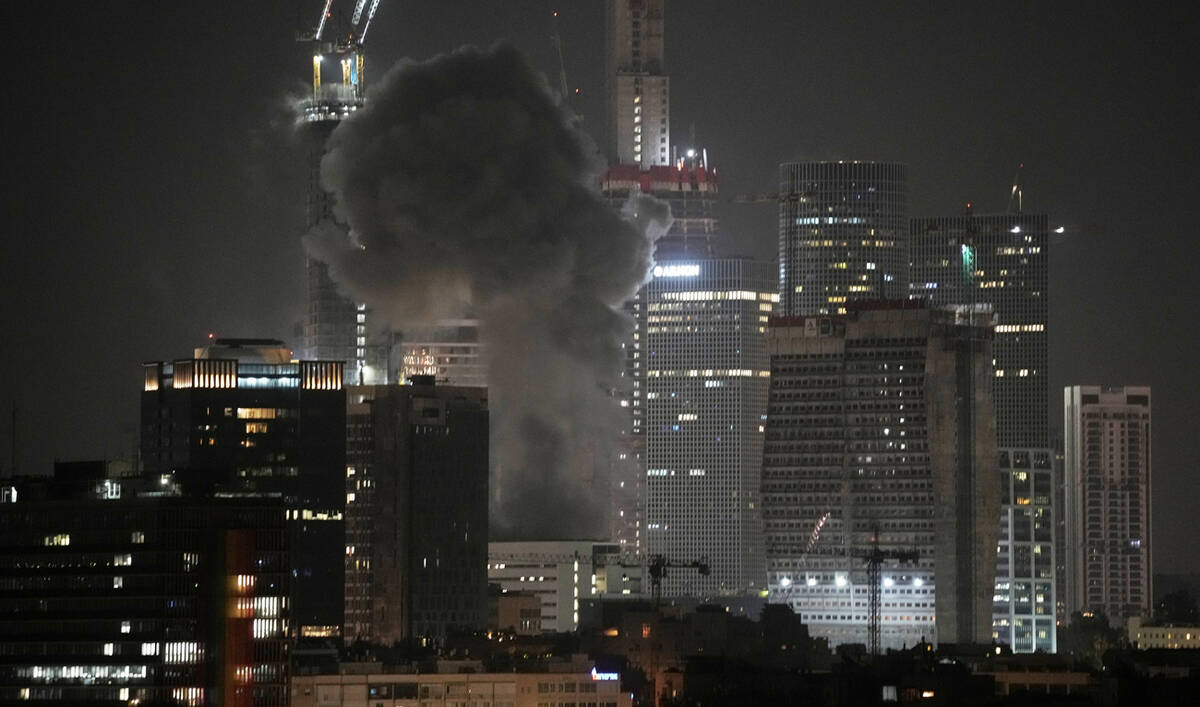
Smoke billows after a projectile hit a building in Tel Aviv, Israel on June 14, 2025. (AP)
“Condemning the blatant Israeli aggression against the Islamic Republic of Iran in total disregard of the UN Charter and international law, DPM/FM reiterated strong support of Pakistan to the Government and brotherly people of Iran for achieving peace and stability in the region,” it added.
Dar also conveyed “deepest sympathies on the loss of many precious lives during Israeli attacks,” according to the statement.
Earlier in the day, the Pakistani foreign office said Israel had violated Iran’s sovereignty and that the attacks were “contrary to the UN Charter and fundamental principles of international law.”
It warned the escalation posed “a serious threat to regional peace and security,” adding that Iran had the right to self-defense under Article 51 of the UN Charter.
Dar, writing on X, described the Israeli strikes as a “brazen violation” of Iranian sovereignty and said they “gravely undermine regional stability and international security.”
“Pakistan stands in solidarity with the government and the people of Iran,” he wrote.
He also said the foreign ministry had established a 24/7 Crisis Management Unit to ensure the safety and security of Pakistani nationals and pilgrims in Iran.
Prime Minister Shehbaz Sharif echoed the condemnation and called on the international community and the United Nations to “take urgent steps to prevent any further escalation that could imperil regional and global peace.”
Israeli military spokesperson Defrin said all air defense systems had been activated in response to Iran’s retaliation and the country expected “difficult hours ahead.”
In Washington, the US administration said it had not been involved in the Israeli operation.
“Israel took unilateral action against Iran,” US Secretary of State Marco Rubio said in a statement released by the White House. “Our top priority is protecting American forces in the region.”
Saudi Arabia’s foreign ministry also condemned the Israeli strikes.
“The Kingdom condemns these heinous attacks and affirms that the international community and the Security Council bear a great responsibility to immediately halt this aggression,” the Saudi statement said.
Airlines cleared out of the airspace over Israel, Iran, Iraq and Jordan on Friday following the strikes, according to Flightradar24 data, as carriers scrambled to divert or cancel flights to ensure passenger and crew safety.
Iran closed its airspace and Tel Aviv’s Ben Gurion Airport was shut down until further notice.
Israeli military Chief of Staff Eyal Zamir said tens of thousands of soldiers had been called up and deployed across all borders.
“We are amidst a historic campaign unlike any other. This is a critical operation to prevent an existential threat, by an enemy who is intent on destroying us,” he said.
With inputs from AP and Reuters


