

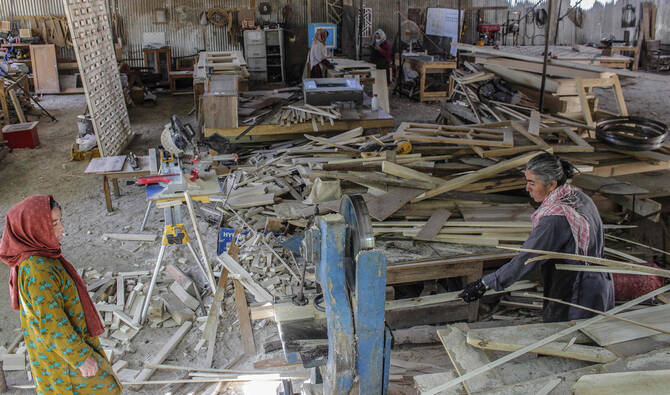

KARIMABAD, Pakistan: In a sawdust-filled workshop nestled in the Karakoram Mountains, a team of women carpenters chisel away at cabinets — and forge an unlikely career for themselves in Pakistan.
Women make up just a fraction of Pakistan’s formal workforce. But in a collection of villages sprinkled along the old Silk Road between China and Afghanistan, a group of women-led businesses is defying expectations.
“We have 22 employees and have trained around 100 women,” said Bibi Amina, who launched her carpentry workshop in 2008 at the age of 30.
Hunza Valley’s population of around 50,000, spread across mountains abounding with apricot, cherry, walnut and mulberry orchards, follow the Ismaili branch of Shiite Islam.
Ismailis are led by the Aga Khan, a hereditary position held by a family with Pakistani roots now living in Europe.
The family opened a girls’ school in Hunza in 1946, kickstarting an educational investment that pushed the valley’s literacy rate to 97 percent for both men and women. That rate far outstrips the country average of around 68 percent for men and 52.8 percent for women.
As a result, attitudes have shifted, and women like Amina are taking expanded roles.
“People thought women were there to wash dishes and do laundry,” Amina said of the generation before her.
Trained by the Aga Khan Foundation to help renovate the ancient Altit Fort, Amina later used her skills to start her own business. Her carpenters are currently at work on a commission from a luxury hotel.
Only 23 percent of the women in Pakistan were officially part of the labor force as of 2024, according to data from the World Bank.
In rural areas, women rarely take on formal employment but often toil in the fields to support the family’s farming income.
In a Gallup poll published last year, a third of women respondents said their father or husband forbade them from taking a job, while 43.5 percent said they had given up work to devote themselves to domestic tasks.
Cafe owner Lal Shehzadi spearheaded women’s restaurant entrepreneurship in Hunza.
She opened her cafe at the top of a winding high street to supplement her husband’s small army pension.
Sixteen years later, her simple set-up overlooking the valley has become a popular night-time tourist attraction. She serves visitors traditional cuisine, including yak meat, apricot oil and rich mountain cheese.
“At the start, I used to work alone,” she said. “Now, 11 people work here and most of them are women. And my children are also working here.”
Following in Shehzadi’s footsteps, Safina quit her job to start her own restaurant around a decade ago.
“No one wanted to help me,” she said. Eventually, she convinced family members to sell two cows and a few goats for the money she needed to launch her business.
Now, she earns the equivalent of around $170 a month, more than 15 times her previous income.
The socio-economic progress of women in Hunza compared to other rural areas of Pakistan has been driven by three factors, according to Sultan Madan, the head of the Karakoram Area Development Organization and a local historian.
“The main reason is the very high literacy rate,” he told AFP, largely crediting the Aga Khan Foundation for funding training programs for women.
“Secondly, agriculture was the backbone of the economy in the region, but in Hunza the landholding was meager and that was why women had to work in other sectors.”
Women’s increased economic participation has spilled into other areas of life, like sports fields.
“Every village in the valley has a women’s soccer team: Gojal, Gulmit, Passu, Khyber, Shimsal,” said Nadia Shams, 17.
On a synthetic pitch, she trains with her teammates in jogging pants or shorts, forbidden elsewhere by Pakistan’s dress code.
Here, one name is on everyone’s lips: Malika-e-Noor, the former vice-captain of the national team who scored the winning penalty against the Maldives in the 2010 South Asian Women’s Football Championship.
Fahima Qayyum was six years old when she witnessed the killer kick.
Today, after several international matches, she is recruiting the next generation.
“As a girl, I stress to others the importance of playing, as sport is very good for health,” she told AFP.
“If they play well, they can also get scholarships.”


