Saudi Arabia leads Arab condemnation of Israel attacks on Iran

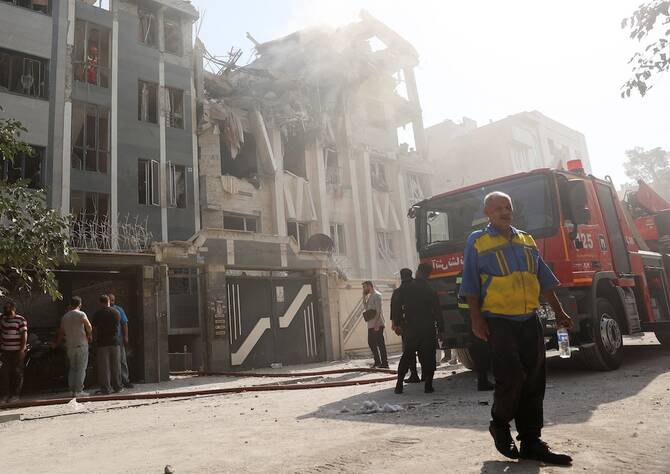
Rescuers work at the scene of a damaged building in Tehran in the aftermath of Israeli strikes on June 13, 2025. (West Asia News Agency via Reuters)
Short Url
Updated 17 June 2025
Follow

Saudi Arabia leads Arab condemnation of Israel attacks on Iran

  • ‘Heinous attacks’ on ‘brotherly’ Iran violates international law
  • UN, global community must ‘immediately halt this aggression’

RIYADH: Saudi Arabia led Arab condemnation Israel’s strikes on Iran early on Friday, which targeted multiple sites it linked to the country’s nuclear program and killed at least two top military officers, raising the potential for an all-out war between the two bitter Middle East adversaries.

The strikes killed Hossein Salami, the chief of Iran’s Islamic Revolutionary Guards Corps, along with another top IRGC official and two nuclear scientists in the initial raids.

It appeared to be the most significant attack Iran has faced since its 1980s war with Iraq.

Saudi Arabia was the first Arab nation to speak out against the attacks, stating that the Kingdom “expresses its strong condemnation and denunciation of the blatant Israeli aggressions against the brotherly Islamic Republic of Iran, which undermine its sovereignty and security and constitute a clear violation of international laws and norms,” the Foreign Ministry said in a statement on Friday.

The statement added: “While the Kingdom condemns these heinous attacks, it affirms that the international community and the (UN) Security Council bear a great responsibility to immediately halt this aggression.”


The strikes came amid simmering tensions over Iran’s rapidly advancing nuclear program and appeared certain to trigger a reprisal, with Supreme Leader Ayatollah Ali Khamenei warning that “severe punishment” would be directed at Israel. Hours later, Israel’s military said it had begun intercepting Iranian drones launched in retaliation.

Israel’s Prime Minister Benjamin Netanyahu said the military operation on Iran would “continue for as many days as it takes” to “roll back the Iranian threat to Israel’s very survival.”

Israel has declared a state of emergency in anticipation of retaliatory missile and drone strikes.

Iran’s Supreme Leader Ayatollah Ali Khamenei meanwhile warned that Israel would suffer severe consequences after the deadly attacks.

“With this crime, the Zionist regime has set itself for a bitter and painful fate and it will definitely receive it,” Khamenei said in a statement.

Early speculation as to how aware US President Donald Trump was of the attacks soon came to an end after telling Fox News he had received “advanced notice”, stating that “Iran cannot have a nuclear bomb and we are hoping to get back to the negotiating table. We will see.”

Iran later said it would not be attending talks scheduled to take place in Oman. 


Minzal brings Saudi traditions to life in Diriyah

Updated 07 January 2026
Follow

Minzal brings Saudi traditions to life in Diriyah

  • From leather crafts and archery to Saudi coffee, Minzal offers a lesson in ‘Sloum Al-Arab’

RIYADH: This season of Minzal places social norms and traditional etiquette at its center, with tents set up to teach what is locally known as “Sloum Al-Arab” alongside gatherings for coffee, dinner and stargazing around campfires.

“Sloum Al-Arab” refers to the unwritten customers and values that have shaped Arab and Bedouin society for centuries, including generosity, coffee preparation, courage and archery. 

In Saudi Arabia, these traditions are closely ties to cultural identity and religious belief. 

Leather products and the making of leather goods is one of the crafts featured at Minzal this year and is one of the oldest crafts still practiced in the kingdom.

“The most difficult thing I faced to work on was camel leather because it is a little tough,” Nada Samman, a leather trainer and craftsman at Minzal, told Arab News. 

Minzal continues to evolve with each season, offering activities that highlight Bedouin values, traditional skills and sports. (AN photo by Haifa Alshammari)

“The work on leather is wonderful whether it is goat leather, cow leather, Sawakni sheep, and of course, camel leather. At Minzal, we are offering multiple handicraft workshops, most specifically the leather handicrafts. We want visitors to spend time at something useful and fun."

Samman explained the workshops allowed participants to preserve heritage while engaging in meaning, hands on activities. 

Faisal Al-Khaled, a visual artist and craftsman specializing in Saudi designs at Minzal, shared a similar goal: “I want people to have, by the end of this experience, a unique and traditional art piece created by them, and that I know I helped them to preserve this craft.”

Minzal, which has been organized for several years now, continues to evolve with each season, offering activities that highlight Bedouin values, traditional skills and sports. Archery is a key feature, reflecting its deep roots in Arab and Islamic history.

Mohammed Al-Sharif, a certified archery player and coach with the Saudi Archery Federation since 2028, said the sport was closely connected to Saudi culture. It was encouraged by the Prophet Muhammad, which led people to learn and teach it through generations.

“Our traditional bow is considered one of the most important and widely used bows in Arab culture,” Al-Sharif said. “We have several styles, and professional archers specializing in traditional bow shooting … There are various types of archery, such as horseback archery and standing archery, where bow sizes vary according to specific needs, such as types used for hunting and others used during warfare.”

He explained that archery was historically part of daily life, used for protection and hunting. 

Saudi coffee also plays a significant role in the Minzal experience, with live demonstrations. One of the most frequently consumed beverages in the Kingdom, it is a symbol of hospitality and generosity.

Ahmed Al-Shuaibi explained how it was prepared at the Sloum tent, first by roasting the beans and then allowing them to cool. The beans are ground with spices in a Nigr.

“Coffee is passed from our grandparents,” he added. “In significant majlis, you see them offering our local coffee and not other types of coffee. We organized this corner so that young generations can visit and learn this.”