

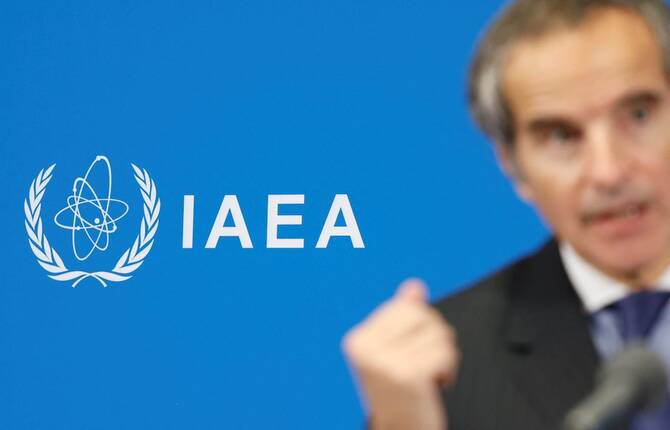
UN nuclear watchdog chief ready to travel to Iran to assess situation

UN nuclear watchdog chief Rafael Grossi said on Friday he was ready to travel to Iran to assess the situation there. (Reuters)
Short Url
Updated 17 June 2025
Follow

UN nuclear watchdog chief ready to travel to Iran to assess situation

VIENNA: UN nuclear watchdog chief Rafael Grossi said on Friday he was ready to travel to Iran to assess the situation there after Israel carried out widespread military strikes that hit the sprawling nuclear complex at Natanz.

In a statement to a meeting of the International Atomic Energy Agency’s Board of Governors, Grossi said the other main enrichment center in Iran, Fordow, was not hit and neither was another nuclear facility in Esfahan, citing Iranian authorities.

There are no elevated radiation levels at Natanz, he added.

“I call on all parties to exercise maximum restraint to avoid further escalation. I reiterate that any military action that jeopardizes the safety and security of nuclear facilities risks grave consequences for the people of Iran, the region, and beyond,” Grossi said in his statement.

“I have indicated to the respective authorities my readiness to travel at the earliest to assess the situation and ensure safety, security and non-proliferation in Iran.”

He did not say what the extent of the damage at Natanz was or what parts of the site were hit. The site includes a vast underground uranium enrichment plant and a smaller, above-ground pilot enrichment plant.

Iran is enriching to up to 60 percent purity, close to the roughly 90 percent of weapons grade, at the pilot plant, but it is producing smaller quantities of that material there than at Fordow, a site dug into a mountain that military experts have said would be difficult for Israel to destroy through bombardment.

“Despite the current military actions and heightened tensions, it is clear that the only sustainable path forward – for Iran, for Israel, the entire region, and the international community – is one grounded in dialogue and diplomacy to ensure peace, stability, and cooperation,” Grossi said.


Lebanese PM urges swift approval of law aimed at paying back depositors

Updated 13 sec ago
Follow

Lebanese PM urges swift approval of law aimed at paying back depositors

BEIRUT: Lebanese Prime Minister Nawaf Salam urged the Cabinet to swiftly approve a draft law allowing depositors to gradually recover funds frozen in the banking system since a financial collapse in 2019, a move critical to reviving the economy.
The collapse — the result of decades of unsustainable financial policies, waste and corruption — led the state to default on its sovereign debt and sank the Lebanese pound.
The draft law marks the first time Beirut has put forward legislation aimed at addressing a vast funding shortfall — estimated at $70 billion in 2022 but now believed to be higher.

BACKGROUND

The draft law marks the first time Beirut has put forward legislation aimed at addressing a vast funding shortfall — estimated at $70 billion in 2022 but now believed to be higher.

The Cabinet approved several articles on Monday. Discussions would continue on Tuesday, Information Minister Paul Morcos said. Lebanon’s divided parliament must pass the law after cabinet approval.
Salam said the law is realistic and its goal is to do “justice to depositors,” also spurring recovery in the banking sector.
Finance Minister Yassine Jaber said implementation of the law would boost the economy, pumping deposits of $3-$4 billion annually into the system.
The draft, published on Friday, foresees repayments to small depositors – those with deposits valued at less than $100,000 – in monthly or quarterly instalments over four years.
Deposits larger than $100,000 will be repaid via tradable, asset-backed securities to be issued by the central bank or Banque du Liban, with no less than 2 percent of the value paid annually.
The maturity period will be set at 10 years for deposits valued at up to $1 million, at 15 years for deposits valued from $1 million to $5 million, and at 20 years for deposits valued at more than $5 million.
The securities will be backed by the income, revenues and returns of BdL-owned assets and any proceeds from the sale of assets, if any occur. The draft mentions precious metals, which have soared in value this year, as one possible source of income.
It says commercial banks will bear 20 percent of the responsibility for payments for the asset-backed securities. It says BdL and commercial banks will jointly finance the payments of the small deposits, with BdL’s share not exceeding 60 percent.
Debt owed by the state to BdL will be converted into a bond whose maturity and interest rate would be agreed between the Finance Ministry and BdL.
The Association of Banks in Lebanon has objected to the draft, saying on Sunday that the proposals do not reflect banks’ ability to meet “their obligations towards depositors” and that the state was not “fulfilling its outstanding debts to BdL.” 
Mike Azar, an expert on the financial system, said the law appeared to be intentionally vague on politically sensitive but critical questions.
“For example, what happens if the BdL or the banks can’t pay what they owe to depositors?” he said.

Swapping deposits for asset-backed securities issued by BdL could imply a big “contingent state debt,” he said. The government has yet to provide quantitative analysis underpinning the plan, including deposit repayment amounts, sources of funding, and bank recapitalization needs, he added.

Jaber noted that the value of BdL’s gold assets had risen with the price of gold since 2020, which would help provide confidence in the asset-backed securities.
The law requires an international auditing firm to evaluate BdL’s assets within one month to determine the size of the funding shortfall. Banks must also conduct an asset quality review and recapitalize.
The law would write off some dollar deposits.
These would include deposits that resulted from funds being converted into dollars from pounds at the official exchange rate long after it had collapsed as well as deposits containing illicit funds, in accordance with a law to counter money-laundering and financing for terrorism.