

Pakistan ranks last among 148 nations in WEF global gender gap index

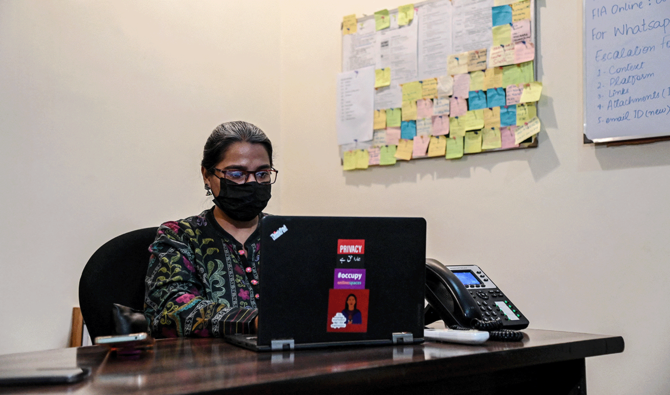
In this photograph taken on October 21, 2024, a staff member works at the Digital Rights Foundation (DRF), an NGO aims to strengthen protections for human rights defenders in digital spaces, in Lahore, Pakistan.
Short Url
Updated 12 June 2025
Follow

Pakistan ranks last among 148 nations in WEF global gender gap index

  • Pakistan has closed just 56.7 percent of its overall gender gap, down from 57 percent in the previous year
  • While Pakistan recorded improvements in education, broader gender equality remained elusive

ISLAMABAD: Pakistan has ranked last among 148 countries in the World Economic Forum’s Global Gender Gap Report 2025, underscoring persistent gender disparities in political and economic representation despite modest gains in female literacy.

The annual report, released this week, assesses gender parity across four key dimensions: economic participation and opportunity, educational attainment, health and survival, and political empowerment.

“Occupying the bottom rank of the index (148), Pakistan sees its overall parity score decline from last year’s edition from 57 percent to 56.7 percent,” the report said, marking the second consecutive annual decline in parity.

While Pakistan recorded improvements in education, the report noted that broader gender equality remained elusive.

The country showed a 1.5 percentage point gain in educational attainment, raising its parity in this area to 85.1 percent, driven partly by a rise in female literacy from 46.5 percent to 48.5 percent, according to WEF.

“Part of the shift is driven by an increase in female literacy rates from 46.5 percent to 48.5 percent,” the report said.

However, it cautioned that the improvement at the university level was partially due to a decline in male enrollment, rather than a significant surge in female participation.

In contrast, the country’s economic participation and opportunity index fell by 1.3 percentage points, amid a widening income and wage gap. The report noted a marginal increase in income disparity and a four-percentage-point rise in perceived wage inequality.

Women continue to make up a small share of Pakistan’s labor force — just 22.8 percent, according to a 2024 World Bank report — and few hold leadership or managerial positions.

Pakistan also saw a notable regression in political empowerment, with parity dropping from 12.2 percent in 2024 to 11 percent in 2025. While women’s representation in parliament rose slightly by 1.2 percentage points, the share of women in ministerial positions dropped from 5.9 percent to zero, according to the WEF.

“Overall Pakistan has closed +2.3 of its gender gap since 2006,” the report noted. “However, this year’s results are a second consecutive drop from the economy’s best score of 57.7 percent achieved in 2023.”

Pakistan has consistently ranked near the bottom in past editions of the Global Gender Gap Index and the 2025 report underscores the country’s ongoing struggle to create equitable opportunities for women, particularly in the political and economic spheres. Progress in education, while encouraging, remains insufficient to offset broader systemic inequalities.


Suicide bomber kills at least five at wedding in northwest Pakistan

Updated 9 sec ago
Follow

Suicide bomber kills at least five at wedding in northwest Pakistan

  • Attack took place in Dera Ismail Khan, targeting the home of a local peace committee member
  • Peace committees are community-based groups that report militant activity to security forces

PESHAWAR: A suicide bomber killed at least five people and wounded 10 others after detonating explosives at a wedding ceremony in northwestern Pakistan on Friday, officials said, in an attack that underscored persistent militant violence in the country’s restive Khyber Pakhtunkhwa province.

The blast took place at the home of a local peace committee member in Dera Ismail Khan district, where guests had gathered for a wedding, police and emergency officials said.

Peace committees in the region are informal, community-based groups that work with security forces to report militant activity and maintain order, making their members frequent targets of attacks.

“A blast occurred near Qureshi Moor in Dera Ismail Khan. Authorities have recovered five bodies and shifted 10 injured to hospital,” said Bilal Faizi, a spokesman for the provincial Rescue 1122 emergency service, adding that the rescue operation was ongoing.

Police said the attacker blew himself up inside the house during the ceremony and that the bomber’s head had been recovered, confirming it was a suicide attack.

Several members of the local peace committee were present at the time, raising fears the toll could rise.

District Police Officer Sajjad Ahmed Sahibzada said authorities had launched an investigation into the incident, while security forces sealed off the area.

Militant attacks have surged in parts of Khyber Pakhtunkhwa after the Taliban returned to power in neighboring

Afghanistan in 2021, with the administration in Islamabad blaming the Afghan government for “facilitating” cross-border attacks targeting Pakistani civilians and security forces. However, Kabul has repeatedly denied the allegation.

Khyber Pakhtunkhwa has also seen frequent intelligence-based operations by security forces targeting suspected militants.

No group has immediately claimed responsibility for Friday’s attack.