

Pakistan ranks last among 148 nations in WEF global gender gap index

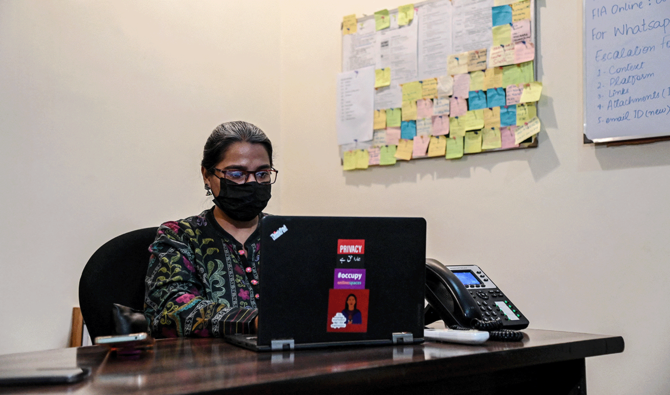
In this photograph taken on October 21, 2024, a staff member works at the Digital Rights Foundation (DRF), an NGO aims to strengthen protections for human rights defenders in digital spaces, in Lahore, Pakistan.
Short Url
Updated 12 June 2025
Follow

Pakistan ranks last among 148 nations in WEF global gender gap index

  • Pakistan has closed just 56.7 percent of its overall gender gap, down from 57 percent in the previous year
  • While Pakistan recorded improvements in education, broader gender equality remained elusive

ISLAMABAD: Pakistan has ranked last among 148 countries in the World Economic Forum’s Global Gender Gap Report 2025, underscoring persistent gender disparities in political and economic representation despite modest gains in female literacy.

The annual report, released this week, assesses gender parity across four key dimensions: economic participation and opportunity, educational attainment, health and survival, and political empowerment.

“Occupying the bottom rank of the index (148), Pakistan sees its overall parity score decline from last year’s edition from 57 percent to 56.7 percent,” the report said, marking the second consecutive annual decline in parity.

While Pakistan recorded improvements in education, the report noted that broader gender equality remained elusive.

The country showed a 1.5 percentage point gain in educational attainment, raising its parity in this area to 85.1 percent, driven partly by a rise in female literacy from 46.5 percent to 48.5 percent, according to WEF.

“Part of the shift is driven by an increase in female literacy rates from 46.5 percent to 48.5 percent,” the report said.

However, it cautioned that the improvement at the university level was partially due to a decline in male enrollment, rather than a significant surge in female participation.

In contrast, the country’s economic participation and opportunity index fell by 1.3 percentage points, amid a widening income and wage gap. The report noted a marginal increase in income disparity and a four-percentage-point rise in perceived wage inequality.

Women continue to make up a small share of Pakistan’s labor force — just 22.8 percent, according to a 2024 World Bank report — and few hold leadership or managerial positions.

Pakistan also saw a notable regression in political empowerment, with parity dropping from 12.2 percent in 2024 to 11 percent in 2025. While women’s representation in parliament rose slightly by 1.2 percentage points, the share of women in ministerial positions dropped from 5.9 percent to zero, according to the WEF.

“Overall Pakistan has closed +2.3 of its gender gap since 2006,” the report noted. “However, this year’s results are a second consecutive drop from the economy’s best score of 57.7 percent achieved in 2023.”

Pakistan has consistently ranked near the bottom in past editions of the Global Gender Gap Index and the 2025 report underscores the country’s ongoing struggle to create equitable opportunities for women, particularly in the political and economic spheres. Progress in education, while encouraging, remains insufficient to offset broader systemic inequalities.



Pakistan PM invites UAE investment across tech and resource sectors at National Day event

Updated 08 December 2025
Follow

Pakistan PM invites UAE investment across tech and resource sectors at National Day event

  • Shehbaz Sharif says the UAE remains a key economic partner and continues to lend ‘critical support’ to Pakistan
  • UAE envoy says both nations have potential for cooperation in renewable energy, AI and economic diversification

ISLAMABAD: Pakistan is ready to welcome investment from the United Arab Emirates across emerging technologies and resource sectors, Prime Minister Shehbaz Sharif said on Monday, as both countries marked the 54th National Day of the Gulf country in Islamabad.

Speaking at the ceremony attended by senior ministers, diplomats and business leaders, Sharif said the UAE remained a key economic partner for Pakistan and continued to lend “critical support” to the country’s stabilizing economy.

“Pakistan takes great pride in its strategic partnership with the UAE, which continues to deepen across every domain of life,” he said. “With Pakistan’s economy stabilizing, we stand ready to welcome Emirati investment in renewable energy, AI, fintech, agriculture and minerals.”

Sharif praised the UAE’s leadership and recalled his earliest memories of the Gulf nation as “a land that believed in possibilities long before they became realities,” saying the country’s progress under President Sheikh Mohamed bin Zayed Al Nahyan commanded “profound admiration.”

UAE Ambassador Salem Al Bawab Al Zaabi said the Emirates was committed to strengthening ties with Pakistan in areas including the economy, energy and artificial intelligence.

He said the two countries shared a “deep-rooted friendship built on mutual respect, shared values and a common vision for regional peace and development.”

“We see tremendous potential for collaboration in renewable energy, artificial intelligence, sustainability and economic diversification,” the ambassador said, adding that the UAE aimed to broaden the scope of its economic relations with Pakistan.

The UAE hosts around 1.8 million Pakistani expatriates, one of the country’s largest overseas communities, who Sharif said contributed “tirelessly” to the Gulf state’s development.

Sharif and Deputy Prime Minister Ishaq Dar also joined the UAE ambassador in a cake-cutting ceremony to mark the occasion.