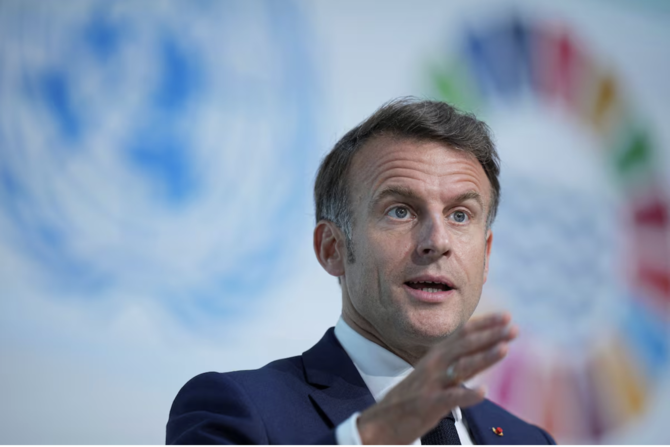

LONDON: France’s President Emmanuel Macron on Thursday praised Palestinian Authority President Mahmoud Abbas’ “concrete and unprecedented commitments” after receiving a letter from the latter ahead of the UN-backed Saudi-French conference on a two-state solution in Palestine.
In his letter on Monday, which was addressed to Macron and Saudi Arabia’s Crown Prince Mohammed bin Salman, Abbas outlined the main steps to be taken to end the war on Gaza.
He called for the demilitarization of Hamas, the release of hostages, a ceasefire in Gaza and deployment of international forces to protect “the Palestinian people,” while reaffirming his commitment to reforms and elections.
Abbas also demanded an end to “the occupation and conflict once and for all” and halting settler activities.
In a post on X, Macron described the letter as “a decisive moment, praising the Palestinian leader for charting “a course toward a horizon of peace.”
I received a letter of hope, courage, and clarity.
The President of the Palestinian Authority, Mahmoud Abbas, charts a course toward a horizon of peace.
A condemnation of terrorism, the release of hostages, the demilitarization of Hamas, an end to the war in Gaza,… pic.twitter.com/zQ2ZgEOQ5k
— Emmanuel Macron (@EmmanuelMacron) June 12, 2025
“Concrete and unprecedented commitments that demonstrate a genuine willingness to move forward,” said Macron.
France and Saudi Arabia will co-chair the high-level International Conference for the Peaceful Settlement of the Palestinian Question and the Implementation of the Two-State Solution in New York next week.
The conference at the UN’s headquarters aims to achieve concrete steps toward the two-state solution.
In his letter, Abbas stressed the Palestinian Authority’s commitment to presidential and general elections within a year across the Occupied Territories — including East Jerusalem — under international supervision.
“The Palestinian people are entitled to live in freedom and dignity in their homeland. Palestine and Israel are entitled to exist as states, in peace and security, in conformity with international law,” Abbas wrote in his letter.
Reaffirming his commitment to the two-state solution, he said: “We are ready to conclude within a clear and binding timeline, and with international support, supervision and guarantees, a peace agreement that ends the Israeli occupation and resolves all outstanding and final status issues.”