

Family of detained Baloch rights activist moves Supreme Court against her arrest

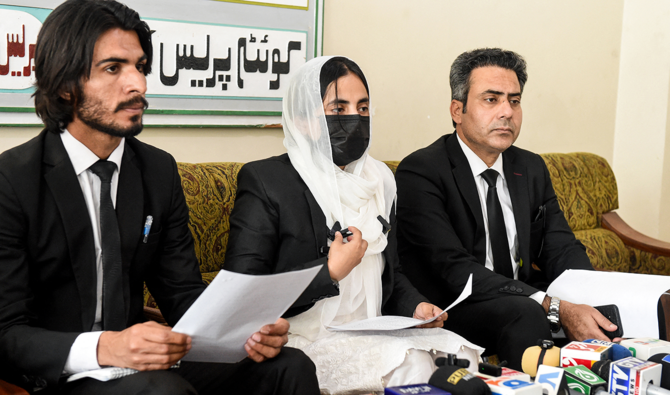
Nadia Baloch (C), lawyer and sister of detained female Baloch activist Mahrang Baloch, attends a press conference with Mahrang's chief lawyer Imran Baloch (R) at the Quetta Press Club in Quetta, Pakistan, on April 15, 2025. (AFP/File)
Short Url
Updated 12 June 2025
Follow

Family of detained Baloch rights activist moves Supreme Court against her arrest

  • Dr. Mahrang Baloch has been held in a Quetta prison since she was arrested on March 22
  • She published a letter from jail in a US magazine, saying ‘speaking for justice is not a crime’

ISLAMABAD: The family of a detained Pakistani Baloch rights activists, Dr. Mahrang Baloch, filed a petition in Pakistan’s Supreme Court on Wednesday, seeking to overturn a provincial court ruling that upheld her arrest under public order laws, according to a local media report.

Baloch, a physician and a civil society activists, has been held at Quetta’s Hudda District Jail since March 22 after she participated in protests following a separatist militant attack on a passenger train in Balochistan.

She was arrested under the Maintenance of Public Order (MPO) law, a move her supporters described as part of a broader crackdown on nonviolent dissent in the restive province.

The petition, filed by her sister, argues that the detention is arbitrary and aimed at silencing peaceful activism.

“Nadia Bal­och, the sister of Dr. Mah­­rang Baloch, urged the Supreme Court on Wed­­nesday to set aside the April 15 order of the Balo­ch­istan High Court that rej­ected the plea against her detention under the Main­tenance of Public Order,” the English-language newspaper Dawn quoted from the petition.

The detained activist, who leads the Baloch Yakjehti Committee, also published a letter from prison in the US-based Time magazine this week, in which she asserted that “speaking up for justice is not a crime.”
Pakistani authorities have accused Baloch of promoting the narrative of separatist groups like the Balochistan Liberation Army (BLA) in public. However, her letter in the American magazine maintained the officials had not provided any evidence of her links with BLA or any other militant group while criticizing the authorities for blurring the line between militancy and peaceful protest.

Earlier this year, the Balochistan High Court dismissed Baloch’s initial challenge to her detention, advising her to seek administrative remedies instead of judicial relief.

Her sister’s petition has now asked the apex court to suspend that ruling and review whether constitutional protections such as habeas corpus were ignored in the previous judicial decision.
The Supreme Court has yet to announce when it will take up the case for hearing.


OIC’s COMSTECH stresses academic collaborations across Muslim world in Islamabad meeting

Updated 4 sec ago
Follow

OIC’s COMSTECH stresses academic collaborations across Muslim world in Islamabad meeting

  • COMSTECH holds annual meeting in Islamabad featuring 30 delegates from Iran, Somalia, Palestine, Indonesia and other OIC states
  • Limited pool of skilled professionals one of the foremost challenges facing Muslim world, notes COMSTECH secretary general 

ISLAMABAD: The OIC Standing Committee on Scientific and Technological Cooperation (COMSTECH) called for stronger academic collaboration across Islamic states to secure the future of higher education in the Muslim world, state-run media reported on Saturday. 

COMSTECH’s Coordinator General Prof. Dr. Muhammad Iqbal Choudhary was speaking at the Annual Meeting of the COMSTECH Consortium of Excellence at the organization’s Secretariat in Islamabad. The event brought together vice chancellors, rectors, and senior representatives from leading universities across OIC member and observer states. 

Nearly 30 international delegates representing universities from Iran, Somalia, Palestine, Indonesia, Malaysia, Thailand, Uganda, Bangladesh, Benin, Cameroon, Gabon, Côte d’Ivoire, and Senegal joined their counterparts from several Pakistani institutions at the meeting. Participants attempted to chart a collective path forward for tertiary education in OIC countries.

“Collaborations, knowledge sharing, best practices, exchange of scholars, technology transfer and joint academic programs are vital for overcoming the educational challenges faced across the OIC region,” Choudhary said, according to the state-run Associated Press of Pakistan (APP).

The COMSTECH secretary general noted that one of the foremost developmental challenges facing OIC nations remains the limited pool of skilled professionals and workforce. 

He said this gap can only be bridged through strengthened tertiary education systems and expanded opportunities for knowledge transfer.

Discussions at the event highlighted the urgent need for competency-driven education, modern pedagogical tools, university–industry partnerships and collaborative training programs designed to equip graduates with the skills necessary to address emerging global challenges.

“The Annual Meeting served as a vital platform for reviewing progress achieved over the past year, identifying future priorities, and deepening academic cooperation to promote scientific excellence and sustainable development across the OIC region,” the APP said.