

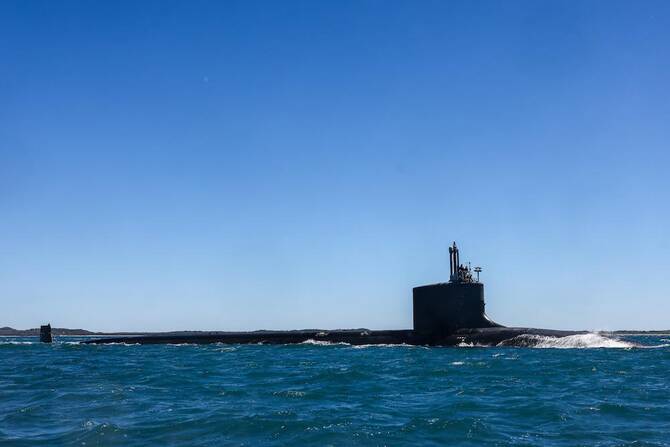

SYDNEY: Australia said Thursday it is “very confident” in the future of a US agreement to equip its navy with a fleet of nuclear-powered submarines, after the Trump administration put the pact under review.
The 2021 AUKUS deal joins Australia, the United Kingdom and the United States in a multi-decade effort to balance China’s growing military might.
It aims to arm Australia with a fleet of cutting-edge, nuclear-powered submarines from the United States and provides for cooperation in developing an array of warfare technologies.
US President Donald Trump’s administration has advised Australia and the United Kingdom that it is reviewing AUKUS, a spokesperson for the Australian Department of Defense confirmed Thursday.
Defense Minister Richard Marles said he was “very confident” Australia would still get the American submarines.
“I think the review that’s been announced is not a surprise,” he told public broadcaster ABC.
“We’ve been aware of this for some time. We welcome it. It’s something which is perfectly natural for an incoming administration to do.”
Australia plans to acquire at least three Virginia Class submarines from the United States within 15 years, eventually manufacturing its own subs.
The US Navy has 24 Virginia-class vessels, which can carry cruise missiles, but American shipyards are struggling to meet production targets set at two new boats each year.
In the United States, critics question why Washington would sell nuclear-powered submarines to Australia without stocking its own military first.
Marles said boosting the US production of US Virginia Class submarines was a challenge.
“That’s why we are working very closely with the United States on seeing that happen. But that is improving,” he said.
Australia’s focus is on “sticking to this plan and on seeing it through,” Marles said.
He criticized Australia’s previous conservative government for “chopping and changing” its submarine choice.
On the eve of announcing its participation in AUKUS in 2021, the government of the time abruptly scrapped plans to buy diesel-powered submarines in a lucrative deal with France — infuriating Paris.
The AUKUS submarine program alone could cost the country up to $235 billion over the next 30 years, according to Australian government forecasts, a price tag that has contributed to criticism of the strategy.
Australia should conduct its own review of AUKUS, said former conservative prime minister Malcolm Turnbull, noting that Britain and now the United States had each decided to re-examine the pact.
“Australia, which has the most at stake, has no review. Our parliament to date has been the least curious and least informed. Time to wake up?” he posted on X.
Former Labour Party prime minister Paul Keating, a vehement critic of AUKUS, said the US review might “save Australia from itself.”
Australia should carve its own security strategy “rather than being dragged along on the coat tails of a fading Atlantic empire,” Keating said.
“The review makes clear that America keeps its national interests uppermost. But the concomitant question is: Why has Australia failed to do the same?”
Any US review of AUKUS carries a risk, particularly since it is a Biden-era initiative, said Euan Graham, senior analyst at the Australian Strategic Policy Institute.
But it is “fundamentally a good deal for the US,” he said, with Australia already investing cash to boost American submarine production as part of the agreement.
“I just do not think it is realistic for Australia, this far backed in, to have any prospect of withdrawing itself from AUKUS,” Graham said.
“I don’t think there is a Plan B that would meet requirements and I think it would shred Australia’s reputation fundamentally in a way that would not be recoverable.”


