

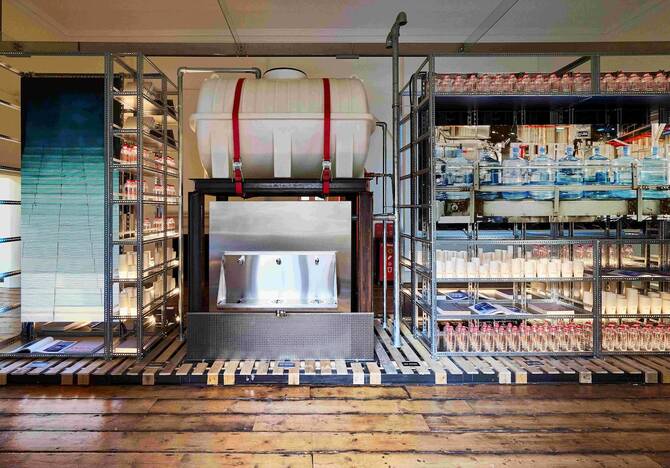

DHAHRAN: Saudi Arabia is presenting “Good Water” at the London Design Biennale, which runs until June 29 at the UK capital’s Somerset House.
The Saudi National Pavilion — commissioned by the Architecture and Design Commission supported by the Ministry of Culture, and presented under the leadership of commission CEO Sumayah Al-Solaiman — examines water systems, accessibility, equity and scarcity.
“In a biennale that explores the intersection of inner experiences and external influences, ‘Good Water’ reflects the spirit of inquiry we hope to share with the world,” Al-Solaiman said in a statement. “With this pavilion, we are proud to support the next generation of Saudi practitioners and provide platforms that amplify their voices on the international stage.”

The pavilion's design team - Clockwise from top left - Dur Kattan, Aziz Jamal, Fahad bin Naif, and Alaa Tarabzouni. (Supplied)
Saudi artists Alaa Tarabzouni, Dur Kattan, Fahad bin Naif and Aziz Jamal worked as co-curators, collaborating across various disciplines.
“In this team, we don’t have specific roles,” Jamal told Arab News. “We all collaborated on everything. For example, the video, we all shot together — we all wrote together. We all have different backgrounds in the arts sector but we’ve worked together (in the Saudi art scene) for the past five years; it’s more of a democratic process and there’s no strict guidelines.”
At the heart of “Good Water” is the sabeel, a traditional water fountain usually placed and funded privately in a shaded outdoor communal space. It is meant for use by anyone in the community, free of charge.
The sabeel is an enduring symbol of hospitality and generosity, deeply rooted in the Arabian Peninsula and found in many spots throughout the Middle East.

A sabeel fountain in Saudi Arabia. (Photo by Aziz Jamal - Courtesy of the Architecture and Design Commission)
“Growing up in Dhahran, you would see sabeels everywhere. Our house didn’t have one, but there was a mosque in front of our house that had one,” Jamal said.
The London installation strips the sabeel of nostalgia and recenters it as a contemporary, working object. Visitors are invited to fill their cups as they pause to reflect on the often unseen systems, labor and energy that make the flowing “free” water possible.
Stacks of paper cups will be provided, bearing the message “Good Water: 500 ml = one AI prompt” in vibrant color. There will also be refillable water bottles so spectators can have a “water-cooler moment” to chat, sip and ponder.
The pavilion also features four short videos filmed at an old water factory in Riyadh, showing the painstaking journey of water from droplet to distribution. The screens trace the production process across different sizes of bottles.
Jamal’s relationship with water has shifted since he started working on this project.

A water delivery truck in Saudi Arabia. (Photo by Aziz Jamal - Courtesy of the Architecture and Design Commission)
“I have to say, going to visit the water factory (in Riyadh) and seeing the enormous effort that it takes to fill up one tiny water bottle, you don’t take that effort for granted anymore, because it’s not just a matter of getting the water filled up; it’s testing it, going through inspection, doing all the mineral checks,” he said. “Before, if there was a little bit of water in my water bottle, I’d just leave it, but now I make it a point to drink (it) all … to finish the bottle. It has made me more conscious of every drop.”
Jamal’s aim is for visitors to the pavilion to reach that same realization.
“What I really hope for is for people to interact with the piece,” he said. “We want that act of generosity to come through and we want people to drink the water.” He noted that the sabeel in London will dispense locally sourced water, not imported.
A catalogue written by the curators will also be available, offering further context in the form of essays, research material and images of water infrastructure and sabeels from across the Middle East and North Africa region.
Saudi Arabia is one of the most water-scarce countries in the world and the largest producer of desalinated water globally, supplying over 60 percent of its potable water, according to the Saudi Pavilion team’s research.
“We thought (the sabeel) was a perfect symbol of the attitude and the general principle behind this concept of water as a human right and not as a luxury,” Jamal said. “It’s free drinking water, but it’s from a private source. So we felt it really encompassed this phenomenon of paying it forward and offering water to people who don’t have access to it.”
With “Good Water,” the Saudi National Pavilion puts this scarcity — and the labor behind everyday hydration — center stage.
“Our research was about water and access to water,” Jamal explained. “When we were first conceptualizing the piece for the London Biennale, we were looking at the infrastructure and water and access and what’s the hidden cost of free water in Saudi — and specifically looking at the objective of a sabeel: What does this act of generosity and act of making water into a human right mean? And what is the hidden cost of that?”
Though the widespread distribution of plastic bottles has displaced the sabeel to some extent, Jamal emphasized its enduring relevance, especially in a country with scorching summers and sizeable outdoor workforces.
“People are on the go, so they need something convenient,” he said. “I don’t think water bottles have killed off sabeels completely. A lot of the workforce in Saudi still use it all the time. It’s not just drinking water, it’s cold drinking water, and in Saudi that’s very important.”


