

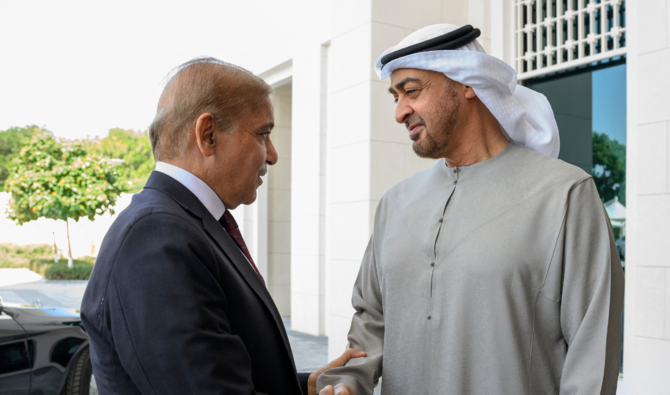

ISLAMABAD: Pakistani Prime Minister Shehbaz Sharif arrived in the United Arab Emirates on Thursday for talks with UAE President Sheikh Mohamed bin Zayed Al Nahyan on a “range of bilateral, regional and global issues,” a statement from the Prime Minister’s Office said.
Sharif’s last visit to the UAE was in February to attend the World Government Summit in Dubai and meet President Sheikh Mohamed.
The latest visit marks another step in Islamabad’s ongoing efforts to deepen strategic ties with Gulf partners, particularly as Pakistan looks to attract foreign investment and bolster regional economic integration.
“Sharif will hold high-level meetings with the UAE leadership, including a bilateral meeting with President of the UAE and Ruler of Abu Dhabi,” the PM’s office said.
“A wide range of bilateral, regional and global issues of mutual interest and concern will be discussed during the high-level interactions.”
The statement added that the visit would serve to “further strengthen the longstanding brotherly relations between Pakistan and the UAE, deepen economic ties, and foster multifaceted collaboration.”
Pakistan and the UAE maintain close cooperation across a broad range of areas including trade, investment, energy, defense, and diaspora engagement. Approximately 1.5 million Pakistanis reside in the UAE, the second largest expatriate group after Indians. It is also the second largest source of remittances to Pakistan after Saudi Arabia, sending $754.2 million home in May, according to central bank data released this week.
The UAE is one of Pakistan’s largest trading partners in the Gulf and a major source of foreign remittances. High-level exchanges between the two nations have increased in recent years, with both countries expressing interest in expanding collaboration in renewable energy, infrastructure development, and regional security.
In May 2024, the UAE said it had committed $10 billion to invest in promising economic sectors in Pakistan. The investment pledge came after a meeting between Sharif, then on a two-day visit to the UAE, and President Sheikh Mohamed.
Pakistan needs foreign investment to boost its economy and shore up its currency reserves to meet rising external repayment obligations as it treads a tricky path to economic recovery under a $7 billion IMF bailout deal.
The latest UAE visit also comes weeks after Pakistan engaged in its worst military conflict in decades with arch-rival India, in which the two nations exchanged drones, missiles, and artillery strikes between May 7-10 before a ceasefire was announced. Though the US was the main broker, it is believed that Gulf partners like Saudi Arabia and UAE also mediated in the crisis.


