Makkah’s Mashaer metro transports 1.87m passengers during Hajj

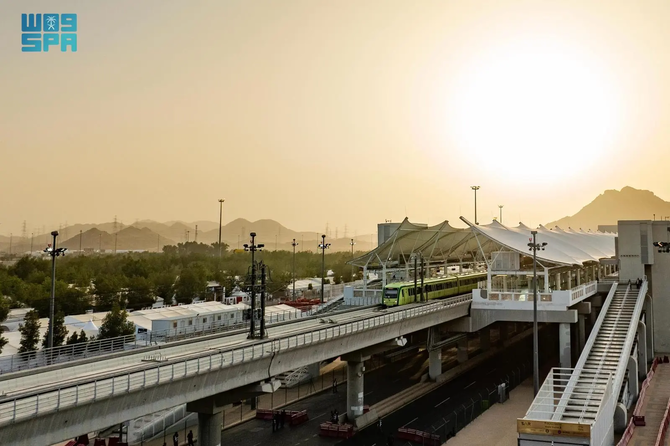
With a fleet of 17 eco-friendly electric trains, each capable of carrying 3,000 passengers, the metro system has significantly reduced traffic congestion and carbon emissions by replacing about 50,000 passenger buses during the Hajj season. (SPA photo)
Short Url
Updated 12 June 2025
Follow

Makkah’s Mashaer metro transports 1.87m passengers during Hajj

  • Mashaer completes 2,154 trips between Mina, Muzdalifah, Arafat
  • Dedicated to serving Hajj pilgrims, it runs for only 7 days every year

MAKKAH: A total of 1.87 million passengers used the Mashaer Metro Train to travel between Makkah’s holy sites during this year’s Hajj, according to Saudi Arabia Railways.

From Dhul Hijjah 7 (June 3) until the end of the Days of Tashreeq (June 9), there were 2,154 trips between the stations of Mina, Muzdalifah and Arafat, the railway agency said in a statement carried by the Saudi Press Agency.

The operational plan for the Mashaer transport system during Hajj 2025 had five main phases, with the first one from June 3 to 4 transporting over 27,000 passengers across all stations.

The second phase moved 282,000 pilgrims from Mina to Arafat, the third transported 294,000 from Arafat to Muzdalifah, and the fourth moved over 349,000 from Muzdalifah to Mina.

“The final phase, which lasted until sunset on the last day of Tashreeq, recorded the movement of over 920,000 passengers to and from Mina 3 (Jamarat) station,” the SPA said.

Saudi Arabia Railways CEO Bashar AlMalik attributed the successful completion of the operational plan to extensive preparatory work, including simulation exercises and trial runs by the agency in coordination with operational and security agencies.


Traveling at 80 km per hour, the train can move passengers from Mina to Arafat in just 20 minutes. (SPA)

Also known as the Al-Mashaer Al-Mugaddasah Metro, or The Sacred Sites Train Line, it consists of nine stations across the holy sites, connected by an 18-km double-track railway. It can accommodate 72,000 passengers per hour in one direction.

Traveling at 80 km per hour, the train can move passengers from Mina to Arafat in just 20 minutes, giving pilgrims ease and comfort and allowing them to concentrate on their Hajj rituals.

Opened in 2010, the line is used exclusively as a shuttle train for pilgrims between holy sites in Makkah, Mina, Mount Arafat and Muzdalifah.

With a fleet of 17 eco-friendly electric trains, each capable of carrying 3,000 passengers, the metro system has reduced traffic congestion and carbon emissions by replacing about 50,000 passenger buses during the Hajj season.


Why Saudi Arabia’s desert night skies are becoming a magnet for stargazers

Updated 4 sec ago
Follow

Why Saudi Arabia’s desert night skies are becoming a magnet for stargazers

  • AlUla’s remote desert landscape offers some of the Middle East’s darkest skies, creating ideal conditions for celestial tourism
  • The growth of desert stargazing reflects a wider push to revive the region’s ancient astronomy traditions and heritage

LONDON: Within living memory, knowledge of the famously vivid night skies over Arabia was essential for the safe passage of sailors on the high seas, and travelers crossing the region’s great, trackless deserts.

Now, fascination with, and knowledge of, the heavenly bodies over the deserts of Saudi Arabia is flourishing once again as astronomy and simple stargazing are poised to play a starring role in the development of the Kingdom as an attractive destination for cultural tourism.

The science of astronomy flourished during the Golden Age of Islam, from the 9th to the 13th centuries, to the extent that many stars still have their original Arabic names, including Altair in the constellation Aquila, and Aldebaran in Taurus.

The astronomical terms azimuth and nadir, still in universal use, are also Arabic in origin, and Arab scientists are credited with the invention of navigational tools such as the astrolabe, an ingenious mechanical computer that could be used to fix a ship’s position by the stars, or to indicate the direction of Makkah.

In addition to creating the famous House of Wisdom academy, the Abbasid Caliph Abu Al-Mamun (who ruled from 813 to 833 A.D.) also built the region’s first observatory in Baghdad.

As the journal Astronomy has noted: “While the pinnacle of the science is most commonly thought to have been during the Renaissance, it actually began a thousand years earlier and 8,000 kilometers to the east.” While in the Dark Ages “Europe was in an intellectual coma, the Islamic empire, which stretched from Moorish Spain to Egypt and even China, was entering its Golden Age (and) astronomy was of particular interest.”

Now, in the dramatic landscapes of northwestern Saudi Arabia, astronomy is becoming a subject of particular interest once again.

Near the ancient Nabataean city of Hegra, work is underway on a unique visitor attraction, AlUla Manara, described by the Royal Commission for AlUla as “a place unlike anywhere else on Earth, an inspiring destination within a destination where the universe unveils its secrets, a space dedicated to advancing research and education in astronomy and space science.”

The full details are not expected to be revealed until next year but, says the RCU, AlUla Manara will be “an architectural marvel and state-of-the-art facility that invites visitors to explore the wonders of the cosmos.”

Interactive exhibits, high-tech telescopes and immersive workshops “will bridge the gap between ancient celestial wisdom and modern scientific discovery.” As a hub for astrotourism, the attraction will offer “unique stargazing experiences, drawing visitors from around the world to connect with the cosmos in an unforgettable way.”

AlUla is already recognized as a unique destination for stargazing. In October 2024, AlUla Manara and Gharameel Nature Reserve, two key protected areas covering a total of 2,334 sq. km, were formally designated as an International Dark Sky Park.

This certification, awarded by the organization DarkSky International, was a first for the Gulf region. As a spokesperson for AlUla said at the time, it recognizes “a vast stretch of desert where the stars can still be seen as they were by ancient travelers: clearly, vividly and without interference.”

AlUla joins the ranks of 249 other dark-sky locations around the world certified by DarkSky International since 2001. To earn its certification, AlUla had to demonstrate “strict environmental and lighting controls, a long-term conservation strategy, and a clear commitment to education and public access.”

Naif Al-Malik, executive program director at AlUla Manara, welcomed the accreditation as “a major boost … particularly to the development of a new astrotourism ecosystem.”

He added: “Preserving and celebrating access to the night sky is an important part of what makes AlUla a unique destination where visitors can explore the natural, scientific and cultural world, while also raising awareness of the impact of light pollution and the need to protect dark skies globally.”

In its accreditation, DarkSky noted that amid stunning rocky landscapes, the reserves at AlUla “offer captivating and surreal desert vistas paired with stunning views of the night sky. Thanks to their isolation from urban lights, and optimal atmospheric conditions, AlUla is the perfect destination for travelers seeking an unparalleled dark-sky experience.”

There is also much to see nearby at ground level, including towering rock formations sculpted by the desert winds, and the ancient ruins and rock art of the Nabatean civilization.

But as the sun sets and dusk gives way to true darkness, unspoiled by man-made lighting, “another spectacle unfolds, as travelers are greeted by thousands of stars and the Milky Way arching across the night sky,” creating “one of the best stargazing spots in the world.”

Even before AlUla Manara is fully up and running, curious tourists are already traveling to the area to sample the new “astrotourism” on offer, camping under clear night skies for organized experiences in which “Bedouin storytelling meets astrophysics.”

Astronomer Nawal Al-Anazi, who in 2017 became the first woman to graduate with a master’s degree in astronomy from King Saud University in Riyadh, said she is “thrilled and very happy that astronomy is being linked with tourism” in the Kingdom.

“Our relationship with the stars goes way back in history,” she added. “As an Arab civilization, we were looking to the sky to identify the time of the rains for farming, and of course for navigation, and today we still have Arabic names for stars.”

In the deserts of Saudi Arabia, she said, “there is no light pollution and we have the clearest skies, which makes it perfect for seeing the stars with a telescope or even the naked eye.”

Her interest in astronomy grew from trips into the desert as a child, when “we used to go camping to see the stars at night and learn their names.” The conditions for this were perfect in Al-Dahna desert, about 100 kilometers east of Riyadh and far from the lights of civilization.

“In this location you can see the stars very clearly, especially if it is a new moon, when there is no moonlight,” Al-Anazi said.

Her favorite constellation is Orion, “the hunter.” It features several bright stars, including Rigel and Betelgeuse, and is clearly visible in the vicinity of Riyadh.

Always visible in the Arabian night sky is the constellation Ursa Minor, also known as the “Little Bear or Little Dipper,” which has been used by travelers for navigation for millennia because it includes Polaris, the bright, always visible North Star.

Through a quirk of astrophysics, Polaris always appears to be stationary in the sky, thanks to the fact that the Earth’s axis points directly towards it.

There is no shortage of clubs and societies devoted to encouraging an interest in astronomy among young people in Saudi Arabia, including Noor Astronomy in Al-Qassim, Falak for Space Science and Research in Riyadh, and Hajr Astronomy Association in Al-Ahsa.

Falak, which is supported by Misk, the Mohammed bin Salman Foundation, is “dedicated to building a passionate astronomical community that contributes to enriching scientific content in space and its applications to enhance human quality of life.”

As astronomy continues to grow in popularity in Saudi Arabia, Al-Anazi has some tips for first-time stargazers. Travel at least 100 kilometers from any towns or cities, she said, to avoid light pollution.

Stargazing in Arabia is better during the winter months, between October and March, she added, not only because of the cooler temperatures but because the sky will be clearer.

“If you have a small telescope, with a tripod, so much the better, but you will see plenty of stars and the Milky Way with the naked eye,” Al-Anazi said.

To help identify stars and constellations one can use an app; she recommends Stellarium Mobile, which is used by students at the University of Glasgow in Scotland, where she teaches and is studying for her doctorate in astronomy.

Another good app option is Skyview. Both will identify stars and constellations, and can also be used to track satellites, the International Space Station, and even rocket debris orbiting the earth.

Al-Anazi said she is excited by the developments at AlUla Manara and plans to visit as soon as she completes her studies.

“We have the clear skies and the wide-open spaces, and I think it is going to focus attention on the importance of astronomy in Saudi Arabia and how tourism can transform it into a cultural experience,” she added. “I can’t wait to see it.”