PARIS: Medical charity Medecins du Monde Wednesday accused Israel of violating international law with drone strikes on a building housing one of its offices in war-torn Gaza that killed eight people, none of them staff.
The France-based aid group said in a statement the attack on Tuesday “constitutes a serious violation of international humanitarian law, which protects both civilian populations and humanitarian organizations operating in conflict zones.”
The Israeli military did not immediately respond to a request for comment.
“Yesterday morning, at around 11:00 am local time, a building in Deir el-Balah housing a Medecins du Monde office was attacked by drones,” the aid group said.
Its staff had not been present as they had been off as part of the Eid Al-Adha holiday, it added.
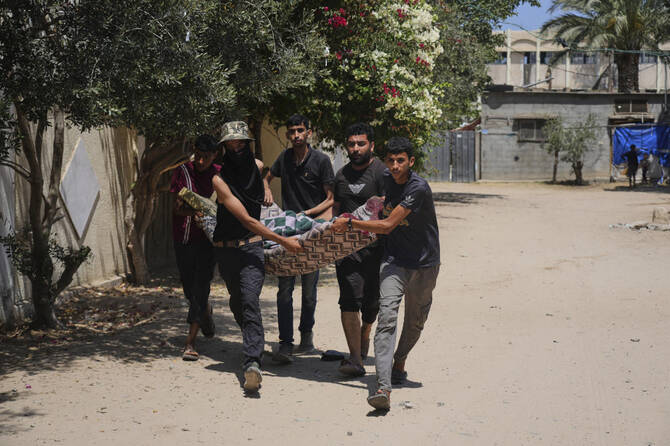
“At least eight people were killed in the bombardment. All were on the last floor of the building,” it said, without providing more details on those killed.
“Medecins du Monde had informed the Israeli military of the presence of its office, which had officially been declared ‘deconflicted’, or shielded from Israeli military attacks under humanitarian coordination agreements,” it said.
“However, as during previous Israeli attacks, the team received no forward warning that would have allowed it to evacuate the building or take measures to protect anyone inside,” it added.
Several other non-governmental organizations as well as Palestinians displaced by the war are based in the same area, it said.
Israel is facing mounting pressure to allow more humanitarian aid into Gaza, whose entire population the United Nations has warned is at risk of famine.
Medecins du Monde last month, after more than two months of a total blockade on Gaza, accused Israel of using hunger as “a weapon of war” in the Palestinian territory.
Israel recently allowed some deliveries to resume through the newly formed, US-backed Gaza Humanitarian Foundation.
But the United Nations refuses to work with it, citing concerns over its practices and neutrality.
Dozens of people have been killed near GHF distribution points since late May, according to Gaza’s civil defense agency. It said Israeli forces killed 31 people waiting for aid early on Wednesday.
Palestinian militant group Hamas on October 7, 2023 attacked Israel, resulting in the deaths of 1,219 people on the Israeli side, mostly civilians, according to an AFP tally of official figures.
The health ministry in Hamas-run Gaza says the retaliatory Israeli military offensive has killed at least 54,981 people, the majority civilians. The United Nations considers these figures to be reliable.
Out of 251 taken hostage during the Hamas attack, 54 are still held in Gaza including 32 the Israeli military says are dead.


![]()

Charity accuses Israel of deadly strike on Gaza office building
Short Url
https://arab.news/zwb5h
Charity accuses Israel of deadly strike on Gaza office building
- Medical charity Medecins du Monde says Israel violated international law with drone strikes on building housing one of its offices


Latest updates


Recommended


© 2026 SAUDI RESEARCH & PUBLISHING COMPANY, All Rights Reserved And subject to Terms of Use Agreement.