More than 55,000 Palestinians killed in Gaza war

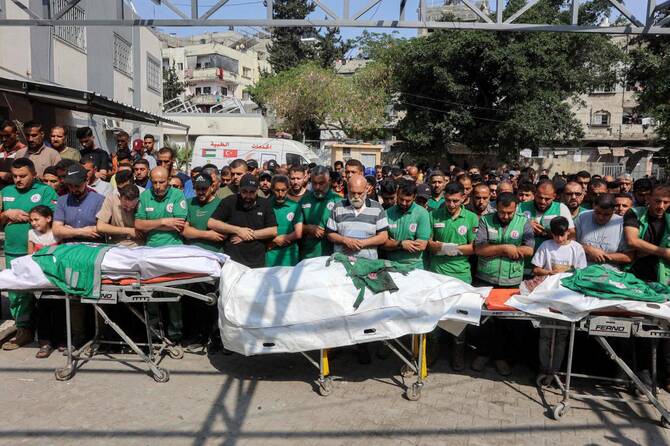
Mourners pray by the bodies of three paramedics killed by Israeli bombardment on the Tuffah neighborhood, during the funeral at the Sheikh Radwan Clinic in Gaza City on Tuesday. (AFP)
Short Url
Updated 11 June 2025
Follow

More than 55,000 Palestinians killed in Gaza war

  • Gaza Health Ministry says more than half the victims are women and children
  • More than 127,000 Palestinians have been wounded

DEIR AL-BALAH: The Palestinian death toll from the 20-month Israel-Hamas war has climbed past 55,000, the Gaza Health Ministry said Wednesday.

The ministry doesn’t distinguish between civilians and combatants, but has said that women and children make up more than half the dead.

It’s a grim milestone in the war that began with Hamas’ attack into southern Israel on Oct. 7, 2023, and shows no sign of ending. Israel says it only targets militants and blames civilian deaths on Hamas, accusing the militants of hiding among civilians, because they operate in populated areas.

The ministry says 55,104 people have been killed since the start of the war and 127,394 wounded. Many more are believed to be buried under the rubble or in areas that are inaccessible to local medics.

Israeli forces have destroyed vast areas of Gaza, displaced about 90 percent of its population and in recent weeks have transformed more than half of the coastal territory into a military buffer zone that includes the now mostly uninhabited southern city of Rafah.

A 2½-month blockade imposed by Israel when it ended a ceasefire with Hamas raised fears of famine and was slightly eased in May. The launch of a new Israeli- and US-backed aid system has been marred by chaos and violence, and the UN says it has struggled to bring in food because of Israeli restrictions, a breakdown of law and order, and widespread looting.

Israel accuses Hamas of siphoning off aid, but the UN and aid groups deny there is any systematic diversion of aid to militants.

Hamas has suffered major setbacks militarily, and Israel says it has killed more than 20,000 militants, without providing evidence. The militants still hold 55 hostages — less than half of them believed to be alive — and control areas outside of military zones despite facing rare protests earlier this year.

The war began when Hamas-led militants killed around 1,200 people, mostly civilians, in the Oct. 7 attack and abducted 251 hostages. More than half the captives have been released in ceasefires or other deals. Israeli forces have rescued eight and recovered the remains of dozens more.

Israel’s military campaign, one of the deadliest and most destructive since World War II, has transformed large parts of cities into mounds of rubble. Hundreds of thousands of people are living in squalid tent camps and unused schools, and the health system has been gutted, even as it copes with waves of wounded from Israeli strikes.


The UN says Al-Hol camp population has dropped sharply as Syria moves to relocate remaining families

Updated 15 February 2026
Follow

The UN says Al-Hol camp population has dropped sharply as Syria moves to relocate remaining families

  • Forces of Syria’s central government captured the Al-Hol camp on Jan. 21 during a weekslong offensive against the SDF, which had been running the camp near the border with Iraq for a decade

DAMASCUS: The UN refugee agency said Sunday that a large number of residents of a camp housing family members of suspected Daesh group militants have left and the Syrian government plans to relocate those who remain.
Gonzalo Vargas Llosa, UNHCR’s representative in Syria, said in a statement that the agency “has observed a significant decrease in the number of residents in Al-Hol camp in recent weeks.”
“Syrian authorities have informed UNHCR of their plan to relocate the remaining families to Akhtarin camp in Aleppo Governorate (province) and have requested UNHCR’s support to assist the population in the new camp, which we stand ready to provide,” he said.
He added that UNHCR “will continue to support the return and reintegration of Syrians who have departed Al-Hol, as well as those who remain.”
The statement did not say how residents had left the camp or how many remain. Many families are believed to have escaped either during the chaos when government forces captured the camp from the Kurdish-led Syrian Democratic Forces last month or afterward.
There was no immediate statement from the Syrian government and a government spokesperson did not respond to a request for comment.
At its peak after the defeat of IS in Syria in 2019, around 73,000 people were living at Al-Hol. Since then, the number has declined with some countries repatriating their citizens. The camp’s residents are mostly children and women, including many wives or widows of IS members.
The camp’s residents are not technically prisoners and most have not been accused of crimes, but they have been held in de facto detention at the heavily guarded facility.
Forces of Syria’s central government captured the Al-Hol camp on Jan. 21 during a weekslong offensive against the SDF, which had been running the camp near the border with Iraq for a decade. A ceasefire deal has since ended the fighting.
Separately, thousands of accused IS militants who were held in detention centers in northeastern Syria have been transferred to Iraq to stand trial under an agreement with the US
The US military said Friday that it had completed the transfer of more than 5,700 adult male IS suspects from detention facilities in Syria to Iraqi custody.
Iraq’s National Center for International Judicial Cooperation said a total of 5,704 suspects from 61 countries who were affiliated with IS — most of them Syrian and Iraqi — were transferred from prisons in Syria. They are now being interrogated in Iraq.