

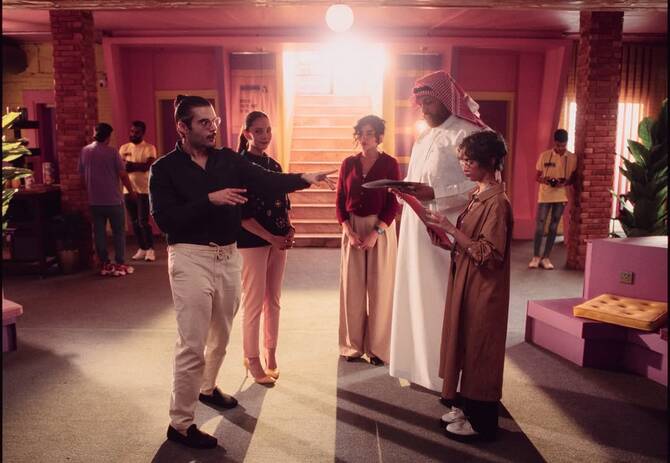
‘Fever Dream’ starring Fatima Al-Banawi lands on Netflix

The film dropped on Netflix this week. (Instagram)
Short Url
Updated 11 June 2025
Follow

‘Fever Dream’ starring Fatima Al-Banawi lands on Netflix

DUBAI: Saudi filmmaker Faris Godus’ latest feature “Fever Dream” is now available to stream on Netflix, bringing together a star-studded local cast including Fatima Al-Banawi, Sohayb Godus, Najm, Hakeem Jomah and Nour Al-Khadra.

Supported by the Red Sea Fund, the film, which explores themes of media manipulation, digital identity, and the cost of fame in the age of online influence, had its world premiere at the 2023 Red Sea International Film Festival. 

It tells the story of Samado, a retired football star who, burdened by media scrutiny and public notoriety, finds a chance to reclaim control. Partnering with his daughter, he sets out to take revenge on a powerful social media portal. But as they plunge deeper into their pursuit of fame and digital redemption, the line between ambition and obsession begins to blur.

Najm plays Ahlam, the daughter of Samado, while Jomah appears as Hakeem, a PR agent hired to help restore Samado’s public image. Al-Banawi takes on the role of Alaa, another key PR agent working alongside Hakeem.

Godus is famous for his work “Shams Alma’arif” (The Book of Sun), which also streamed on Netflix, and “Predicament in Sight.” 

He previously said in an interview with Arab News: “(In Saudi Arabia), we have a rich soil to build content on and so many stories to tell. I do believe that nowadays the support coming from our country is just awesome. People have so many chances to create films now.”

Meanwhile, Al-Banawi is recognized for her roles in “Barakah Meets Barakah” and the Saudi thriller “Route 10.” 

She made her directorial debut with “Basma,” in which she also plays the title role — a young Saudi woman who returns to her hometown of Jeddah after studying in the US. Back home, she is confronted with her father’s mental illness, strained family ties, and the challenge of reconnecting with a past life that no longer feels familiar.

“I really went into cinema — in 2015 with my first feature as an actress — with one intention: to bridge the gap between the arts and social impact and psychology,” she previously told Arab News. “And I was able to come closer to this union when I positioned myself as a writer-director, more so than as an actor.” 


Review: ‘Sorry, Baby’ by Eva Victor

Eva Victor appears in Sorry, Baby by Eva Victor, an official selection of the 2025 Sundance Film Festival. (Supplied)
Updated 27 December 2025
Follow

Review: ‘Sorry, Baby’ by Eva Victor

  • Victor makes a deliberate narrative choice; we never witness the violence of what happens to her character

There is a bravery in “Sorry, Baby” that comes not from what the film shows, but from what it withholds. 

Written, directed by, and starring Eva Victor, it is one of the most talked-about indie films of the year, winning the Waldo Salt Screenwriting Award at Sundance and gathering momentum with nominations, including nods at the Golden Globes and Gotham Awards. 

The film is both incisive and tender in its exploration of trauma, friendship, and the long, winding road toward healing. It follows Agnes, a young professor of literature trying to pick up the pieces after a disturbing incident in grad school. 

Victor makes a deliberate narrative choice; we never witness the violence of what happens to her character. The story centers on Agnes’ perspective in her own words, even as she struggles to name it at various points in the film. 

There is a generosity to Victor’s storytelling and a refusal to reduce the narrative to trauma alone. Instead we witness the breadth of human experience, from heartbreak and loneliness to joy and the sustaining power of friendship. These themes are supported by dialogue and camerawork that incorporates silences and stillness as much as the power of words and movement. 

The film captures the messy, beautiful ways people care for one another. Supporting performances — particularly by “Mickey 17” actor Naomi Ackie who plays the best friend Lydia — and encounters with strangers and a kitten, reinforce the story’s celebration of solidarity and community. 

“Sorry, Baby” reminds us that human resilience is rarely entirely solitary; it is nurtured through acts of care, intimacy and tenderness.

A pivotal scene between Agnes and her friend’s newborn inspires the film’s title. A single, reassuring line gently speaks a pure and simple truth: “I know you’re scared … but you’re OK.” 

It is a reminder that in the end, no matter how dark life gets, it goes on, and so does the human capacity to love.