


KARACHI: Analysts, investors and key business chambers on Wednesday broadly welcomed Pakistan’s federal budget for 2025-26 as a “balanced” attempt at fiscal consolidation and economic stimulus, though they raised concerns about the achievability of the government’s ambitious growth target of 4.2 percent and heavy reliance on existing taxpayers.
Presenting the federal budget on Tuesday, the government announced a range of tax reforms, spending priorities, and incentives aimed at maintaining its ongoing $7 billion International Monetary Fund (IMF) loan program while also trying to revive investor sentiment and ease pressure on the salaried class.
“The budget announced by the government yesterday [Tuesday] was pretty much in line with what we were expecting, a balanced budget,” said Sana Tawfik, head of research at Arif Habib Ltd, a major Pakistani financial services company.
“The government tried to ensure that the reforms being undertaken currently are on track and Pakistan continues with the fiscal consolidation phase.”
Tawfik was pointing to several key ongoing fiscal and structural reforms that align with Pakistan’s commitments under the IMF program and broader efforts to stabilize the economy.
These include fiscal consolidation through broadening the tax base, rationalizing subsidies, and phasing out tax exemptions; revenue mobilization though increased taxation on interest income, a phased reduction in the super tax and the removal of certain tax exemptions to improve revenue collection; and debt rationalization by managing debt servicing costs, likely by shifting to more concessional financing and restructuring high-cost debt.
While presenting the budget, the government also maintained it would continue its focus on providing relief to the salaried class and try to strike a balance between austerity with social protections.
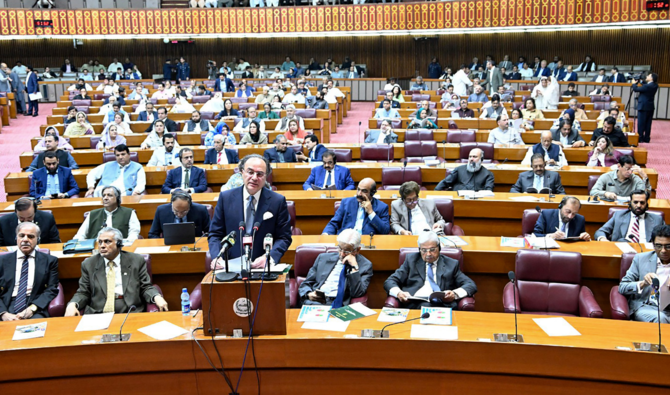
This handout photograph taken on June 10, 2025, and released by Pakistan's National Assembly shows Finance Minister Muhammad Aurangzeb presenting the 2025–26 fiscal budget at the Parliament House in Islamabad. (AFP)
Tawfik agreed that the government had attempted to strike such a balance between providing relief and raising revenue, citing relief measures for the salaried class in the budget and the phased reduction in super tax.
“The government tried to make sure that we continue with the reforms that we have undertaken in the recent past, while ensuring that we meet the targets set for the upcoming fiscal year,” Tawfik said.
UNREALISTIC GROWTH TARGET?
However, Tawfik was skeptical of the government’s 4.2 percent GDP growth target, calling it “unrealistic” in the current economic context.
“Agriculture has been underperforming, and industries have not been performing due to the high cost of doing business. While we have seen interest rates coming down, agriculture would be the key sector to look forward to,” she said.
Arif Habib Ltd. has forecast GDP growth of around 3.6 percent for FY26, below the government’s target.
Tawfik also noted that while the government had projected inflation at 7.5 percent, her team expected it to be slightly lower, around 6 percent to 6.5 percent, although risks remained from global commodity prices, exchange rate pressures and the fading base effect.
She also flagged a projected current account deficit for FY26, in contrast to a surplus of $1.5 billion expected this fiscal year, citing pent-up demand and increased imports.
Muhammad Waqas Ghani, head of research at JS Global Capital Ltd., echoed the sentiment that the budget was more “measured” compared to previous years.
“In the last two years, we’ve seen very strict budgets. This time, the government has been a little lenient. We’ve seen reform measures but also some relaxations,” Ghani said.
He pointed to tax relief for the salaried class and incentives for the construction sector, though he noted that the Public Sector Development Programme (PSDP) allocation had decreased.
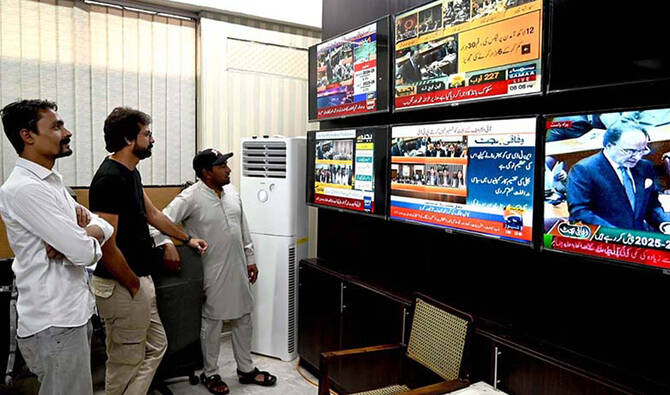
Corporate employees watching television screens as Pakistan Finance Minister Muhammad Aurangzeb presents Pakistan’s $62 billion federal budget for fiscal year 2025–26, in Islamabad on June 10, 2025. (APP)
“There are many allied industries that benefit when we see measures taken for construction,” he said, while noting a less favorable outcome for the auto sector.
Ghani acknowledged the government’s target of a 2.4 percent primary surplus as “optimistic,” but achievable, and described the overall budget as “laying the groundwork” for sustained economic growth.
On the 4.2 percent GDP target, he noted:
“It’s an optimistic target… but with interest rates coming down, we hopefully will see contribution from [agriculture and industrial] segments, and we can get closer to the target.”
STRONG SUPPORT FROM EQUITY MARKETS
While the budget drew applause for investor-friendly policies and efforts toward macroeconomic stability, analysts cautioned that delivery on ambitious fiscal and growth targets remained key to sustaining momentum.
The stock market, however, responded positively from the opening bell.
“As soon as the market started today [Wednesday], it rallied close to 1,400 points,” Ghani said.
“We are in an IMF program and we’re seeing a decent budget this time. All of these things point to the fact that the market is going to reach new heights in the coming months.”
Indeed, despite macroeconomic challenges, the budget drew strong support from equity markets.
“Measures we have seen so far are broadly positive for the stock market,” said Tawfik. “The government kept capital gains tax and dividend income tax unchanged, which the market had feared would be increased.”
Sector-specific measures were seen as favorable for cement, steel, and textile sectors, particularly with subsidies for low-cost housing and removal of sales tax exemptions for certain regions, which levels the playing field for local manufacturers.
“Intraday today, market has gone north of 124,000 points, and we have seen an intraday surge of 2,000 points,” Tawfik said.
DIVIDED BUSINESS COMMUNITY
The reaction from Pakistan’s business chambers, however, was more mixed.
Both the Federation of Pakistan Chambers of Commerce and Industry (FPCCI), and the Karachi Chamber of Commerce and Industry (KCCI), warned that unless structural reforms were implemented and energy costs reduced, the budget may not succeed in spurring industrialization or export growth.
The FPCCI welcomed certain relief measures, particularly for the salaried class and property sector, but flagged concerns about revenue expectations.
“We welcome steps to end harassment of taxpayers,” said Atif Ikram Sheikh, President FPCCI, noting the simplified tax return form as a positive step.
However, he added: “The increase in tax collection target by Rs2,500 billion ($8.8 billion) is unrealistic.”
The FPCCI also expressed disappointment over the absence of support packages for key sectors such as IT, minerals, fishing, and e-commerce.
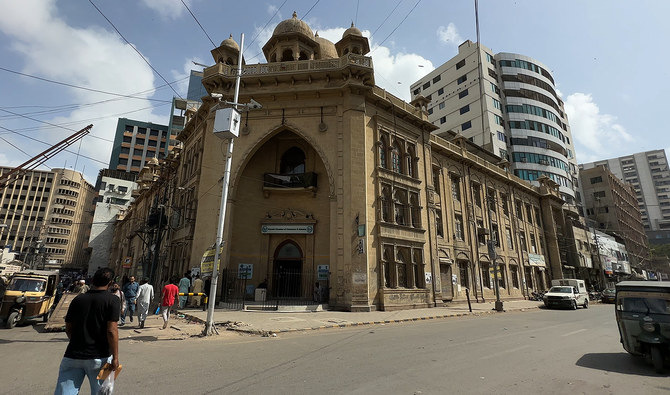
People walk past the Karachi Chamber of Commerce & Industry building in Karachi on May 4, 2024. (AN Photo/File)
The KCCI, by contrast, issued a harsh critique of the budget, calling it disconnected from ground realities.
“This is a camouflage budget,” said Zubair Motiwala, Chairman of the Businessmen Group (BMG) at KCCI. “There is no meaningful relief for the business community or the common man. Instead of reforms to expand the tax base, the government is squeezing existing taxpayers.”
KCCI President Muhammad Jawed Bilwani added:
“Electricity bills are unaffordable, interest rates are high, and there’s no relief for the industrial sector. Without addressing the cost of doing business, you cannot expect growth or job creation.”


