
KARACHI: The government has “gone heavy” on taxing passive incomes and foreign online vendors, including Chinese e-commerce platforms, said an economic expert Tuesday, as it seeks to raise over Rs14 trillion ($50 billion) in taxes in the next fiscal year, an ambitious target trade bodies have criticized as “unrealistic.”
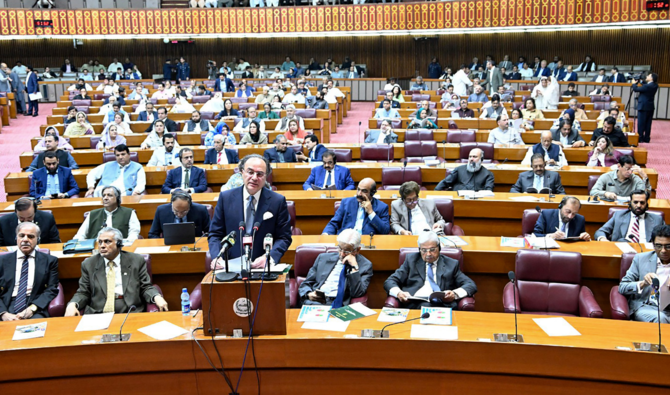
Finance Minister Muhammad Aurangzeb had unveiled Pakistan’s Rs17.6 trillion ($62 billion) federal budget for 2025-26 earlier in the day, saying the Federal Board of Revenue (FBR) would target Rs14.13 trillion in tax collection, which is nine percent higher than the outgoing year’s target.
“The government has gone heavy in terms of taxes on passive income like tax on bank deposits income has gone up,” Shankar Talreja, director research at the Topline Securities, told Arab News.
Prime Minister Shehbaz Sharif’s administration is aiming for 4.2 percent GDP growth and a fiscal deficit of 3.9 percent in line with commitments made to the International Monetary Fund (IMF) during recent negotiations.
The IMF has pushed Pakistan to broaden its tax base, including income from retail, agriculture and real estate sectors, while ensuring social protection and priority spending.
Talreja called the new budget a “continuation of fiscal discipline.” His comments referred to the government’s plan to increase tax on interest income by five percentage points to 20 percent, excluding income from the National Savings Scheme.
With one of the region’s lowest tax-to-GDP ratios, Pakistan is under pressure to raise it to 14 percent under the IMF’s $7 billion loan program.
DIGITAL TAX ON FOREIGN VENDORS
In a first, the government plans to introduce the Digital Presence Proceeds Tax Act, 2025, to tax income earned by foreign vendors operating in Pakistan’s digital space.
“This is specific to foreign vendors, i.e. Chinese e-commerce websites,” Talreja said, referring to platforms like Temu. He added those buying from such vendors could also face an additional five percent tax.
Aurangzeb said banks, financial institutions and licensed exchange companies would collect the tax on transactions involving goods or services provided by foreign traders within the Pakistani domain.
“Essentially this is to be paid by vendors, but let’s see if they pass it on to consumers,” Talreja said, noting the move could fuel inflation if the tax burden is transferred. “Nonetheless, items coming through foreign vendors doesn’t hold a major pie in inflation basket.”
FBR OVERHAUL
Aurangzeb also announced an FBR transformation plan to address Pakistan’s estimated Rs5.5 trillion tax gap, nearly half of its potential receipts. Talreja emphasized the significance of the move, saying it was part of the government’s plan to raise the tax-to-GDP ratio from 10 to 14 percent.
“It is not possible [for the government] to stabilize the economy and achieve national targets without transforming the FBR,” he continued.
To clamp down on non-compliant businesses, the government plans to freeze bank accounts, block property transfers, and seal premises of unregistered entities evading sales tax.
Withholding tax on bank transactions by non-filers has been raised to one percent from 0.6 percent, and tax on e-commerce transactions doubled to two percent.
SMUGGLING AND SOLAR IMPORTS
The FBR will be empowered to confiscate goods lacking original tax stamps or barcodes under its track and trace system, with the aim of curbing smuggling, especially in tobacco, and supporting the formal industry.
“These measures send a clear message that the law-abiding people and companies will get facilities and the tax defaulters will be made accountable effectively,” Aurangzeb said during his budget speech.
The government will also apply 18 percent sales tax on online traders operating through courier and logistics firms to ensure parity with traditional retailers. Imported solar panels will face the same tax, a move designed to protect local manufacturers.
CUSTOMS REFORMS AND RELIEF MEASURES
Proposed customs reforms include new laws to promote pre-arrival clearance of goods and reduce port delays and litigation.
To support businesses, the government has offered a 0.5 percent reduction in super tax on income slabs between Rs200 million ($708,692) and Rs500 million ($1.78 million), according to JS Global Capital’s initial review.
The 15 percent capital gains tax on stocks remains unchanged, but a 25 percent tax will apply to income from loans to encourage investment in equities. Withholding tax on property purchases has been lowered by 1.5 percent across various slabs.
According to Talreja, the measures aim to ensure the government does not exceed its 3.9 percent fiscal deficit target, a milestone that, if achieved, would mark the lowest in 21 years.
“The ultimate objective of the government in the FY26 budget was to achieve primary surplus over 2% and total deficit of less than 4%,” he said.
BUSINESS COMMUNITY REACTS
Meanwhile, the business community’s response to the proposed tax structure remained mixed, with some trade bodies expressing concern over the government’s reliance on existing taxpayers rather than expanding the tax net.
Leaders at the Karachi Chamber of Commerce and Industry (KCCI), including Zubair Motiwala and Muhammad Jawed Bilwani, described the budget as a “camouflage” document that offered “no incentives for growth” and failed to reduce the high cost of doing business.
“The budget may satisfy external lenders but does not offer any practical hope for businesses or the wider population,” Motiwala said, warning that continued pressure on the formal sector could shrink economic output rather than expand it.
By contrast, the Federation of Pakistan Chambers of Commerce and Industry (FPCCI) offered a more positive reaction. President Atif Ikram Sheikh welcomed the simplification of tax return forms for small and medium enterprises along with employees, calling it “a long-standing demand of the FPCCI.”
He also praised the reduction in super tax and the abolition of duty on property transfers, though he called the increase in the tax collection target “unrealistic.”
FPCCI Senior Vice President Saqib Fayyaz Magon expressed disappointment over the taxation of e-commerce and the lack of relief packages for IT, minerals and fishing sectors.
“E-commerce should not have been taxed,” he said, adding the budget ignored several proposals submitted by the FPCCI.