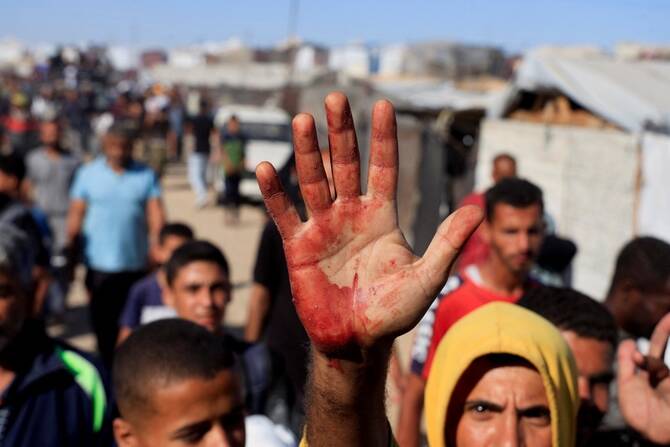
KHAN YUNIS, Palestinian Territories: Gazan mother Amal Abu Shalouf ran her hand over her son’s face and hair, a brief farewell before a man abruptly sealed the body bag carrying the three-year-old who was killed just hours earlier on Tuesday.
“Amir, my love, my dear!” cried his mother, struggling to cross the crowded courtyard of Nasser Hospital in Khan Yunis, southern Gaza’s main city, where several bodies lay in white plastic shrouds.
According to the civil defense agency, at least nine people were killed on Tuesday in the southern Gaza Strip as Israeli forces carried out military operations, more than 20 months into the war triggered by Hamas’s 2023 attack on Israel.
Contacted by AFP, the military did not respond to a request for comment about Amir Abu Shalouf’s death.
At the hospital, a man carried the boy’s body in his arms through a crowd of dozens of mourners.
“I swear, I can’t take it,” his teenage brother, Ahmad Abu Shalouf, said, his face covered in tears.
“What wrong did he do?” said another brother, Mohammad Abu Shalouf. “An innocent little boy, sitting inside his tent, and a bullet struck him in the back.”
Mohammad said he had “found him shot in the back” as he returned to the tent that has become the family’s home in Al-Mawasi, a coastal area near Khan Yunis that is now a massive encampment for displaced Palestinians.
The devastating war has created dire humanitarian conditions in Gaza, where the United Nations has warned that the entire population is at risk of famine.
The grieving mother, comforted by relatives, said her young son had been begging for food in recent days and dreaming of a piece of meat.
“There is no food, no water, no clothing,” said Amal, who has eight children to take care of.
Amal said she too was injured in the pre-dawn incident that killed her son.
“I heard something fall next to my foot while I was sitting and baking, and suddenly felt something hit me. I started screaming,” she said.
Outside the tent at the time, she said she tried crawling and reaching for other family members.
“Then I heard my daughter screaming from inside the tent... found them holding my son, his abdomen and back covered in blood.”
A group of men formed lines to recite a prayer for the dead, their words almost drowned out by the noise of Israeli drones flying overhead.
In the second row, Ahmad Abu Shalouf held his hands over his stomach in prayer, unable to hold back a stream of tears.
Similar scenes played out at the hospital courtyard again and again over several hours, as the day’s dead were mourned.
At one point, an emaciated man collapsed in front of the shrouded bodies.
One mourner pressed his head against one of the bodies, carried on a stretcher at the start of a funeral procession, before being helped up by others.
At a distance, a group of women supported Umm Mohammad Shahwan, a grieving mother, with all of them in tears.
“We need the war to end,” said Amal Abu Shalouf.
In Gaza, she lamented, “there’s no hope or peace.”


![]()


‘What wrong did he do?’ Gaza family mourn three-year-old shot dead
Short Url
https://arab.news/j3uwf
‘What wrong did he do?’ Gaza family mourn three-year-old shot dead
- In Gaza, “There’s no hope or peace”


Gaza fuel running short after Israel closes borders amid Iran war
CAIRO/JERUSALEM: Gaza is rapidly running out of its limited fuel supply and stocks of food staples may become tight, officials say, after Israel blocked the entry of fuel and goods into the war-shattered territory, citing fighting with Iran.
Israel’s military closed all Gaza border crossings on Saturday after announcing air strikes on Iran carried out jointly with the United States. Israeli authorities say the crossings cannot be operated safely during war and have not said how long they would be shut.
Few days’ worth of supplies
Gaza is wholly dependent on fuel brought in by trucks from Israel and Egypt and a lack of fresh supplies would put hospital operations at risk and threaten water and sanitation services, local officials say. Most Palestinians in Gaza are internally displaced after Israel’s two-year war with Hamas militants.
“I expect we have maybe a couple of days’ running time,” said United Nations official Karuna Herrmann, who directs fuel distribution in Gaza.
Amjad Al-Shawa, a Palestinian aid leader in Gaza, who works with the UN and NGOs, estimated fuel supplies could last three or four days, while stocks of vegetables, flour, and other essentials could also soon run out if the crossings remain shut.
Reuters was unable to independently verify those estimates.
Israel’s COGAT military agency, which controls access to Gaza, said that enough food had been delivered to the territory since the start of an October truce to provide for the population.
“(The) existing stock is expected to suffice for an extended period,” COGAT said, without elaborating. It declined to comment on potential fuel shortages.
The truce was part of broader US-backed plan to end the war that involves reopening the Rafah border crossing with Egypt, increasing the flow of aid into the enclave, and rebuilding it.
Hamada Abu Laila, a displaced Palestinian in Gaza, said the closures were stoking fear of a return of famine, which gripped parts of the enclave last year after Israel blocked aid deliveries for 11 weeks.
“Why is it our fault, in Gaza, with regional wars between Israel, Iran, and America? It is not our fault,” Abu Laila said.
Israel’s military closed all Gaza border crossings on Saturday after announcing air strikes on Iran carried out jointly with the United States. Israeli authorities say the crossings cannot be operated safely during war and have not said how long they would be shut.
Few days’ worth of supplies
Gaza is wholly dependent on fuel brought in by trucks from Israel and Egypt and a lack of fresh supplies would put hospital operations at risk and threaten water and sanitation services, local officials say. Most Palestinians in Gaza are internally displaced after Israel’s two-year war with Hamas militants.
“I expect we have maybe a couple of days’ running time,” said United Nations official Karuna Herrmann, who directs fuel distribution in Gaza.
Amjad Al-Shawa, a Palestinian aid leader in Gaza, who works with the UN and NGOs, estimated fuel supplies could last three or four days, while stocks of vegetables, flour, and other essentials could also soon run out if the crossings remain shut.
Reuters was unable to independently verify those estimates.
Israel’s COGAT military agency, which controls access to Gaza, said that enough food had been delivered to the territory since the start of an October truce to provide for the population.
“(The) existing stock is expected to suffice for an extended period,” COGAT said, without elaborating. It declined to comment on potential fuel shortages.
The truce was part of broader US-backed plan to end the war that involves reopening the Rafah border crossing with Egypt, increasing the flow of aid into the enclave, and rebuilding it.
Hamada Abu Laila, a displaced Palestinian in Gaza, said the closures were stoking fear of a return of famine, which gripped parts of the enclave last year after Israel blocked aid deliveries for 11 weeks.
“Why is it our fault, in Gaza, with regional wars between Israel, Iran, and America? It is not our fault,” Abu Laila said.
Latest updates





© 2026 SAUDI RESEARCH & PUBLISHING COMPANY, All Rights Reserved And subject to Terms of Use Agreement.