


BOSTON/LONDON: Global stocks and the dollar held steady on Tuesday as trade talks between the United States and China continued into a second day, giving investors some reason to believe tensions between the world's two largest economies may be easing.
US Commerce Secretary Howard Lutnick said discussions between the two sides in London were going well, while President Donald Trump on Monday put a positive spin on the talks.
Any progress in the negotiations is likely to provide relief to markets given that Trump's often-shifting tariff announcements and swings in Sino-US ties have undermined the two economies, disrupted supply chains and threatened to hobble global growth.
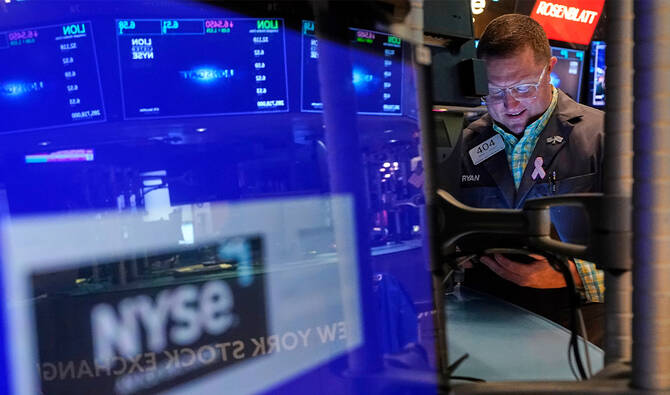
On Wall Street, the Dow Jones Industrial Average rose 0.06%, to 42,788, the S&P 500 added 0.16%, to 6,015, and the Nasdaq Composite advanced 0.12%, to 19,616.
World stocks, as reflected by the MSCI All-Country World index traded near record highs, while the dollar steadied against a range of currencies.
"While market participants are clearly taking a glass half-full view of the outlook, both on trade policy and more broadly, we don’t think that should be interpreted as a view that tariffs will be fully unwound," said Jonas Goltermann, deputy chief markets economist at Capital Economics.
Goltermann anticipates US duties on Chinese goods to settle at around 40%, while most analysts have said that the universal 10% levy on imports into the United States is here to stay.
In Europe, the STOXX 600 edged higher, constrained by UBS, whose shares dropped 5.5% as investors worried about the impact of new government proposals to force the Swiss bank to hold $26 billion in extra capital.
Meanwhile, in Tokyo, Finance Minister Katsunobu Kato said policymakers were looking at measures to promote domestic ownership of Japanese government bonds, a day after Reuters reported that Japan is considering buying back some super-long government bonds issued in the past at low interest rates.
Japanese government 30-year yields were virtually flat at 2.92%, having retreated from late May's record high of 3.18%.
OPEC plus oil output is rising as members unwind their cuts.
The yen strengthened throughout the day, leaving the dollar roughly unchanged on the day around 144.5 yen, while the euro also turned positive, up 0.2% at $1.144. The pound dropped 0.2% to $1.35 after weak UK employment data.
QUALITY NOT SIZE
Trump's fluid trade policies and worries over Washington's growing debt pile have dented investor confidence in US assets, in turn undermining the dollar, which has already fallen more than 8% this year.
"It's not that the Americans are blowing up their fiscal situation because the deficit is going to remain more or less stable. But the quality of the deficit has degenerated," Samy Chaar, an economist at Lombard Odier, said.
"If you invest, and spend on productive investments, you'll get macro payoffs, because you're going to develop an industry, you're going to strengthen your economy, you're going to create jobs, you have a payoff. If you spend by basically reducing revenues because you cut taxes on people who don't need the money, they won't be consuming more, or investing more, so the macro payoff is more limited," he said.
US Treasuries were yielding around 4.44%, down 4 basis points on the day.
Data on US consumer inflation for May due out on Wednesday could show the impact of tariffs on goods prices.
The producer price index report will be released a day later.
"May's US CPI and PPI data will be scrutinized for signs of lingering inflationary pressures," said Convera's FX and macro strategist Kevin Ford.
"If core CPI remains elevated, expectations for rate cuts could be pushed beyond the June 18 FOMC meeting."
Traders expect the Federal Reserve to leave rates unchanged at its policy meeting next week. Just 44 bps worth of easing have been priced in by December.
In commodity markets, oil prices rose on the back of optimism that the US-China talks could ease trade tensions and improve demand for energy, pushing Brent crude up 0.4% to $67.30 a barrel. Spot gold rose 0.5% to $3,344 an ounce.


