

Dollar, stocks muted as investors watch progress in US-China trade talks

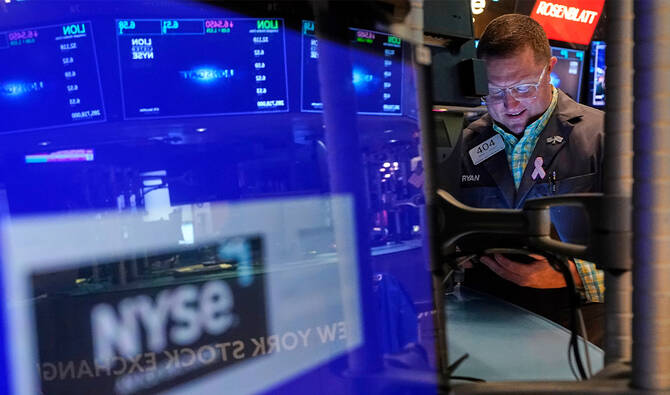
Trader Ryan Falvey works on the floor of the New York Stock Exchange on June 9, 2025. (AP/File)
Short Url
Updated 10 June 2025
Follow

Dollar, stocks muted as investors watch progress in US-China trade talks

  • US Commerce Secretary Howard Lutnick said talks in London going well, Trump puts a positive spin on discussions
  • World stocks, as reflected by MSCI All-Country World index traded near record highs, dollar steadied against range of currencies

BOSTON/LONDON: Global stocks and the dollar held steady on Tuesday as trade talks between the United States and China continued into a second day, giving investors some reason to believe tensions between the world's two largest economies may be easing.

US Commerce Secretary Howard Lutnick said discussions between the two sides in London were going well, while President Donald Trump on Monday put a positive spin on the talks.

Any progress in the negotiations is likely to provide relief to markets given that Trump's often-shifting tariff announcements and swings in Sino-US ties have undermined the two economies, disrupted supply chains and threatened to hobble global growth.

On Wall Street, the Dow Jones Industrial Average rose 0.06%, to 42,788, the S&P 500 added 0.16%, to 6,015, and the Nasdaq Composite advanced 0.12%, to 19,616.

World stocks, as reflected by the MSCI All-Country World index traded near record highs, while the dollar steadied against a range of currencies.

"While market participants are clearly taking a glass half-full view of the outlook, both on trade policy and more broadly, we don’t think that should be interpreted as a view that tariffs will be fully unwound," said Jonas Goltermann, deputy chief markets economist at Capital Economics.

Goltermann anticipates US duties on Chinese goods to settle at around 40%, while most analysts have said that the universal 10% levy on imports into the United States is here to stay.

In Europe, the STOXX 600 edged higher, constrained by UBS, whose shares dropped 5.5% as investors worried about the impact of new government proposals to force the Swiss bank to hold $26 billion in extra capital.

Meanwhile, in Tokyo, Finance Minister Katsunobu Kato said policymakers were looking at measures to promote domestic ownership of Japanese government bonds, a day after Reuters reported that Japan is considering buying back some super-long government bonds issued in the past at low interest rates.

Japanese government 30-year yields were virtually flat at 2.92%, having retreated from late May's record high of 3.18%.

OPEC plus oil output is rising as members unwind their cuts.

The yen strengthened throughout the day, leaving the dollar roughly unchanged on the day around 144.5 yen, while the euro also turned positive, up 0.2% at $1.144. The pound dropped 0.2% to $1.35 after weak UK employment data.

QUALITY NOT SIZE

Trump's fluid trade policies and worries over Washington's growing debt pile have dented investor confidence in US assets, in turn undermining the dollar, which has already fallen more than 8% this year.

"It's not that the Americans are blowing up their fiscal situation because the deficit is going to remain more or less stable. But the quality of the deficit has degenerated," Samy Chaar, an economist at Lombard Odier, said.

"If you invest, and spend on productive investments, you'll get macro payoffs, because you're going to develop an industry, you're going to strengthen your economy, you're going to create jobs, you have a payoff. If you spend by basically reducing revenues because you cut taxes on people who don't need the money, they won't be consuming more, or investing more, so the macro payoff is more limited," he said.

US Treasuries were yielding around 4.44%, down 4 basis points on the day.

Data on US consumer inflation for May due out on Wednesday could show the impact of tariffs on goods prices.

The producer price index report will be released a day later.

"May's US CPI and PPI data will be scrutinized for signs of lingering inflationary pressures," said Convera's FX and macro strategist Kevin Ford.

"If core CPI remains elevated, expectations for rate cuts could be pushed beyond the June 18 FOMC meeting."

Traders expect the Federal Reserve to leave rates unchanged at its policy meeting next week. Just 44 bps worth of easing have been priced in by December.

In commodity markets, oil prices rose on the back of optimism that the US-China talks could ease trade tensions and improve demand for energy, pushing Brent crude up 0.4% to $67.30 a barrel. Spot gold rose 0.5% to $3,344 an ounce.


AI will never replace human creativity, says SRMG CEO 

Updated 30 January 2026
Follow

AI will never replace human creativity, says SRMG CEO 

  • Speaking to Maya Hojeij, senior business anchor at Asharq with Bloomberg, Jomana R. Alrashid expressed pride in SRMG platforms that had absorbed and adopted AI

RIYADH: Jomana R. Alrashid, CEO of Saudi Research and Media Group, highlighted how AI cannot replace human creativity during a session at The Family Office’s “Investing Is a Sea” summit at Shura Island on Friday. 

“You can never replace human creativity. Journalism at the end of the day, and content creation, is all about storytelling, and that’s a creative role that AI does not have the power to do just yet,” Alrashid told the investment summit. 

“We will never eliminate that human role which comes in to actually tell that story, do the actual investigative reporting around it, make sure to be able to also tell you what’s news or what’s factual from what’s wrong ... what’s a misinformation from bias, and that’s the bigger role that the editorial player does in the newsroom.”

Speaking on the topic of AI, moderated by Maya Hojeij, senior business anchor at Asharq with Bloomberg, the CEO expressed her pride in SRMG platforms that had absorbed and adopted AI in a way that was “transformative.”

“We are now translating all of our content leveraging AI. We are also now being able to create documentaries leveraging AI. We now have AI-facilitated fact-checking, AI facilities clipping, transcribing. This is what we believe is the future.”

Alrashid was asked what the journalist of the future would look like. “He’s a journalist and an engineer. He’s someone who needs to understand data. And I think this is another topic that is extremely important, understanding the data that you’re working with,” she said.

“This is something that AI has facilitated as well. I must say that over the past 20 years in the region, especially when it comes to media companies, we did not understand the importance of data.”


The CEO highlighted that previously, media would rely on polling, surveys or viewership numbers, but now more detailed information about what viewers wanted was available. 

During the fireside session, Alrashid was asked how the international community viewed the Middle Eastern media. Alrashid said that over the past decades it had played a critical role in informing wider audiences about issues that were extremely complex — politically, culturally and economically — and continued to play that role. 

“Right now it has a bigger role to play, given the role again of social media, citizen journalists, content creators. But I also do believe that it has been facilitated by the power that AI has. Now immediately, you can ensure that that kind of content that is being created by credible, tier-A journalists, world-class journalists, can travel beyond its borders, can travel instantly to target different geographies, different people, different countries, in different languages, in different formats.”

She said that there was a big opportunity for Arab media not to be limited to simply Arab consumption, but to finally transcend borders and be available in different languages and to cater to their audiences. 


The CEO expressed optimism about the future, emphasizing the importance of having a clear vision, a strong strategy, and full team alignment. 

Traditional advertising models, once centered on television and print, were rapidly changing, with social media platforms now dominating advertising revenue.

“It’s drastically changing. Ultimately in the past, we used to compete with one another over viewership. But now we’re also competing with the likes of social media platforms; 80 percent of the advertising revenue in the Middle East goes to the social media platforms, but that means that there’s 80 percent interest opportunities.” 

She said that the challenge was to create the right content on these platforms that engaged the target audiences and enabled commercial partnerships. “I don’t think this is a secret, but brands do not like to advertise with news channels. Ultimately, it’s always related with either conflict or war, which is a deterrent to advertisers. 

“And that’s why we’ve entered new verticals such as sports. And that’s why we also double down on our lifestyle vertical. Ultimately, we have the largest market share when it comes to lifestyle ... And we’ve launched new platforms such as Billboard Arabia that gives us an entry into music.” 

Alrashid said this was why the group was in a strong position to counter the decline in advertising revenues across different platforms, and by introducing new products.

“Another very important IP that we’ve created is events attached to the brands that have been operating in the region for 30-plus years. Any IP or any title right now that doesn’t have an event attached to it is missing out on a very big commercial opportunity that allows us to sit in a room, exchange ideas, talk to one another, get to know one another behind the screen.” 

The CEO said that disruption was now constant and often self-driving, adding that the future of the industry was often in storytelling and the ability to innovate by creating persuasive content that connected directly with the audience. 

“But the next disruption is going to continue to come from AI. And how quickly this tool and this very powerful technology evolves. And whether we are in a position to cope with it, adapt to it, and absorb it fully or not.”