

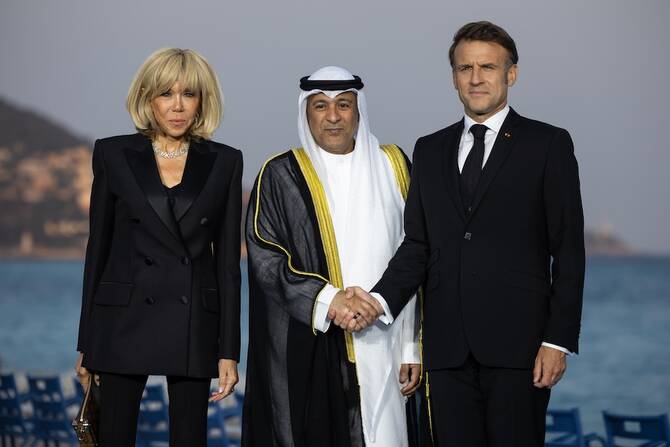

RIYADH: The Gulf Cooperation Council has reaffirmed its commitment to implement strong climate action efforts to tackle environmental issues faced by coastal communities.
Jasem Mohamed Al-Budaiwi, secretary-general of the GCC, said that the council is undertaking various efforts to safeguard the marine environment, particularly the Arabian Gulf, through policies and initiatives that are already yielding visible results.
Al-Budaiwi was speaking at the 3rd UN Ocean Conference, which is being held in Nice, France, from June 9-13 and hosted by French President Emmanuel Macron.
Despite being oil-dependent nations, countries in the GCC, including Saudi Arabia, are taking significant steps to combat climate change, with the Kingdom setting its net-zero target for 2060.
In his speech, Al-Budaiwi reviewed the GCC’s collective efforts in working in marine protected areas, combating marine pollution, sustainable fisheries management, marine research and innovations.
“The GCC countries are investing in modern technologies to reduce the risk of spills and protect the marine environment in the Gulf. These efforts embody a strong commitment from the GCC to achieve the goals of (UN) Sustainable Development Goal 14, amidst numerous environmental challenges,” he said according to a statement issued by the organization, adding that the GCC seeks to unify policies, exchange data, and collaborate on early warning systems to address marine and climate risks.
Al-Budaiwi went on to say that the coastal zones of GCC nations are environmentally vulnerable, and protecting them is crucial for sustainable development and prosperity in the region.
“Over 40,000 ships are navigating in the Arabian Gulf annually, including many oil tankers that support the global economy and enhance the region’s status as a business and energy hub. It is not just an environmental asset for our nations but a fundamental pillar for our food security, economic growth, and cultural heritage,” he said.
Al-Budaiwi also used his speech to underscore the importance of adopting ambitious, actionable strategies rooted in local and international expertise to address growing environmental challenges.
He also called for urgent and collective action to transform climate pledges into measurable outcomes, particularly in vulnerable coastal regions.
“Everyone must work together globally through innovation and shared responsibility to confront environmental degradation affecting ocean health,” he added.
During the 43rd meeting on “Future Climate Change Management and Economic Development in the Gulf States” in Muscat in February, Gulf nations announced plans to invest $100 billion in renewable energy by 2030 to cut emissions by up to 20 percent as part of their transition to sustainable energy.
The Kingdom, in particular, is also making significant efforts to ensure a green future and protect marine resources.
The King Abdullah University of Science and Technology has emerged as a world-class partner in marine science, collaborating with multiple entities to inform data-driven conservation efforts.
KAUST is also partnering with Saudi Arabia’s futuristic city, NEOM, to ensure coral reef restoration and coastal habitat mapping using advanced robotics and artificial intelligence.
As part of its broader sustainability efforts, the Kingdom has also launched the Saudi Green Initiative to advance its environmental goals.
Under SGI, the nation aims to plant 10 billion trees, rehabilitate 40 million hectares of degraded land, and reduce carbon emissions by more than 278 million tons per year.
In April, Saudi Arabia’s National Center for Wildlife signed an agreement with the UK’s National Oceanography Center to collaborate on marine biodiversity projects.
Under the deal, studies will be conducted to assess the impact of human activities on marine ecosystems, and the use of advanced technologies will be explored to mitigate their potential harm.


