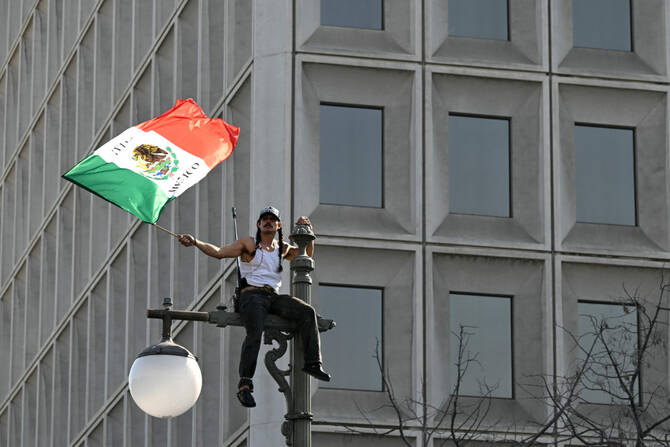
WASHINGTON: The US Department of Defense was scrambling Monday to establish rules to guide Marines who could be faced with the rare and difficult prospect of using force against citizens on American soil, now that the Trump administration is deploying active duty troops to the immigration raid protests in Los Angeles.
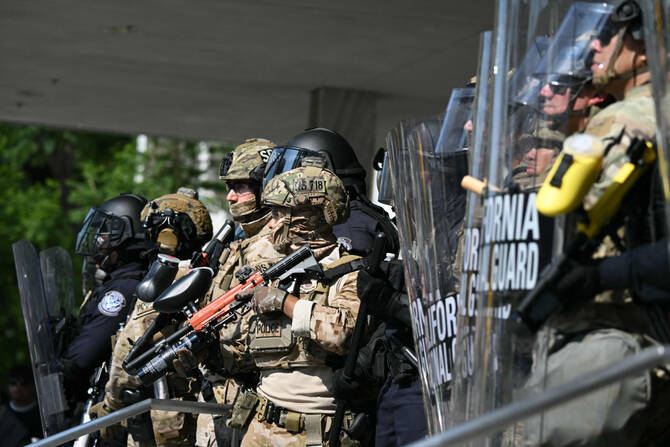
US Northern Command said it is sending 700 Marines into the Los Angeles area to protect federal property and personnel, including federal immigration agents. The 2nd Battalion, 7th Marines are coming from Twentynine Palms, California, and will augment about 4,100 National Guard members already in LA or authorized to be deployed there to respond to the protests.
The forces have been trained in de-escalation, crowd control and standing rules for the use of force, Northern Command said.
But the use of the active duty forces still raises difficult questions.
The Marines are highly trained in combat and crisis response, with time in conflict zones like Syria and Afghanistan. But that is starkly different from the role they will face now: They could potentially be hit by protesters carrying gas canisters and have to quickly decide how to respond or face decisions about protecting an immigration enforcement agent from crowds.
According to a US official, troops will be armed with their normal service weapons but will not be carrying tear gas. They also will have protective equipment such as helmets, shields and gas masks.
When troops are overseas, how they can respond to threats is outlined by the rules of engagement. At home, they are guided by standing rules for the use of force, which have to be set and agreed to by Northern Command, and then each Marine should receive a card explaining what they can and cannot do, another US official said.
For example, warning shots would be prohibited, according to use-of-force draft documents viewed by The Associated Press. Marines are directed to de-escalate a situation whenever possible but also are authorized to act in self-defense, the documents say.
The AP reviewed documents and interviewed nine US officials, who spoke on condition of anonymity to discuss details not yet public, about the guidance being determined for the Marines.
The Pentagon also is working on a memo with clarifying language for the Marines that will lay out the steps they can take to protect federal personnel and property. Those guidelines also will include specifics on the possibility that they could temporarily detain civilians if troops are under assault or to prevent harm, the first US official said.
Those measures could involve detaining civilians until they can be turned over to law enforcement.
Having the Marines deploy to protect federal buildings allows them to be used without invoking the Insurrection Act, one US official said.
The Insurrection Act allows the president to direct federal troops to conduct law enforcement functions in national emergencies. But the use of that act is extremely rare. Officials said that has not yet been done in this case and that it’s not clear it will be done.
President George H.W. Bush used the Insurrection Act to respond to riots in Los Angeles in 1992 after the acquittal of white police officers who were videotaped beating Black motorist Rodney King.
If their role expands if the violence escalates, it is not clear under what legal authority they would be able to engage, said Elizabeth Goitein, a senior director of the Liberty and National Security Program at the Brennan Center for Justice at NYU Law.
“If in fact those Marines are laying hands on civilians, doing searches, then you have pretty powerful legal concerns,” Goitein said. “No statutory authority Trump has invoked so far permits this.”
Defense Secretary Pete Hegseth tweeted late Saturday that he was considering deploying the Marines to respond to the unrest after getting advice earlier in the day from Gen. Dan Caine, chairman of the Joint Chiefs of Staff, according to one of the US officials.
Still, the tweet, which was posted to Hegseth’s personal X account and not to his official government account, caught many inside the Pentagon by surprise. As late as Monday, the military’s highest offices were still considering the potential ramifications.
But the Marine Corps were asking broader questions, too: Do they send more senior, experienced personnel so as not to put newer, less experienced troops at risk of potentially making a judgment call on whether to use force against a civilian?
What’s lawful under a domestic deployment — where troops may end up in a policing role — is governed by the Fourth Amendment in the US Constitution, which forbids seizure of persons, including temporarily restraining them, unless it could be considered reasonable under the circumstances.
Troops under federal authorities are in general prohibited from conducting law enforcement on US soil under the Posse Comitatus Act.


![]()
![]()

US defense department draws up rules on possible use of force by Marines deployed to LA protests
Short Url
https://arab.news/bxt9a
US defense department draws up rules on possible use of force by Marines deployed to LA protests
- 700 Marines will augment about 4,100 National Guard members already in LA
- President George H.W. Bush used the Insurrection Act to respond to riots in LA in 1992


Latest updates




Recommended


© 2026 SAUDI RESEARCH & PUBLISHING COMPANY, All Rights Reserved And subject to Terms of Use Agreement.